
Lindy Review 2026: Features, Pricing, Use Cases & Is It Worth It for Small Businesses?
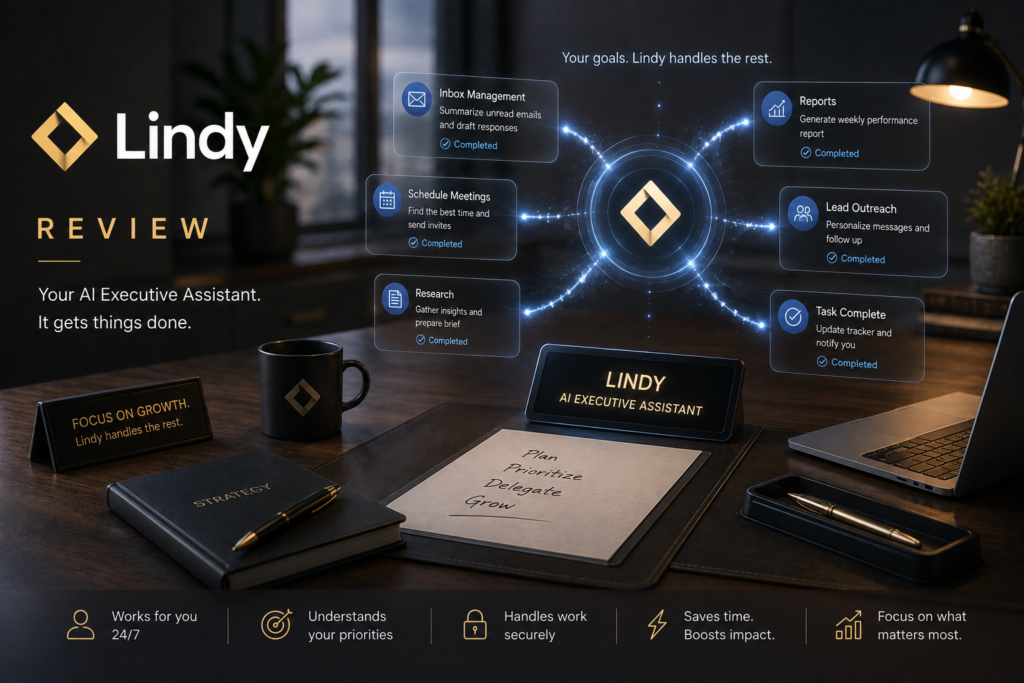
Review type: Research-Based Assessment
Last verified: 19 October 2026
Target audience: Small-business owners, entrepreneurs, sales and customer-support teams, consultants, marketing agencies, and busy executives
Primary business problem: Manual email management, meeting scheduling, lead follow-up, CRM updates, and repetitive customer communication
Disclosure: This review is based on publicly available product documentation, pricing information, and other research. Intelligent AI Lab has not independently tested Lindy. Features, pricing, integrations, and policies may change. Verify current details with the provider before making a purchase decision.
Quick Verdict: Lindy
| Review detail | Assessment |
|---|---|
| Primary business problem | Repetitive communication and administrative work |
| Best-fit audience | Small businesses needing assistance with email, scheduling, CRM, and customer communication |
| Not ideal for | Teams requiring self-hosted AI infrastructure or highly customized agent development |
| Main purpose | Create AI teammates that perform tasks across business applications |
| Strongest documented advantage | Combining AI-assisted workflows with email, calendar, CRM, integrations, and MCP |
| Main trade-off | Credit consumption, workflow reliability, and AI-output accuracy need validation |
| Starting price | Research indicates $29.99/user/month for Plus; verify the current offer before purchase |
| Free plan or trial | $50 in free credits, reportedly without a credit card; a permanent free plan was not verified |
| Business-fit verdict | Good Fit for communication-heavy small businesses, subject to a successful pilot |
| Research-based rating | 4.2/5 — analyst assessment, not a performance benchmark |
| Assessment type | Research-Based Assessment |
| Last verified | 19 October 2026 |
Our Verdict
Lindy is an AI teammate platform designed to automate work across email, calendars, meetings, CRM systems, and other business applications. It is worth evaluating if your business regularly handles lead follow-ups, meeting coordination, inbox triage, or routine customer communication. The research identifies a broad integration ecosystem, MCP support, and a credit-based usage model. However, Lindy’s published pricing presentations appear inconsistent, and the practical accuracy of its AI teammates and exact credit consumption have not been independently tested. Our recommendation is to start with its reported free credits, pilot one low-risk workflow, and measure output accuracy, human-correction effort, and cost before committing to a paid plan.
Key Takeaways
- Best reason to consider it: AI-assisted workflows that span email, calendars, CRM, and other connected applications.
- Main limitation: Real-world reliability and credit consumption need to be established for your particular workflow.
- Best business application: Inbound-lead follow-up involving email, CRM updates, meeting scheduling, and notifications.
- Pricing consideration: Research reports $50 in free credits and paid plans called Plus, Pro, and Max, but the current pricing presentations require clarification.
- Alternative to consider: Zapier for straightforward app-to-app automation, Make for visual workflows, or n8n for greater technical control.
- Our recommendation: Pilot Lindy on one bounded workflow and confirm pricing, data permissions, and credit consumption before scaling.
1. Introduction
Businesses spend countless hours on repetitive tasks like scheduling meetings, replying to emails, qualifying leads, updating CRMs, and following up with customers. While traditional automation tools can automate workflows, they often require manual configuration and cannot make intelligent decisions.
Lindy is an AI-powered teammate platform intended to help businesses automate repetitive work across email, calendars, meetings, CRM systems, customer support, and other business applications. According to its product information, users can interact with Lindy through channels such as email, Slack direct messages, and iMessage, while connecting supported accounts and tools.
For small businesses, its most relevant potential use cases include inbox triage, meeting scheduling, sales follow-ups, CRM updates, and routine customer communication. These tasks often involve several applications and repeated manual steps, making them possible candidates for workflow automation.
Lindy’s proposition is different from using a chatbot to generate a single response: it is designed to coordinate multi-step tasks across connected systems. However, the ability to configure a workflow does not by itself prove that it will operate accurately, reliably, or economically in a live business.
This review evaluates Lindy’s documented capabilities, pricing, integrations, business applications, limitations, alternatives, and suitability for small businesses. It follows Intelligent AI Lab’s principle: Business Value First. AI Second.
2. What Is Lindy?
Lindy is an AI teammate and workflow-automation platform from Lindy AI. It is designed to help users delegate selected tasks to AI assistants that work with connected business applications.
| Attribute | Research finding |
|---|---|
| Provider | Lindy AI |
| Product category | AI teammate and business workflow automation platform |
| Core functionality | Email, calendar, meeting, CRM, customer communication, and multi-step workflow automation |
| Target audience | Entrepreneurs, small businesses, sales teams, support teams, consultants, agencies, and executives |
| Availability | Cloud-based service; specific channel and feature availability should be confirmed in the product documentation |
| Business problem | Repetitive communication and administrative tasks across multiple applications |
| Deployment model | Managed cloud platform; self-hosting was not verified in the sources reviewed |
| Official website | Lindy |
Lindy should not be treated as a guaranteed autonomous employee or as a replacement for accountable staff. It is a software platform that can be configured to perform defined tasks. The reliability of those tasks depends on the workflow, data, permissions, integrations, instructions, and review controls.
How It Works
A typical Lindy workflow can be understood in five stages:
- Input: A task begins with a user instruction or an event, such as an email or meeting request, where the relevant trigger is supported.
- Processing: Lindy uses its AI capabilities and configured workflow to interpret information and determine the next step.
- Output: Depending on the workflow, it may draft a response, prepare meeting information, update a record, or create a notification.
- Review: A person checks the result or approves consequential actions according to the workflow’s controls.
- Integration or action: Lindy interacts with connected applications when the relevant integration, permissions, and action are supported.
The exact steps depend on the workflow. Not every action is available in every plan, and integration availability does not guarantee that every operation within an application is supported.
3. Research Methodology and Evidence Standards
How This Review Was Prepared
This is a research-based assessment, not a hands-on product test. The review draws on the Lindy product and pricing information summarized in the supplied research, including documentation about integrations, email and calendar connectivity, security, and enterprise capabilities.
The assessment considers:
- Documented features and supported workflows.
- Pricing presentations, credit allowances, and usage considerations.
- Integration availability and technical dependencies.
- Published privacy, security, and governance statements.
- Potential business applications and relevant alternatives.
- Risks, implementation requirements, and unresolved evidence gaps.
We distinguish product documentation from analyst interpretation and proposed examples. No workflow described here has been independently implemented or tested by Intelligent AI Lab.
Evidence Classification
| Label | Meaning |
|---|---|
| Verified from identified sources | The supplied research reports that the detail was confirmed against a relevant source |
| Research-Based Analysis | Our interpretation of the documented capabilities and their likely suitability |
| Not Independently Verified | The detail could not be sufficiently confirmed through the available research |
| Illustrative Scenario | A proposed workflow, not an implemented or tested solution |
What We Could Not Verify
| Evidence area | Finding |
|---|---|
| Real-world reliability | No independent benchmark of workflow completion, email accuracy, or scheduling accuracy was identified |
| Ease of use | The product is positioned around AI teammates and workflow configuration, but learning time and usability were not independently measured |
| Support quality | Support quality across Plus, Pro, Max, and Enterprise was not independently established |
| Security and compliance | Lindy states that it meets several security and compliance standards; Intelligent AI Lab did not independently audit those claims |
| Integration behavior | The research reports broad integration support, but individual connector reliability was not independently tested |
| Salesforce and Airtable | These integrations were not independently verified in the primary sources reviewed |
| Credit consumption | Exact credit usage for every task, integration, and workflow was not established |
| Business performance | Specific savings, productivity improvements, and faster lead response were not independently demonstrated |
| Pricing packaging | The relationship between the homepage’s credit tiers and the documented Plus/Pro/Max plans requires clarification |
Sources Consulted
The supplied Perplexity research identifies the following source categories:
| Source | Information Used |
|---|---|
| Lindy official homepage | Free credits, credit tiers, integrations, MCP, browser automation, and Enterprise capabilities |
| Lindy Pricing documentation | Plus, Pro, Max, Enterprise plans and credit pricing |
| Lindy workflow pricing page | Plus, Pro, and Max credit allowances and credit-consumption ranges |
| Lindy integrations page | 1,000+ integrations and Google Calendar workflow support |
| Lindy email assistant page | 1,500+ integrations, MCP, Gmail/Slack/calendar workflow, and free credits |
| Lindy setup documentation | Google/Microsoft email and calendar connectivity |
| Lindy quickstart documentation | Inbox, meetings, scheduling, Notion, HubSpot, Linear, and integration setup |
| Lindy security page | SOC 2 Type II, encryption, no-training, deletion, and data-residency support |
| Lindy docs security page | SOC 2 Type II, GDPR, HIPAA, PIPEDA, SSO, SCIM, and BAA |
| Lindy Enterprise page | Enterprise permissions, integrations, and seat pricing above 50 seats |
4. Key Features of Lindy
The features most relevant to small businesses are those that help coordinate communication and administrative tasks across applications.
| Feature | What it does | Potential business value | Availability and limitations |
|---|---|---|---|
| AI teammates | Supports configurable AI assistants for business tasks | May reduce repeated manual steps | Workflow quality and reliability need testing |
| Email automation | Supports email-related workflows such as triage and drafting | May help organize inboxes and prepare responses | Review sensitive or consequential messages |
| Calendar automation | Connects calendar workflows for scheduling and coordination | May reduce manual scheduling exchanges | Connected account permissions and supported actions must be confirmed |
| Meeting support | Supports meeting preparation, notes, and follow-ups | May improve consistency of meeting administration | Specific features and connected services should be verified |
| CRM workflows | Supports sales and customer-data workflows | May reduce repetitive record updates | HubSpot was identified in the supplied research; Salesforce and Airtable were not independently verified |
| Integrations and MCP | Connects workflows to external applications and MCP-compatible services | May help coordinate work across multiple systems | Integration count does not establish connector reliability or depth |
| Browser automation | Can extend workflows through browser-based interactions | May help with selected tasks where a suitable native connector is unavailable | The research says this is available on Pro and above; verify current restrictions |
| Credit-based usage | Measures usage according to the work Lindy performs | Provides a way to track consumption | Actual usage and costs depend on task complexity |
| Enterprise controls | Includes reported SSO, SCIM, audit logs, and other controls | May support organizational governance requirements | Enterprise plan and contractual conditions apply |
The Features That Matter Most for Businesses
1. Email and calendar workflows
Email and scheduling are natural starting points because they often involve recurring tasks and measurable outputs. Lindy documents connectivity with Google or Microsoft email and calendar environments. Potential tasks include preparing replies, coordinating meetings, and organizing follow-ups.
Before enabling automated actions, confirm which operations are supported, whether approvals are available, and how the workflow handles conflicting instructions or incomplete information.
2. AI teammates across business applications
Lindy’s reported support for integrations and MCP may be useful when a workflow spans several tools. For example, an inbound inquiry might require information to be checked, a CRM record to be updated, a sales representative to be notified, and a meeting to be arranged.
The key question is not the total number of advertised integrations. It is whether the specific applications, data fields, triggers, and actions required by your business are supported and reliable.
3. Credit-based usage
Lindy uses credits to measure the work performed. The supplied research describes approximate consumption ranges for different task types, but actual consumption for a specific workflow was not established.
Before purchasing a plan, test representative tasks and measure credit use per completed workflow. Do not estimate monthly costs from the number of tasks alone unless you understand how those tasks consume credits.
4. Enterprise governance
Lindy’s Enterprise information describes capabilities such as SSO, SCIM, audit logs, dedicated support, and HIPAA-related arrangements. These are relevant to organizations with formal governance requirements.
Provider-published security statements should not replace reviewing current contractual terms, applicable documentation, and the organization’s own security and compliance requirements.
5. How Businesses Can Use Lindy
| Business function | Example problem | How Lindy may help | Human oversight or requirement |
|---|---|---|---|
| Sales | Leads require repeated follow-up and CRM updates | Coordinate supported lead, email, CRM, and calendar steps | Review qualification rules and customer-facing messages |
| Customer support | Routine inquiries require repetitive triage | Organize requests and prepare responses or escalations where supported | Human review for complaints, refunds, and sensitive cases |
| Executive assistance | Email and scheduling consume administrative time | Assist with inbox management, meeting coordination, and follow-ups | Review replies and calendar changes |
| Marketing operations | Campaign follow-up spans several tools | Coordinate supported communications and workflow steps | Review targeting, consent, claims, and campaign content |
| Internal operations | Repetitive notifications and requests require manual handling | Coordinate defined administrative workflows | Human approval for access, payroll, and policy decisions |
| Knowledge management | Staff need help locating internal information | Use supported connected information to assist with responses | Validate answers and maintain reliable source material |
These are potential applications, not proof of improved performance. Feasibility depends on the exact connectors, workflow configuration, permissions, and plan.
Best-Fit Business Use Case: Inbound-Lead Follow-Up
Business problem: A small B2B company receives inquiries that require reviewing lead details, updating a CRM, scheduling meetings, and preparing follow-up communications.
Relevant capabilities: Lindy’s documented positioning includes email, calendar, CRM, integrations, and multi-step workflows.
Inputs and systems required: A supported lead source, relevant CRM fields, email and calendar access, qualification rules, and an approval process.
Proposed workflow:
- Receive a new inquiry through a supported trigger.
- Organize the lead information and apply defined qualification rules.
- Prepare a response and, where supported, update the CRM.
- Suggest or coordinate meeting times.
- Notify the responsible salesperson and route exceptions for review.
Risks and limitations: Inaccurate qualification, incorrect data entry, unsuitable messaging, scheduling errors, and unpredictable credit consumption.
Suggested pilot metrics:
- Time from lead capture to first response.
- Percentage of records completed correctly.
- Meeting-booking rate.
- Credit cost per lead.
- Human-correction rate.
- Number of failed or escalated workflows.
Establish a baseline before introducing Lindy. Compare the results with the existing process before deciding whether to expand.
6. Intelligent AI Lab Business Decision Analysis
The Business Problem Lindy Is Best Suited to Address
Lindy appears most relevant to businesses with recurring communication-heavy administrative work. This includes managing email, coordinating meetings, following up with leads, and updating customer records across connected applications.
A typical candidate is a founder, sales representative, or support lead who regularly performs the same multi-step process across several tools. Lindy’s AI teammate and integration approach may help coordinate those steps.
The desired outcome is not simply deploying AI. It is completing the business workflow accurately, at an acceptable cost, with appropriate human accountability.
Is This the Right Tool for the Job?
| Decision factor | Assessment |
|---|---|
| Primary use case | AI-assisted email, scheduling, CRM, and customer communication |
| Capability fit | Strong potential fit for communication-heavy workflows; less established for highly customized or self-hosted AI infrastructure |
| Main advantage | Connects AI-assisted tasks with multiple business applications |
| Main trade-off | Workflow reliability, AI accuracy, and credit consumption require validation |
| Cost consideration | Subscription charges, credits, integration dependencies, and human-review time |
| Implementation consideration | Requires permissions review, workflow design, testing, monitoring, and exception handling |
| Key uncertainty | Whether actual output quality and credit consumption meet the business’s requirements |
When to Choose Lindy
Consider Lindy when:
- Email, scheduling, and follow-up tasks recur frequently.
- The required applications and actions are supported.
- You want AI assistance across connected business systems rather than only a chatbot response.
- The business can define clear workflow rules and approval points.
- You can monitor usage and review important outputs.
- The potential benefit justifies the subscription and operational costs.
When to Choose an Alternative
Consider a different option when the workflow or operating model points elsewhere:
- Zapier: For straightforward trigger-and-action automation between applications.
- Make: For visual workflows involving multiple branches, filters, and data transformations.
- n8n: For technical teams needing self-hosting, API control, or customized automation infrastructure.
- Dify: For building custom AI applications, retrieval-augmented generation (RAG) assistants, or LLM-powered workflows.
- Gumloop: For AI-oriented research, document processing, data enrichment, or web-data workflows.
- CrewAI: For developer-led multi-agent systems requiring custom orchestration.
Compare current capabilities and pricing before choosing. The alternatives serve overlapping but different purposes.
When Not to Use AI
AI automation may not be justified when the process is infrequent, straightforward, or already handled reliably by existing software.
Before adopting Lindy, consider whether the problem could be addressed by:
- Improving the existing business process.
- Using a built-in CRM, email, or calendar feature.
- Applying predictable rules-based automation.
- Using a form, spreadsheet, template, or simple integration.
- Keeping the process human-led when AI adds disproportionate cost or risk.
Do not make AI the sole decision-maker for sensitive customer, financial, legal, or regulated decisions.
Our Recommended Next Step
Recommendation: Conduct a limited pilot.
Start with one frequent, low-risk workflow, such as inbox triage or inbound-lead follow-up. Use the reported free credits if the current offer remains available.
Track credit consumption, output accuracy, human-correction rate, completion rate, and maintenance effort. Compare these results against the existing process. Expand only if the workflow meets predefined success criteria and the business case remains positive after including review and operational costs.
7. Illustrative Business Automation Examples
The following examples are proposed workflows, not systems implemented or tested by Intelligent AI Lab.
Example 1: Inbound-Lead Follow-Up
Business scenario: A small B2B business wants to coordinate lead follow-up and reduce repetitive CRM administration.
Tools involved: Lindy, a supported lead source, CRM, email, calendar, and a notification channel.
Before: A salesperson reviews each inquiry, prepares a response, updates the CRM, checks availability, and coordinates a meeting.
Proposed workflow:
- Trigger: A new inquiry arrives through a supported source.
- Input: Lead details, qualification criteria, relevant CRM fields, and calendar availability.
- AI processing: Lindy organizes the information and prepares a proposed response or next step.
- Integration or action: Where supported and configured, it updates records, coordinates scheduling, and notifies the salesperson.
- Human oversight: A salesperson reviews qualification decisions and customer-facing communications, particularly for high-value or unusual leads.
- Output: A more organized lead record and a clearly defined follow-up action.
Potential benefits:
- Less repetitive data entry.
- More consistent follow-up steps.
- Potentially faster handling of routine inquiries.
Requirements and limitations:
- Confirm the lead source and CRM actions are supported.
- Test field mapping and qualification rules.
- Keep approval controls for important communications.
- Monitor credit consumption and failed actions.
Suggested success metrics:
- Time to first response.
- CRM record completeness.
- Credit cost per lead.
- Human-correction rate.
- Meeting-booking rate.
Example 2: Executive Inbox and Scheduling
Business scenario: A founder wants help organizing incoming email and coordinating meetings.
Tools involved: Lindy, a supported email account, calendar, and optional task or messaging applications.
Before: The founder manually prioritizes messages, drafts replies, schedules meetings, and tracks follow-up tasks.
Proposed workflow:
- Trigger: A new message or meeting request arrives through a supported workflow.
- Input: Message content, scheduling requirements, and user-defined priorities.
- AI processing: Lindy categorizes the request and prepares a draft or proposed action.
- Integration or action: Where supported, it helps coordinate calendar events or follow-up tasks.
- Human oversight: The founder reviews important replies and confirms consequential calendar changes.
- Output: Organized requests, draft communications, and follow-up actions.
Potential benefits:
- More structured inbox triage.
- Better visibility of follow-up tasks.
- Potentially less manual scheduling work.
Requirements and limitations:
- Review account permissions and privacy implications.
- Verify supported actions and approval controls.
- Check how exceptions and conflicting calendar information are handled.
- Monitor credits and correction effort.
Suggested success metrics:
- Time spent on inbox administration.
- Scheduling error rate.
- Percentage of drafts accepted with little or no correction.
- Credit cost per week.
- Missed follow-up rate.
Evidence note: Both examples are illustrative. Their feasibility and business impact should be validated through a controlled pilot before deployment at scale.
8. Pros and Cons of Lindy
| Pros | Cons |
|---|---|
| Designed for AI-assisted workflows spanning email, calendars, CRM, and other business tools | Actual workflow reliability and output accuracy were not independently benchmarked |
| Supports an integration-oriented approach and MCP, according to the supplied research | Integration count does not prove that every required connector or action is supported |
| Reportedly offers $50 in free credits without requiring a credit card | A permanent free plan was not verified |
| Credit-based model provides a way to track AI work | Actual credit consumption can be difficult to predict before testing |
| Provider documents enterprise-oriented governance capabilities | Enterprise controls and contractual terms require direct verification |
| Can be evaluated on a bounded workflow before broader adoption | Setup, permissions, monitoring, and human review still require effort |
What These Pros and Cons Mean for Buyers
Lindy’s most relevant advantage is the potential to coordinate recurring tasks across several business applications. That may make it worth evaluating when a business has frequent communication-related work.
However, buyers should not equate feature availability with reliable execution. The practical decision depends on whether the required workflow operates accurately, stays within budget, handles exceptions, and complies with the organization’s data-access requirements.
If the requirement is simply to transfer information between applications using predictable rules, a conventional automation platform may be sufficient and easier to assess.
9. Lindy Pricing and Plans
Pricing verification date: 19 October 2026
Lindy’s pricing requires particular care. The supplied research identifies both a Plus/Pro/Max subscription structure and a separate homepage presentation based on credit tiers. These presentations were not reconciled conclusively.
The table below summarizes the figures reported in the supplied research. Treat them as reported prices requiring final confirmation, not a guarantee that every option is currently available to every buyer.
| Plan or offer | Reported price | Reported allowance or positioning | Important note |
|---|---|---|---|
| Free credits | $0 | $50 in free credits, reportedly without a credit card | Confirm current eligibility and expiration or usage terms |
| Plus | $29.99/user/month | 3,000 credits/user/month | Confirm current plan availability and limits |
| Pro | $99.99/user/month | 15,000 credits/user/month | Confirm current plan availability and limits |
| Max | $199.99/user/month | 35,000 credits/user/month | Confirm current plan availability and limits |
| Enterprise | Custom | Custom credits and billing; reported enterprise controls and support | Request a current quotation and contractual details |
| Separate credit-tier presentation | Reported from $49.99/month | Research describes tiers from 5,000 to 700,000 credits | Relationship to the Plus/Pro/Max plans remains unresolved |
Official website: Lindy
Before publication, verify the current pricing page and link directly to it. Confirm whether the plans above remain available, how workspace users are billed, whether credit pools are shared, and whether regional taxes or currency differences apply.
What to Know Before Paying
- Free usage: The research reports $50 in free credits, not a verified permanent free plan.
- Credit allowances: The reported Plus, Pro, and Max allowances differ substantially.
- Usage variability: The number of credits required depends on the work performed. Test representative tasks rather than estimating cost from task count alone.
- Connected accounts: Confirm inbox limits, supported account types, and any plan-specific restrictions.
- Features by plan: The research says browser automation is available on Pro and above. Verify this and other plan-specific restrictions.
- Enterprise: Confirm the current contract, credit arrangement, security documentation, support commitments, and any minimum requirements.
- Regional pricing: Confirm currency, taxes, and final checkout price for the relevant country.
- Cancellation and refunds: Review the provider’s current terms before purchasing.
Is Lindy Worth the Price?
Lindy may be worth evaluating if your business has recurring communication workflows that are difficult to coordinate manually. But value depends on more than the subscription price.
Include credit consumption, integration costs, setup time, monitoring, exception handling, and human-review effort in the assessment. If a workflow consumes many credits or requires frequent corrections, the economics may be less attractive than the feature list suggests.
Best Plan Recommendation
| Buyer type | Recommended next step | Reason | What to verify |
|---|---|---|---|
| Business evaluating Lindy | Start with reported free credits, if still available | Test a real workflow before paying | Eligibility, credit expiry, task consumption |
| Freelancer or solo business | Compare the lowest suitable paid option after a pilot | Avoid paying for capacity that is not needed | Current price, monthly credits, inbox limits |
| Small team | Model actual usage before selecting a plan | Team consumption and collaboration needs may differ | Per-user billing, shared credits, administration |
| High-usage professional | Compare higher tiers only after measuring usage | More credits may help, but value depends on consumption | Actual credit burn rate and included features |
| Enterprise | Request a written proposal | Governance, contracts, and support may drive requirements | Security reports, BAA where applicable, SSO/SCIM, pricing, service terms |
Do not choose a higher-priced plan simply because it includes more credits. Choose based on measured usage and the requirements of the intended workflow.
10. Integrations and Technical Requirements
The supplied research reports that Lindy supports more than 1,500 integrations plus MCP. This is a provider-reported integration count, not an independent assessment of connector quality or reliability.
| Integration or requirement | Research finding | What buyers should check |
|---|---|---|
| Google and Microsoft email connectivity are reported | Supported actions, permissions, and approval options | |
| Calendar | Google and Microsoft calendar connectivity are reported | Scheduling rules, conflict handling, and calendar permissions |
| Collaboration | Slack and other collaboration tools are reported | Specific triggers, actions, and plan restrictions |
| CRM | HubSpot was identified in the research | Verify the exact objects, fields, and actions required |
| Salesforce and Airtable | Not independently verified in the primary sources reviewed | Confirm directly with current official documentation |
| MCP | Reported as supported | Compatible servers, authentication, permissions, and maintenance requirements |
| Browser automation | Reported as available on Pro and above | Current plan eligibility, permitted actions, logging, and failure handling |
| Enterprise administration | SSO, SCIM, and audit logs are reported for Enterprise | Confirm scope, availability, and contractual details |
| Implementation | Workflow configuration and permissions review are necessary considerations | Setup requirements, data preparation, ownership, and monitoring |
Native vs. Third-Party Integrations
- Native Lindy capability: AI teammates and workflow features offered within Lindy.
- Direct or supported connector: A connection explicitly documented by Lindy for the application and action in question.
- MCP-based connection: An integration route involving a compatible MCP server; its setup and permissions must be confirmed.
- Browser-based automation: A method of interacting with a supported web interface, not proof of a native API integration.
- Unverified integration: A connection that has not been confirmed by reliable documentation.
Do not assume that a service is fully supported simply because it appears in an integration directory. Confirm the exact operation needed by your workflow.
Implementation Considerations
Before connecting business systems:
- Identify the minimum data Lindy needs to access.
- Confirm supported integrations and required subscription levels.
- Review account permissions and credential handling.
- Define which actions can run automatically and which need approval.
- Establish a fallback process for failed or incomplete tasks.
- Assign responsibility for monitoring usage, quality, and errors.
11. Lindy vs. Alternatives
The following alternatives solve overlapping but different business problems. Pricing changes frequently, so verify current prices on each provider’s official website before publishing a direct comparison.
| Tool | Best for | Key difference | Pricing position | Consider it instead when |
|---|---|---|---|---|
| Lindy | AI-assisted email, scheduling, CRM, and business communication | AI teammates and multi-step workflows across connected applications | Research reports free credits and paid tiers; current packaging needs confirmation | You need AI assistance for communication-heavy workflows |
| Zapier | Straightforward app-to-app automation | Trigger-and-action automation with a broad integration ecosystem | Plan and task limits vary | Predictable rule-based automation is sufficient |
| Make | Visual multi-step business workflows | Visual scenarios, branching, filters, and data transformations | Usage and plan limits vary | You need more visual control over complex workflow logic |
| n8n | Technical automation and custom infrastructure | Greater technical control, including self-hosting options | Cloud and self-hosted options; verify current terms | You need self-hosting, API flexibility, or custom AI-agent infrastructure |
| Dify | Custom AI applications and knowledge assistants | LLM application development and RAG-oriented workflows | Cloud and self-hosted options; verify current terms | You want to build a custom AI application rather than primarily delegate administrative tasks |
| Gumloop | AI-oriented research, document processing, and enrichment | Focus on AI-heavy workflows and data tasks | Verify current plans and usage allowances | Your main workflow centers on research or document/data processing |
| CrewAI | Developer-led multi-agent systems | Framework-oriented custom agent orchestration | Verify current pricing and deployment terms | You need custom multi-agent development and have technical resources |
Which Tool Should You Choose?
- Choose Lindy if you need AI-assisted communication and administrative workflows across supported business tools.
- Choose Zapier if a straightforward trigger-and-action workflow solves the problem.
- Choose Make if you need visual control over branching, filters, and multi-step data flows.
- Choose n8n if self-hosting or technical control is a priority.
- Choose Dify if the goal is building a custom AI application or knowledge assistant.
- Choose Gumloop if AI-driven research and document or data processing are central.
- Choose CrewAI if you are building a custom multi-agent system and have the necessary development resources.
There is no universal winner. The best choice is the one that meets the specific workflow, cost, governance, and maintenance requirements.
12. Who Should Use Lindy?
Recommended For
- Small-business owners: If recurring email, scheduling, and follow-up tasks create an administrative bottleneck.
- Entrepreneurs and consultants: If they need help coordinating communication across supported applications.
- Sales teams: If lead follow-up and CRM administration are repetitive and can be defined clearly.
- Customer-support teams: If they need assistance organizing requests and preparing routine responses.
- Busy executives: If inbox and calendar coordination consume substantial time.
Not Ideal For
- Teams needing self-hosted AI infrastructure: The research reviewed did not establish a self-hosting option for Lindy.
- Developers building highly customized AI-agent systems: n8n, Dify, or CrewAI may better match the required technical control.
- Businesses needing only basic rule-based automation: Zapier, Make, or existing application features may be sufficient.
- Teams unable to review consequential AI actions: Sensitive communication and important business decisions need suitable oversight.
Best-Fit Buyer Profile
Lindy is worth evaluating for a small business with recurring email, scheduling, CRM, or customer-communication work across connected applications. The business should have clear permission rules, a workflow owner, a budget for credit consumption, and a process for reviewing errors.
The key buying criteria are actual workflow reliability, cost per completed task, integration fit, data governance, and the effort required to maintain the automation.
13. How to Get Started With Lindy
This is a research-based implementation guide, not a report of product setup performed by Intelligent AI Lab.
Step 1: Identify One Business Problem
Select a frequent, measurable, low-risk task such as inbox triage or meeting coordination. Describe the current process and its main problem.
Step 2: Confirm Product Fit
Verify that Lindy supports the necessary application, trigger, action, and subscription level. Do not rely on an integration count alone.
Step 3: Review Data and Permissions
Identify what email, calendar, customer, or business data the workflow will access. Review the provider’s current privacy, security, and permission documentation before connecting sensitive systems.
Step 4: Design a Limited Pilot
Specify inputs, expected outputs, approval steps, exception handling, and the fallback process. Keep human approval for consequential or sensitive actions.
Step 5: Establish a Baseline
Measure the current process before introducing Lindy. Depending on the workflow, record:
- Time per task.
- Cost per completed task.
- Error and rework rates.
- Response or resolution time.
- Percentage of tasks completed correctly.
- Number of exceptions requiring intervention.
Step 6: Evaluate the Pilot
Compare the pilot against the baseline using consistent measures. Include subscription, credits, implementation, review, maintenance, and exception-handling costs.
Step 7: Decide Whether to Expand
Continue, revise, or stop based on evidence. Scale only when the workflow is reliable enough for its intended use and demonstrates sufficient business value.
14. Limitations, Risks, and Governance
| Risk area | Research findings and buyer considerations |
|---|---|
| Accuracy and reliability | AI-generated content and actions can be incorrect. No independent benchmark of Lindy’s task accuracy was identified. |
| Privacy and data retention | Lindy states that data is encrypted and describes data-handling and deletion practices. Review current policies and contractual terms. |
| Model training and data use | Lindy states that customer data is not used to train AI models. Confirm the current policy and relevant provider terms. |
| Security | Lindy states that it has SOC 2 Type II and other security or compliance credentials. Intelligent AI Lab did not independently audit these claims. |
| Compliance | The provider reports GDPR, HIPAA, and PIPEDA-related compliance. Applicability depends on the service, configuration, contract, and use case. |
| Access and permissions | Lindy states that it operates through users’ existing accounts and permissions. Confirm the actual access scope and revocation process. |
| Usage limits | Credits measure usage, but exact consumption for every workflow was not established. Monitor costs and define usage limits where possible. |
| Human oversight | Email, customer communications, calendar actions, and consequential decisions may need human review or approval. |
| Vendor dependency | Portability of agent configurations, workflows, and related settings was not established by the research reviewed. |
| Support and continuity | Dedicated support and onboarding are reported for Enterprise. Support quality and service commitments for other plans were not independently verified. |
What Businesses Should Check Before Adoption
Before deploying Lindy in a live business workflow:
- Confirm current plan prices, credit allowances, account limits, and regional terms.
- Estimate credit consumption by testing representative tasks.
- Review the privacy policy, data-processing terms, subprocessors, retention, and deletion processes.
- Confirm what information the connected account can expose to the workflow.
- Establish approval rules, monitoring, incident handling, and credential management.
- Test how the workflow behaves when data is missing, instructions conflict, or an integration fails.
- Confirm export and migration options before making the workflow business-critical.
For sensitive, regulated, or high-impact workflows, obtain appropriate technical, security, legal, or compliance review. Provider statements are relevant evidence, but they are not a substitute for the buyer’s own due diligence.
15. Final Verdict: Is Lindy Worth It?
Lindy is worth considering for small businesses that repeatedly coordinate email, scheduling, CRM updates, and customer communication across multiple applications. Its strongest documented proposition is the combination of AI teammates, communication workflows, integration support, and MCP.
The most compelling use case is a bounded workflow such as inbound-lead follow-up or inbox triage, where the business can measure task completion, response time, correction effort, and cost. Lindy may be useful if it reliably completes the required steps with less total effort than the existing process.
The main trade-offs are uncertainty around actual workflow performance, variable credit consumption, and the need to maintain suitable human oversight. Pricing also requires care: the supplied research identifies Plus, Pro, and Max subscriptions alongside a separate credit-tier presentation that needs to be reconciled with the current official offer.
Businesses needing only simple rules-based automation should compare Zapier or Make. Teams requiring self-hosted infrastructure or deeper developer control should investigate alternatives such as n8n, Dify, or CrewAI.
Final buying recommendation: Pilot. Start with the reported free credits if the offer is still available, verify current pricing, and test one low-risk workflow. Commit to a paid plan only when the measured results, total cost, and governance requirements justify adoption.
16. Intelligent AI Lab Rating and Scorecard
A. Business-Fit Verdict
Good Fit for communication-heavy small businesses that need AI assistance for email, scheduling, CRM, and customer communication.
It is a Conditional Fit for developer-focused custom AI systems or self-hosted deployments.
B. Assessment Type
Research-Based Assessment. No hands-on testing or business pilot was conducted by Intelligent AI Lab.
C. Evidence Confidence
Overall Moderate.
High for core capabilities, pricing structure, credit model, integration positioning, and security claims, because these are documented by official Lindy sources. However, the pricing presentations require reconciliation, and real-world reliability, output accuracy, credit consumption, and business outcomes remain insufficiently established.
Security and compliance claims are reported as provider statements; they should not be interpreted as an independent security audit by Intelligent AI Lab.
D. Numerical Rating
Research-based rating: 4.2/5
Rating date: 19 October 2026
This rating represents a structured analyst assessment of documented suitability for the selected use case. It is not a hands-on performance benchmark.
Weighted Scorecard
The following weights are Intelligent AI Lab’s proposed evaluation rubric, not a validated industry standard.
| Criterion | Weight | Score | Evidence and rationale |
|---|---|---|---|
| Core capability fit | 25% | 5/5 | Documented AI teammate, email/calendar, and workflow capabilities align with the intended use case. Actual execution quality remains untested. |
| Business workflow fit | 20% | 4/5 | Strong potential fit for sales, support, and executive-assistance workflows; business impact is not independently demonstrated. |
| Implementation feasibility | 15% | 4/5 | The intended workflow approach may be accessible to business users, but configuration, permissions, testing, and monitoring are still required. |
| Integrations and interoperability | 15% | 4/5 | Broad integration and MCP support are reported; individual connector depth and reliability were not independently verified. |
| Pricing and cost suitability | 15% | 3/5 | The research reports free credits and paid tiers, but pricing presentations need clarification and credit consumption may be difficult to predict. |
| Governance and operational readiness | 10% | 5/5 | Provider-reported security and enterprise controls are relevant, but independent validation and several operational details remain outstanding. |
Weighted calculation:
(5 × 0.25) + (4 × 0.20) + (4 × 0.15) + (4 × 0.15) + (3 × 0.15) + (5 × 0.10) = 4.20/5
Research-based rating: 4.2/5
The score reflects the documented alignment between Lindy’s capabilities and the selected workflow. It does not establish real-world performance or guaranteed business value.
Overall Assessment Summary
- Business-fit verdict: Good Fit
- Research-based rating: 4.2/5
- Evidence confidence: High for documented capabilities, pricing structure, and security claims; Moderate for real-world reliability, AI-output accuracy, and business outcomes
- Assessment type: Research-Based Assessment
- Overall conclusion: Lindy is a strong option for communication-heavy small businesses that need AI assistance across email, scheduling, CRM, and customer communication. Its main buyer decision is cost and accuracy control: businesses with recurring communication workflows should pilot Lindy, while businesses needing simple app automation should compare Zapier or Make first. Its 4.2/5 rating reflects strong workflow fit and governance documentation, offset by credit-cost uncertainty and limited independent performance evidence.
17. Decision Checklist: Should You Choose Lindy?
Choose or Shortlist Lindy If
- Its documented capabilities address a specific, recurring business problem.
- The required applications and actions are supported.
- Current pricing and expected credit usage fit the budget.
- Privacy, data access, and governance requirements can be met.
- You can maintain human review for consequential actions.
- You can measure success through a controlled pilot.
Consider an Alternative If
- You only need simple rule-based automation.
- A required integration or action is unavailable or unsuitable.
- Pricing or credit consumption makes the workflow uneconomical.
- Your organization needs deployment or governance capabilities that Lindy cannot meet.
- A simpler feature in existing business software solves the problem with less complexity.
Decision guidance: If a critical requirement remains unverified, resolve it before committing. Lindy can be worth shortlisting without being ready for immediate production use.
18. Frequently Asked Questions About Lindy
What is Lindy used for?
Lindy is an AI teammate platform designed to help automate business tasks such as email management, meeting scheduling, CRM workflows, lead follow-up, and customer communication across supported applications.
Is Lindy free?
The supplied research reports $50 in free credits without a credit card. A permanent free plan was not verified. Check the official Lindy website for current terms and eligibility.
How much does Lindy cost?
The supplied research reports Plus at $29.99/user/month with 3,000 credits, Pro at $99.99/user/month with 15,000 credits, and Max at $199.99/user/month with 35,000 credits. Enterprise pricing is custom. Because another credit-tier presentation was also identified, verify the current pricing and billing structure directly before purchasing.
Is Lindy suitable for small businesses?
It may suit small businesses that regularly handle email, scheduling, lead follow-up, and customer communication across supported applications. The main considerations are workflow accuracy, credit consumption, permissions, and human-review effort.
Is Lindy better than Zapier?
Neither is universally better. Lindy is positioned for AI-assisted business tasks and communication workflows. Zapier is often a more natural option for straightforward trigger-and-action automation. The right choice depends on whether the workflow needs AI interpretation or primarily predictable rules.
Can Lindy automate business workflows?
Lindy documents AI teammates and multi-step workflow capabilities, with integrations and MCP support. The exact actions, integrations, and plan restrictions must be checked for the intended workflow. A configured workflow should be tested before being relied on in production.
Does Lindy integrate with Salesforce or Airtable?
The supplied research did not independently verify Salesforce or Airtable integrations in the primary sources reviewed. Confirm current support and the exact required actions in Lindy’s official documentation before selecting it for a workflow that depends on either application.
Is Lindy safe for business data?
Lindy states that it uses encryption and describes security, privacy, and compliance practices. Those statements are not an independent audit by Intelligent AI Lab and do not guarantee suitability for every use case. Review