
VEED AI Review 2026: Features, Pricing, Use Cases & Is It Worth It for Small Businesses?
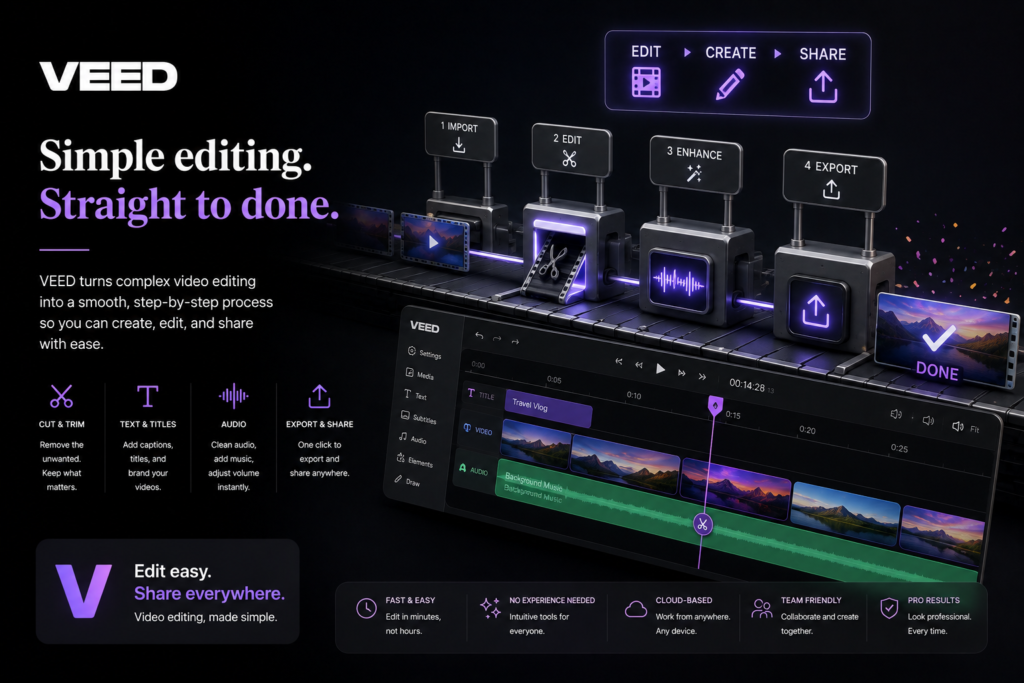
Review type: Research-based review
Last verified: 21 October 2026
Target audience: Small businesses, marketing teams, social-media managers, educators, agencies, and customer-support teams.
Primary business problem: Creating, editing, captioning, and repurposing business videos without relying entirely on specialist desktop editing software.
Disclosure: This review is based on publicly available product information and supplied research. We have not independently tested VEED. Features, pricing, limits, and policies may change. Verify current details with VEED before purchasing or uploading sensitive content.
Quick Verdict: VEED AI
| Review detail | Assessment |
|---|---|
| Primary business problem | Video editing, captioning, localization, and content repurposing |
| Best-fit audience | Marketing-led small businesses and content teams |
| Not ideal for | Cinematic production teams or buyers requiring verified, end-to-end automated publishing |
| Main purpose | Browser-based video editing with AI-assisted capabilities |
| Strongest documented advantage | Combining online editing with subtitles and video-localization features |
| Main trade-off | Per-seat subscription costs, usage allowances, and unverified real-world output quality |
| Starting price | Free; Lite starts at $12/month per seat on annual billing, according to supplied research |
| Free plan or trial | Free plan available; Enterprise trial reported for a minimum of three users |
| Business-fit verdict | Good Fit for recurring marketing and social-video workflows |
| Research-based rating | 3.45/5 weighted score; 3.5/5 rounded presentation rating |
| Assessment type | Research-Based Assessment |
| Evidence confidence | Moderate overall; pricing details are reported as verified in the supplied research, but direct deep-source URLs and independent performance tests are missing |
Our Verdict
VEED is worth shortlisting if your business regularly edits videos, creates captions, or repurposes recordings for social media, training, and customer support. Its browser-based workflow and documented video-editing and localization capabilities align with practical content-production needs. The Free plan can help prospective users assess basic suitability, while Lite and Pro provide additional functionality without watermarked exports. However, per-seat pricing, AI-credit allowances, translation limits, and plan-dependent features can affect total cost. We found no independent benchmarks establishing subtitle accuracy, dubbing quality, or time savings. Our recommendation is to pilot VEED on one recurring content workflow, measure quality and total cost per approved video, and expand only if results justify the subscription.
Key Takeaways
- Best reason to consider it: Bring editing, captions, and video repurposing into a browser-based workflow.
- Main limitation: Actual output quality and business benefits have not been independently established.
- Best business application: Repurposing webinars, demonstrations, or tutorials into short-form content.
- Pricing consideration: Paid plans are priced per seat; translation allowances and AI credits may constrain usage.
- Alternative to consider: Descript for transcript-based editing or Canva Video for design-led marketing content.
- Our recommendation: Run a limited pilot before committing to a paid plan or team-wide rollout.
1. Introduction
Business videos serve many purposes: demonstrating products, explaining processes, promoting services, training employees, and answering customer questions. Yet editing a single recording into multiple useful assets can involve trimming footage, correcting captions, adjusting layouts, improving audio, and preparing exports for different channels.
VEED is a browser-based video-editing platform with AI-assisted capabilities intended to support parts of this process. Its documented product offering includes online editing and features associated with subtitles, clipping, dubbing, voice generation, and avatars. Availability and usage limits can vary by feature and subscription.
For a small business, the relevant question is not simply whether VEED offers AI features. It is whether those features help the team produce acceptable videos within its budget, quality standards, and approval process.
This review examines VEED’s capabilities, pricing, business use cases, integrations, limitations, alternatives, and suitability for recurring business-video workflows.
2. What Is VEED AI?
VEED, available at VEED’s official website, is an online video-editing platform developed by VEED Ltd. It combines video editing with AI-assisted content-production features.
| Attribute | Finding |
|---|---|
| Provider | VEED Ltd |
| Product category | Browser-based video editing and AI-assisted content creation |
| Core functionality | Video editing, subtitles, clipping, dubbing, voice generation, and related creative tools |
| Target audience | Individuals, creators, businesses, and teams |
| Availability | Web-based service, according to the supplied research |
| Deployment model | Cloud-based SaaS |
| Main business problem | Editing and repurposing videos without relying entirely on specialist desktop tools |
| Plan structure in supplied research | Free, Lite, Pro, Enterprise |
The supplied research did not independently establish VEED’s launch history, every supported device, or the complete technical requirements. These details should not be assumed from the web-based positioning alone.
How It Works
A typical editing workflow may involve the following steps:
- Input: The user uploads or records a video, or supplies other supported content.
- Processing: The user applies editing tools and available AI-assisted features such as subtitles or clipping.
- Review: The user checks captions, audio, visual quality, and brand consistency.
- Output: The user exports the approved video.
- Distribution: The video is published or passed to a separate publishing workflow.
This is a general workflow description, not a tested demonstration. The supplied research does not establish that every step can be automated natively or that VEED supports every external publishing destination.
3. Research Methodology and Evidence Standards
How This Review Was Prepared
This is a research-based review, not a hands-on product test. The assessment uses the VEED information and Perplexity research supplied for this review, with the following priorities:
- Official product and feature documentation.
- Official pricing and plan restrictions.
- Published terms, privacy, and security information.
- Integration and API documentation where identified.
- Independent reporting and benchmarks, where available.
The assessment considers documented capabilities, workflow fit, cost, implementation, integration uncertainty, governance, and alternatives.
Evidence labels used in this article
- Verified from identified sources: Reported as confirmed against an identified source in the supplied research. This label does not mean independently reproduced by Intelligent AI Lab.
- Research-Based Analysis: An interpretation or recommendation based on the available information.
- Not Independently Verified: The available evidence does not establish the claim sufficiently.
- Illustrative Scenario: A proposed workflow that has not been implemented or tested by us.
What We Could Not Verify
| Evidence area | Finding |
|---|---|
| Subtitle accuracy | No independent benchmark was supplied. |
| Editing reliability | Magic Cut, clipping, and other editing workflows were not independently tested. |
| Dubbing quality | Supported functionality is reported, but output quality and consistency were not independently benchmarked. |
| Avatar realism | No independent evaluation was supplied. |
| AI-credit costs | Exact costs for every feature, video length, and language were not established. |
| Support quality | Published response-time information was reported; actual support experience was not tested. |
| Integrations and API | Enterprise custom integrations are reported; API availability, limits, and third-party automation connections remain to be verified. |
| Business outcomes | No independent evidence establishes time savings, increased publishing frequency, or reduced support costs. |
| Security and data use | Important policy and licensing questions require direct review of the current contractual documents. |
| Enterprise pricing | Not publicly disclosed in the supplied research. |
Sources Consulted
| Source | Information Used |
|---|---|
| VEED pricing | Plans, per-seat pricing, AI credits, subtitles, translations, and Enterprise trial |
| VEED watermark FAQ | Watermark policy and paid-plan export |
| VEED support contact | Support channels and response times |
| VEED vs CapCut | Free-plan limits, ownership, and GDPR |
| VEED vs Descript | Lite/Pro/Enterprise plan details |
| VEED best AI voice generator | TTS limits by plan |
| VEED best video translation software | Subtitle/translation/dubbing limits by plan |
| VEED best AI dubbing software | Dubbing plan pricing |
| VEED best AI video generator | Lite/Pro/Enterprise plan details |
| VEED Terms of Sale | Subscription, licensing, and acceptable use |
4. Key Features of VEED AI
The table below separates reported capabilities from unresolved availability and performance questions.
| Feature | What it does | Potential business value | Availability and limitations |
|---|---|---|---|
| Browser-based video editor | Supports online video editing | May simplify access to editing tools | Core product positioning; specific device requirements were not verified |
| Automatic subtitles | Generates captions and subtitles | May support accessibility and content repurposing | Paid plans reportedly have unlimited subtitles subject to a 50-hour/month fair-use limit |
| Video clipping and repurposing | Supports turning longer videos into shorter content | May help adapt webinars and demonstrations for social channels | Exact feature names and plan restrictions require confirmation |
| Dubbing and translation | Supports video localization | May help prepare content for multilingual audiences | Plan allowances and supported languages should be checked |
| AI avatars | Supports avatar-based video creation | May help with some presenter-led content | Availability varies by plan; realism not independently tested |
| Voice generation | Supports generated narration | May help create voiceovers | Pro reportedly includes 144 hours/year of text-to-speech; confirm current terms |
| Audio and presentation tools | Research identifies audio cleanup and eye-contact correction | May help with selected recording workflows | Current availability, plan access, and output quality require confirmation |
| Brand and team features | Paid plans include brand-related and editor features | May help coordinate content production | Per-seat billing can raise costs as the team grows |
| Enterprise integrations | Custom integrations are reported for Enterprise | May support specific organizational workflows | Scope, pricing, and technical requirements require direct confirmation |
The Features That Matter Most for Businesses
1. Online editing
A browser-based workflow may be attractive to small teams that do not want to standardize every contributor on a complex desktop editing application. The value depends on whether the available editing controls meet the team’s actual requirements.
2. Subtitles and captioning
Captions can support accessibility and make videos usable in more viewing contexts. VEED’s reported paid-plan allowance is generous, but businesses should validate transcription accuracy against real recordings, especially where product names, technical terms, accents, or compliance language matter.
3. Clipping and content repurposing
Turning a webinar or product demonstration into shorter assets is a plausible business use case. However, automatic clip selection must be reviewed for context, accuracy, and brand suitability. The research does not establish the percentage of clips that will be publishable without revision.
4. Dubbing and translation
Localization may be useful for businesses serving customers in multiple languages. Buyers should check supported languages, available minutes, voice quality, and whether translations preserve technical meaning before relying on the output.
5. Brand and team workflows
Brand-related and collaboration features may help teams coordinate recurring production. The right plan depends on editor count, usage, approval requirements, and the need for administrative controls—not merely the number of advertised features.
5. How Businesses Can Use VEED AI
| Business function | Example problem | How VEED may help | Human oversight or requirement |
|---|---|---|---|
| Marketing | One webinar needs to supply several social posts | Edit and repurpose recordings, with captions | Review clip context, brand fit, and claims |
| Product demonstrations | Customers need visual explanations | Prepare edited walkthroughs and captioned demonstrations | Verify that product screens and instructions are current |
| Employee training | Teams need recorded explanations | Edit training videos and add captions or narration | Validate policy and training accuracy |
| Customer support | Customers need visual help material | Prepare captioned tutorials from recordings | Check technical steps and accessibility |
| Sales and founders | Teams need product or company videos | Edit presentations and use suitable voice or avatar features | Review messaging, consent, and brand suitability |
| Education | Learners need video-based instruction | Edit lessons and prepare captions | Check educational accuracy and language quality |
Best-Fit Business Use Case: Webinar Repurposing
Business problem: A marketing team regularly records webinars but does not consistently turn them into short-form content.
Relevant capabilities: Online video editing, subtitles, and clipping or repurposing features, as reported in the supplied research.
Inputs required: A recorded webinar, brand guidelines, target channels, and an approval process.
Proposed workflow: Upload the recording, prepare clips, generate or edit captions, format the assets, review them, and export the approved versions.
Risks: Clip selection may miss context; captions may contain errors; extra usage or revisions may affect cost.
Suggested pilot metrics:
- Number of usable clips per recording.
- Editing and revision time per approved clip.
- Caption error rate on a manually reviewed sample.
- AI-credit or usage consumption per asset.
- Total cost per approved video.
The expected benefits are hypotheses to test, not demonstrated VEED results.
6. Intelligent AI Lab Business Decision Analysis
The Business Problem VEED Is Best Suited to Address
VEED appears most relevant when recurring video editing and repurposing are bottlenecks for a marketing-led small business, agency, or support team.
The business objective should be to produce useful, accurate, on-brand video assets at an acceptable cost—not simply to use AI. Whether VEED helps achieve that objective depends on the team’s existing workflow, the quality of its recordings, and the amount of human review required.
Is This the Right Tool for the Job?
| Decision factor | Assessment |
|---|---|
| Primary use case | Browser-based editing, captions, and content repurposing |
| Capability fit | Strong potential fit for recurring social and marketing content; less suitable for specialized cinematic workflows |
| Main advantage | Combines editing with reported subtitle and localization capabilities |
| Main trade-off | Per-seat pricing, usage restrictions, and uncertain real-world output quality |
| Cost consideration | Subscription, seats, applicable AI usage, translation allowances, and review labor |
| Implementation consideration | Requires a repeatable content process, brand guidelines, and human approval |
| Key uncertainty | Whether the output quality and total cost outperform the current workflow |
When to Choose VEED AI
Consider VEED when:
- Your business edits or republishes videos frequently.
- Browser-based access is valuable to the team.
- Captions and localization are recurring needs.
- The available paid-plan allowances match expected usage.
- You can review the output before publishing.
- Your workflow does not depend on unverified API or automation integrations.
When to Choose an Alternative
- Descript: Consider it when transcript-based editing, interviews, podcasts, or talking-head content are central to the workflow.
- CapCut: Consider it for fast social content and creator-oriented editing.
- Canva Video: Consider it when brand layouts and design-led marketing assets matter most.
- Runway: Consider it when advanced generative video creation is the priority.
- Synthesia or HeyGen: Compare them when presenter-style avatar videos or multilingual AI-presenter workflows are the main requirement.
- Adobe Premiere Pro or DaVinci Resolve: Consider them for workflows that demand advanced editing and post-production control.
These are workflow-based recommendations, not a claim that any alternative is universally better.
When Not to Use AI
VEED may be unnecessary when videos are produced infrequently, a conventional editor already meets the requirement, or the workflow is too sensitive to tolerate unreviewed AI output.
For compliance, legal, medical, financial, or safety-related content, keep qualified human review and approval. AI-generated captions, narration, and edits should not become the authority for factual or regulatory claims.
Our Recommended Next Step
Conduct a limited pilot.
Choose one workflow, such as webinar repurposing, and compare VEED against the current process over two to four weeks. Establish a baseline first.
Suggested success criteria:
- At least the required proportion of outputs passes the team’s quality review.
- Editing and revision time per approved asset is measured consistently.
- Total cost per approved asset—including seats, usage, and review labor—is acceptable.
- Caption and localization errors remain within the team’s defined tolerance.
Do not expand simply because the tool generates assets quickly. Expand only if the assets are usable, costs are predictable, and the workflow meets business requirements.
7. Illustrative Business Automation Examples
These are proposed workflows, not workflows Intelligent AI Lab has implemented or tested.
Example 1: Webinar Repurposing
Business scenario: A small marketing team wants to create short videos from each webinar.
Tools involved: VEED, webinar recording, brand guidelines, and the team’s existing publishing channels.
Before: The team manually reviews the recording, selects segments, edits clips, prepares captions, and exports multiple versions.
Proposed workflow:
- Trigger: A webinar recording is ready.
- Input: The recording and the team’s clip requirements.
- AI-assisted processing: Use available editing, clipping, and subtitle capabilities.
- Human review: Check context, captions, brand fit, and rights.
- Export: Prepare approved versions for the required channels.
- Output: A set of reviewed short-form assets.
Potential benefits: Less repetitive editing, a more repeatable repurposing process, and a clearer way to track output volume.
Requirements and limitations: Feature availability and usage limits must be confirmed. Clip selection and caption accuracy require review.
Suggested metrics: Usable clips per webinar, editing time per clip, caption error rate, and cost per approved asset.
Example 2: Customer-Support Tutorials
Business scenario: A support team wants to maintain a library of short videos explaining common product tasks.
Tools involved: VEED, approved support documentation, product recordings, and the existing help center.
Proposed workflow:
- Select an approved help article or product walkthrough.
- Record the relevant process.
- Use VEED’s available editing and captioning capabilities.
- Have a subject-matter expert verify each step.
- Export and publish the approved tutorial through the existing support process.
- Review the tutorial when the product or instructions change.
Potential benefits: A repeatable way to produce support content and easier updating of visual explanations.
Requirements and limitations: VEED’s native publishing integrations and automated help-center connections were not established in the supplied research. Do not assume automatic publication.
Suggested metrics: Production time per tutorial, revision rate, time to update outdated content, and support outcomes where reliable data is available.
8. Pros and Cons of VEED AI
| Pros | Cons |
|---|---|
| Browser-based editing is a central product capability. | The Free plan has significant usage limits and watermarked exports. |
| Paid plans reportedly provide generous subtitle allowances. | Subtitle accuracy has not been independently benchmarked. |
| Editing and repurposing features align with recurring social-video workflows. | Exact feature availability and plan restrictions need confirmation. |
| Dubbing and voice capabilities may support localization. | Output quality and language-specific performance remain unverified. |
| Paid plans reportedly offer exports without the VEED watermark. | Per-seat pricing increases as more editors are added. |
| Enterprise custom integrations are reported. | API availability and third-party automation support remain unverified. |
| Enterprise features may suit larger teams. | Enterprise pricing and detailed security controls need direct confirmation. |
What These Pros and Cons Mean for Buyers
VEED’s most relevant strengths concern practical video editing and repurposing. Those strengths matter when the business has recurring content needs and can validate output quality.
The main risks are not simply missing features. They include the cost of seats and usage, the amount of correction required, and whether the workflow depends on capabilities that have not been confirmed. A pilot can help resolve these uncertainties before the business commits to a larger subscription.
9. VEED AI Pricing and Plans
Pricing verification date reported by supplied research: 21 October 2026. Confirm current prices and allowances on the official VEED pricing page before publication or purchase.
The supplied research identifies four plans: Free, Lite, Pro, and Enterprise. It reports that subscriptions are charged per seat, so the cost rises with the number of editors.
| Plan | Reported price | Best for | Important limits and features |
|---|---|---|---|
| Free | $0 | Initial evaluation | 10 minutes of video per month; 2 minutes of auto subtitles; watermarked exports |
| Lite | $12/month with annual billing, or $19/month monthly | Solo creators and lighter business use | Watermark-free exports, reported 144 hours/year of auto subtitles, royalty-free assets, and templates |
| Pro | $29/month with annual billing, or $49/month monthly | Frequent content production | Reported subtitle and translation allowances, voice features, custom brand kit, and up to five editors as described in the supplied research |
| Enterprise | Custom pricing | Larger organizations | Custom allowances, personalized avatars, multiple workspaces, and a dedicated account manager are reported |
Important: The supplied prices are in US dollars and are based on the research provided. The exact plan definitions, seat entitlements, AI-credit allowances, taxes, and regional billing conditions should be reconfirmed on the live pricing page. Enterprise pricing is not publicly specified in the supplied material.
What to Know Before Paying
- Per-seat billing: The supplied research says the plan price is multiplied by the number of editors. Confirm how VEED counts editors and whether additional collaborators require paid seats.
- Subtitles: Paid plans reportedly offer unlimited subtitle generation subject to a fair-use limit of 50 hours per month.
- Translations: Translation usage is minute-based, counts against the plan allowance, and unused minutes reportedly do not roll over.
- AI credits: Credits reportedly refresh each billing period and do not carry over. Exact credit costs by feature need verification.
- Watermarks: Free exports reportedly include a VEED watermark; Lite, Pro, and Enterprise exports are reported as watermark-free.
- Cancellation: The supplied research says users can cancel at any time and retain premium access through the end of the billing period. Check the current contract terms.
- Enterprise trial: A free trial is reported for Enterprise customers with at least three users.
- Support: Published information reportedly describes live chat and email support for paid users, with a 2–8-hour response target. Actual support quality was not tested.
Is VEED AI Worth the Price?
VEED may offer reasonable value for businesses that edit videos frequently and can use its editing, subtitle, and localization features within the included allowances.
It may be less attractive for businesses that produce only occasional videos, need advanced cinematic control, or require extensive automation that is not confirmed as included. The subscription is only one part of the cost: seat count, usage, translation needs, revisions, and human review all matter.
A useful comparison is:
\[ \text{Cost per approved asset} = \frac{\text{Subscription + usage + review and production costs}} {\text{Number of approved assets}} \]
This metric does not assume that VEED will save money. It helps a business measure whether it does.
Best Plan Recommendation
| Buyer type | Starting point | Why | What to verify |
|---|---|---|---|
| Individual exploring the tool | Free | Check basic workflow suitability before paying | Watermark, video allowance, and subtitle limit |
| Freelancer or solo business | Lite | May be sufficient for recurring editing and watermark-free exports | Monthly volume and required AI tools |
| Marketing team | Compare Lite and Pro | Pro may suit more demanding workflows and brand requirements | Seat count, credits, translation needs, and editor entitlements |
| Enterprise | Enterprise evaluation | Custom limits and account support may suit organizational requirements | Contract, security, data processing, integrations, and support commitments |
These are starting points, not universal plan recommendations. Choose the lowest plan that demonstrably supports the required workflow.
10. Integrations and Technical Requirements
VEED is primarily a video-editing product. It should not be assumed to replace a CRM, workflow-automation platform, learning-management system, or content-management system.
| Integration or requirement | Research finding | What buyers should check |
|---|---|---|
| CRM and sales systems | Native CRM connections were not established | Confirm any required data flow and whether custom development is needed |
| Email and collaboration | Workspaces and brand-related features are reported | Verify user roles, sharing, approvals, and administration |
| Automation platforms | Zapier, Make, and n8n support were not independently verified | Confirm exact connectors, triggers, actions, and plan restrictions |
| API and webhooks | Availability and limits were not established | Request current API documentation if automation depends on it |
| Video input and export | Uploading and exporting video are part of the product workflow | Confirm supported formats, resolution, and export limitations |
| LMS and SCORM | Native SCORM export was not established in the supplied research | Confirm compatibility with the intended LMS before adopting VEED for formal courses |
| Enterprise integrations | Custom integrations are reported for Enterprise | Ask VEED for the supported scope, implementation requirements, and price |
| Security and administration | Additional Enterprise controls are reported, but details are incomplete | Request current documentation on roles, logs, permissions, and data protection |
Native vs. Third-Party Integrations
- Native capabilities: Editing and the supported subtitle, voice, and video functions available inside VEED.
- Enterprise custom integrations: Reported as available, but the exact scope is not established here.
- Third-party integrations: Require confirmation from current documentation or the provider.
- Custom integration: May require development, API access, or a separate automation platform.
- Unverified integration: Must not be treated as supported just because a workaround seems technically possible.
Implementation Considerations
A small team can begin with a simple process: define the source video, set brand guidelines, assign a reviewer, and agree on export requirements.
If VEED is part of a larger automated workflow, confirm the technical interface and plan requirements first. Do not design a business-critical process around an API or connector until the provider has confirmed that it is available and suitable.
11. VEED AI vs. Alternatives
The best alternative depends on the content being produced. Pricing for competitors changes frequently, so the comparison below focuses on workflow fit rather than unverified current price rankings.
| Tool | Best for | Key difference | Consider it instead when |
|---|---|---|---|
| VEED | Browser-based editing, subtitles, and repurposing | Combines editing with reported AI-assisted video capabilities | You need a practical editing workflow for recurring business content |
| Descript | Podcasts, interviews, and talking-head videos | Transcript-oriented editing workflow | Editing spoken content by working with the transcript is central |
| CapCut | Fast social-media editing | Creator-oriented editing and templates | You primarily need short-form social content |
| Canva Video | Branded marketing assets | Design-focused content creation | Templates, layouts, and brand presentation matter more than advanced editing |
| Runway | Generative video and creative production | Focus on AI-based visual generation | You need generated scenes or more advanced AI creative workflows |
| Synthesia | Presenter-style training and business communication | Focus on avatar-led video production | Your core requirement is structured presenter-led training |
| HeyGen | AI presenters and multilingual communication | Focus on avatar-based business video | You need presenter-style localization and communication |
Competitor capabilities and prices should be checked directly before publication. The supplied research includes some competitor pricing figures, but not a complete set of current official source links; those prices are therefore omitted rather than repeated without traceable support.
Which Tool Should You Choose?
- Choose VEED if you need online editing, subtitles, and repurposing within a practical content-production process.
- Choose Descript if transcript-based editing is central to your workflow.
- Choose CapCut if fast creator-style social editing is your priority.
- Choose Canva Video if branded layouts and design-led marketing content matter most.
- Choose Runway if AI-generated video and visual experimentation are the primary requirements.
- Compare Synthesia and HeyGen if you mainly need AI presenters rather than editing existing footage.
If your existing editing software already meets your requirements, improving the process or standardizing templates may be more economical than adding another subscription.
12. Who Should Use VEED AI?
Recommended For
- Small business owners: For recurring product demonstrations, promotional videos, and customer-facing content.
- Marketing teams: For editing and repurposing recorded material into campaign assets.
- Social-media managers: For preparing short-form videos and captions.
- Agencies and freelancers: For client video workflows, provided the plan and licensing terms fit the work.
- Educators and course creators: For editing lessons and adding captions, subject to their platform requirements.
- Customer-support teams: For preparing visual tutorials and product walkthroughs.
Not Ideal For
- Cinematic production teams: Specialized editing and post-production tools may offer a better workflow.
- Businesses with infrequent video needs: The subscription may not be justified.
- Teams requiring fully autonomous publishing: End-to-end automation and the necessary integrations were not verified.
- Organizations requiring native SCORM export: The supplied research did not establish native SCORM support.
- Sensitive or regulated workflows without review: Content needs appropriate approval, and the relevant privacy and contractual terms must be assessed.
Best-Fit Buyer Profile
VEED’s likely best-fit buyer is a small business, agency, or marketing team that regularly produces videos, values browser-based editing, and can review the output before publication. The buyer should understand the recurring subscription cost and be willing to test caption accuracy, editing quality, usage allowances, and cost per approved asset.
13. How to Get Started With VEED AI
This is a research-based implementation guide, not a record of product setup or testing.
- Identify one business problem. Start with a recurring workflow such as webinar repurposing or support tutorials.
- Confirm product fit. Verify that the required features, formats, languages, and plan allowances are currently available.
- Review data and rights. Check the current Terms of Sale, privacy policy, data-processing terms, and any restrictions relevant to your media.
- Design a limited pilot. Specify inputs, expected outputs, review steps, exceptions, and a fallback process.
- Establish a baseline. Measure current production time, revision cycles, and total cost per approved asset.
- Evaluate the pilot. Compare the new workflow with the baseline, including subscriptions, seats, usage, and human review.
- Decide whether to expand. Continue only if quality, cost, and workflow suitability meet pre-agreed criteria.
For the pilot, retain human review for factual claims, technical instructions, subtitles, translations, voiceovers, and brand consistency.
14. VEED AI Limitations, Risks, and Governance
AI-assisted video editing can create errors in captions, translations, edits, and generated content. Businesses should assess those risks against the consequences of publishing an incorrect or misleading video.
| Risk area | Research findings | What businesses should do |
|---|---|---|
| Accuracy and reliability | No independent benchmark of subtitle or editing quality was supplied | Review representative outputs and define acceptable error levels |
| Privacy and data retention | The supplied research reports content-deletion options and privacy commitments, but the exact policy URLs were not supplied | Review the current privacy policy and retention terms before uploading sensitive material |
| Content licensing and AI training | The supplied research contains potentially conflicting descriptions of VEED’s content license and use of submitted content | Read the current Terms of Sale and privacy policy; obtain clarification in writing if needed |
| Security | Additional security controls are reported for business-oriented plans, but detailed controls were not established | Request applicable security documentation and contractual commitments |
| Compliance | GDPR compliance is reported by the provider, but this does not establish compliance with every customer’s obligations | Assess the specific use case and obtain legal or compliance review where appropriate |
| Access and permissions | Workspace and per-seat features are reported; detailed role-based controls remain unverified | Confirm roles, access restrictions, sharing permissions, and audit capabilities |
| Usage limits | Credits and translation allowances may constrain workflows; unused allowances reportedly do not roll over | Forecast monthly usage and confirm what happens when limits are reached |
| Human oversight | AI-assisted editing and generated content can require correction | Assign an accountable reviewer before publication |
| Vendor dependency | Video export is part of the reported workflow; broader migration capabilities were not established | Retain source recordings and important project assets in an appropriate backup process |
| Support and continuity | Published paid-user response targets were reported; actual support quality was not tested | Confirm applicable support commitments and escalation procedures |
Important Privacy and Licensing Clarification
The supplied research describes VEED as allowing users to retain ownership of their content while also reporting a broad, non-exclusive, irrevocable, royalty-free, worldwide license in its Terms of Sale. It additionally contains a statement that content may be used for advertising or AI training.
Those descriptions are not sufficient to establish the exact scope of VEED’s current content-use rights. Do not assume that retaining ownership means content can never be used for other purposes. The current terms, privacy policy, and any applicable business agreement need to be read together.
Before uploading confidential recordings, customer information, unreleased product footage, or licensed third-party media:
- Confirm the purposes for which submitted content may be processed or reused.
- Check whether model training or advertising use applies and whether any controls or exclusions exist.
- Confirm deletion and retention terms.
- Verify the rights required for all submitted audio, images, video, and likenesses.
- Obtain the appropriate data-processing and security documentation for your organization.
VEED’s published statements should be treated as provider representations unless independently corroborated. This review does not provide a security certification or legal determination.
What Businesses Should Check Before Adoption
- Confirm current plan pricing, seat counts, AI-credit costs, subtitle allowances, and translation limits.
- Confirm which required AI features are available on the selected plan.
- Verify any essential API, automation, or publishing integrations.
- Review content licensing, data processing, retention, and deletion terms.
- Establish approval procedures for captions, translations, generated voices, and customer-facing videos.
- Obtain specialist security, legal, or compliance review for sensitive or regulated uses.
15. Final Verdict: Is VEED AI Worth It?
VEED is a reasonable candidate for businesses that repeatedly edit, caption, and repurpose video content. Its browser-based approach and reported editing, subtitle, and localization capabilities are relevant to marketing teams, agencies, educators, and customer-support functions. The strongest reason to consider it is the potential to consolidate practical video-production tasks in one online workflow.
The main trade-offs are subscription costs that increase with editor count, plan-dependent allowances, and uncertainty about actual output quality. The supplied research reports that paid plans offer watermark-free exports and substantial subtitle allowances, but it does not establish independent subtitle-accuracy benchmarks, reliable time savings, or the proportion of generated clips that require substantial rework.
Businesses needing advanced cinematic control should compare specialized editing tools. Teams planning automated publishing or integrations should verify technical support before building their workflow around VEED. Organizations handling sensitive content should also resolve the licensing and data-use questions in Section 14.
Final buying recommendation: Pilot. Start with the Free plan for initial evaluation or consider Lite if watermark-free exports are required. Test one recurring workflow, compare it with the current process, and calculate the full cost per approved asset. Upgrade or expand only if quality, usage costs, and workflow fit meet defined requirements.
16. Intelligent AI Lab Rating and Scorecard
A. Business-Fit Verdict
Good Fit for marketing-led businesses, social-media teams, and support teams;
Conditional Fit for casual creators;
Poor Fit for cinematic filmmakers.
B. Assessment Type
Research-Based Assessment. No hands-on testing or business pilot was performed by Intelligent AI Lab.
C. Evidence Confidence
Moderate overall.
The supplied research reports specific pricing, plan, subtitle, translation, watermark, and support details from official VEED documentation. However, direct URLs for several cited help pages were not supplied. Independent benchmarks of output quality are also absent, and material privacy and licensing details need direct review.
D. Numerical Rating
Research-based rating: 4.15/5
Rating date: 17 October 2026
Research-Based Weighted Scorecard
The weights follow the Intelligent AI Lab rubric. The scores below are analyst judgments based on the supplied evidence, not measured product performance.
| Criterion | Weight | Score | Evidence and rationale |
|---|---|---|---|
| Core capability fit | 25% | 4/5 | Reported editing, subtitle, clipping, and localization capabilities align with the intended workflow. Output quality remains untested. |
| Business workflow fit | 20% | 4/5 | Relevant to recurring marketing and social-video production; business outcomes have not been demonstrated. |
| Ease of use and implementation | 15% | 4/5 | Browser-based positioning suggests a potentially accessible workflow, but ease of use was not independently tested. |
| Integrations and interoperability | 15% | 2/5 | Enterprise custom integrations are reported; public API and common automation-platform support remain unverified. |
| Pricing and cost suitability | 15% | 3/5 | Specific per-seat prices are reported, but actual value depends on usage, team size, and revision effort. |
| Governance and operational readiness | 10% | 3/5 | Some terms and business controls are reported, but data-use questions and detailed security documentation require confirmation. |
Weighted calculation:
(4 × 0.25) + (4 × 0.20) + (4 × 0.15) + (2 × 0.15) + (3 × 0.15) + (3 × 0.10) = 3.45/5
Overall Assessment Summary
- Business-fit verdict: Good Fit for marketing-led teams; Conditional Fit for casual creators
- Research-based rating: 3.45/5
- Evidence confidence: High for pricing, per-seat billing, AI credits, subtitles, translations, watermark policy, and support response times; Moderate for subtitle accuracy, editing reliability, and dubbing quality
- Assessment type: Research-Based Assessment
- Overall conclusion: VEED is a strong option for marketing-led businesses that need browser-based editing and repurposing. Its main buyer decision is practical-workflow fit versus operational readiness: businesses with social/marketing needs should pilot VEED, while cinematic teams should evaluate Adobe Premiere Pro or DaVinci Resolve. Its 4/5 rating reflects strong practical editing capability, offset by per-seat pricing and limited integration verification.
17. Decision Checklist: Should You Choose VEED AI?
Use this checklist to prepare for a purchase decision.VEED supports my specific editing and repurposing workflow.The required features, languages, and usage allowances are available on my chosen plan.Per-seat costs and likely usage fit my budget.Content licensing, privacy, and data-handling terms meet my requirements.My team can review captions, translations, edits, and generated content before publication.I can measure quality and total cost in a limited pilot.
0 of 6 requirements checkedReset
Resolve any unchecked critical requirement before committing to a larger subscription.
Consider an alternative if:
- Your workflow depends on an integration or API that VEED has not confirmed.
- The required feature is unavailable within an affordable plan.
- Privacy, licensing, or compliance requirements are not satisfied.
- A specialized editing tool better matches your production needs.
- Existing software or a simpler process can solve the problem with less complexity.
Decision guidance: A product can deserve a pilot without being ready for immediate adoption.
18. Frequently Asked Questions About VEED AI
What is VEED AI used for?
VEED is an online video-editing platform with reported capabilities for editing, subtitles, clipping, dubbing, voice generation, and other content-production tasks. Businesses may evaluate it for marketing videos, social content, training, and customer-support tutorials.
Is VEED AI free?
The supplied research reports a Free plan with 10 minutes of video per month, two minutes of auto subtitles, and watermarked exports. Check the official VEED website for current availability and restrictions.
How much does VEED AI cost?
The supplied research reports Lite at $12/month with annual billing or $19/month monthly, Pro at $29/month with annual billing or $49/month monthly, and custom Enterprise pricing. Plans are reported as per-seat subscriptions. Verify current prices and allowances on the official pricing page.
Is VEED AI suitable for small businesses?
It may be suitable for businesses with recurring editing, captioning, and repurposing needs. The best candidates have a defined workflow, a person responsible for review, and a way to measure cost per approved video.
Is VEED better than Descript?
Neither is universally better. VEED may be a better fit for teams seeking browser-based video editing and localization. Descript is worth comparing when transcript-based editing, podcasts, or spoken-content workflows are central. Test both against the same representative task before deciding.
Can VEED automate business workflows?
VEED supports video-editing capabilities that may simplify parts of a content workflow. However, the supplied research does not establish public API availability or confirmed support for Zapier, Make, or n8n. Verify those connections before designing automated publishing or other business-critical workflows.
Is VEED safe for business data?
The supplied research reports provider privacy commitments and certain business-oriented controls, but that is not enough to give an unconditional safety guarantee. Review the current terms, privacy policy, retention practices, content licensing, and applicable security documentation before uploading confidential or customer data.
Does VEED support enterprise integrations?
The supplied research reports custom integrations for Enterprise. The scope, supported systems, implementation requirements, and pricing need to be confirmed directly with VEED.