
Flowise Review 2026: Features, Pricing, Use Cases & Is It Worth It for Small Businesses?
Review type: Research-Based Assessment
Last research date: 20 October 2026
Target audience: Developers, AI consultants, technical small businesses, SaaS companies, and AI engineering teams
Primary business problem: Building custom AI assistants, document-grounded knowledge systems, and LLM workflows without developing every component from scratch.
Disclosure notice: This review is based on publicly available product information and third-party research. We have not independently tested Flowise. Features, pricing, integrations, security arrangements, and product availability may change. Confirm current product status and official terms before making a purchase or deployment decision.
Quick Verdict: Flowise
| Review detail | Assessment |
|---|---|
| Primary business problem | Building custom AI agents, RAG assistants, and LLM workflows |
| Best-fit audience | Technical teams with AI development and infrastructure capabilities |
| Not ideal for | Non-technical businesses seeking a ready-to-use chatbot or simple automation |
| Main purpose | Visually build AI applications using models, retrieval, tools, and workflow logic |
| Strongest documented advantage | Visual development combining RAG, AI agents, document stores, and self-hosting |
| Main trade-off | Technical complexity, ongoing maintenance, and unresolved product-continuity questions |
| Starting price | Open-source self-hosting is available without a platform subscription; total operating costs remain |
| Free cloud plan | Reported by third parties; current availability not independently verified |
| Cloud pricing | Not independently verified |
| Business-fit verdict | Conditional Fit pending confirmation of product continuity and maintenance |
| Research-based rating | 3.6/5 |
| Assessment type | Research-Based Assessment |
| Evidence confidence | Moderate overall; stronger for documented capabilities than for current operational status |
| Last research date | 20 October 2026 |
Our Verdict
Flowise is an open-source, low-code platform designed to help developers build AI assistants, Retrieval-Augmented Generation (RAG) applications, AI agents, and custom LLM workflows through a visual interface. Its documented capabilities make it relevant to businesses that need AI applications grounded in their own documents and connected to external tools or vector databases. However, a material concern changes the buying decision: third-party research reports that FlowiseAI’s feature development and core-team operations ceased in 2026 and that its repository was archived. We have not independently confirmed this report. Until the current maintenance status, product continuity, and deployment options are verified, businesses should not treat Flowise as a ready-to-adopt platform for new production-critical applications.
Key Takeaways
- Best reason to consider it: Visual development of custom AI applications, including RAG workflows, agents, and document-grounded assistants.
- Main limitation: Technical implementation requirements and unresolved product-continuity concerns.
- Best business application: A controlled internal knowledge-assistant pilot using approved business documents.
- Pricing consideration: Self-hosting avoids a platform subscription but does not eliminate infrastructure, model, maintenance, and operational costs.
- Alternative to consider: Dify for managed AI-application development, Langflow for visual LLM development, or n8n for workflow automation.
- Our recommendation: Verify whether Flowise is actively maintained and supported before investing in a new implementation. If continuity cannot be established, compare maintained alternatives first.
1. Introduction
Small businesses exploring AI often need more than a general-purpose chatbot. They may want an assistant that can answer questions using internal documents, search a knowledge base, interact with tools, or provide AI capabilities inside an existing product. Building these applications from scratch can require model integrations, document processing, retrieval systems, APIs, and application logic.
Flowise is an open-source, low-code platform designed to simplify this development through visual AI workflows. Its documented capabilities include RAG applications, document stores, vector-database connections, AI agents, and API-based deployment.
These capabilities make Flowise relevant to developers, AI consultants, SaaS companies, and technically capable small businesses seeking control over custom AI applications.
However, technical capability is only one part of a sound buying decision. Maintenance, reliability, security, total cost, and the availability of ongoing support also matter.
This review examines Flowise’s features, business use cases, pricing evidence, integration options, limitations, alternatives, and suitability for small businesses. It also examines an unresolved product-continuity concern that should be addressed before adoption.
2. What Is Flowise?
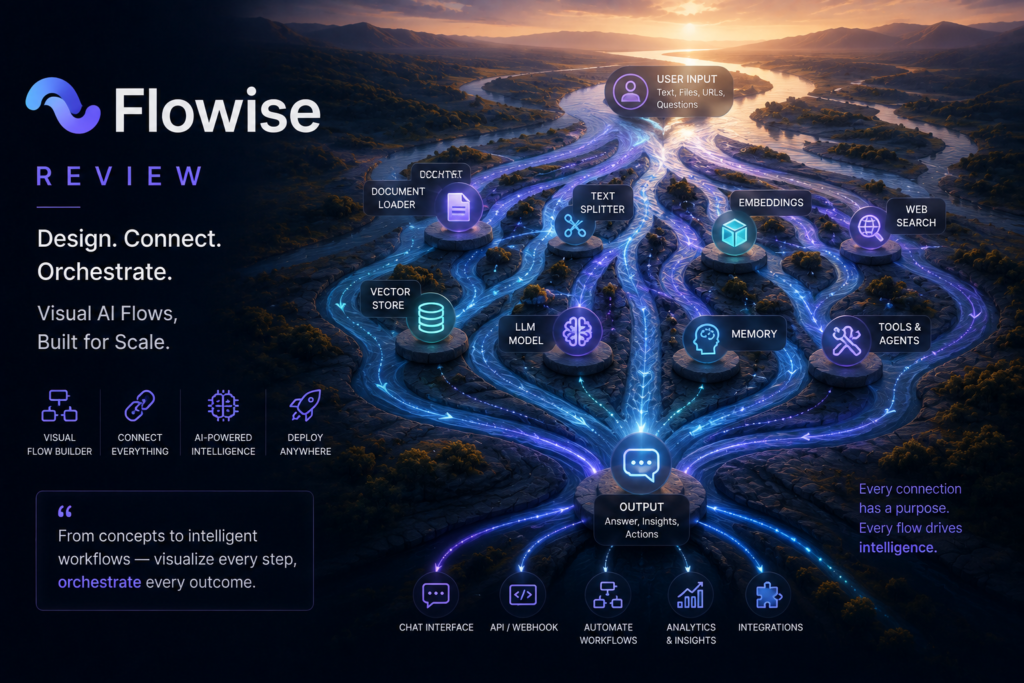
Flowise is an open-source visual development platform for building applications powered by large language models (LLMs). Instead of writing every component from scratch, developers can assemble workflows that connect models, prompts, document retrieval, tools, and other components.
| Attribute | Finding |
|---|---|
| Provider | FlowiseAI |
| Product category | Open-source low-code AI workflow and LLM-application platform |
| Core functionality | Visual workflows, AI agents, RAG, document stores, vector databases, APIs, and self-hosting |
| Target audience | Developers, AI consultants, SaaS companies, technical small businesses, support teams, and operations teams |
| Availability | Open-source self-hosting and managed cloud options |
| Business problem addressed | Building custom AI applications without developing every component from scratch |
| Deployment model | Self-hosted open source or managed cloud |
Flowise is not a plug-and-play chatbot builder. Its core value is developer flexibility for building custom AI applications using visual workflows, RAG, agents, and external data sources.
How It Works
A typical Flowise application can follow this sequence:
- Input: A user submits a question, document, or other supported input.
- Processing: The workflow sends the input through configured prompts, models, retrieval components, or agent logic.
- Knowledge retrieval: Where RAG is configured, the application retrieves relevant document chunks from a vector database or other supported knowledge source.
- Output: An LLM generates a response, summary, classification, or other configured result.
- Review or integration: The application can return a response or expose a workflow through an API, depending on the configuration and supported components.
This describes a possible workflow based on documented capabilities. The precise implementation depends on the selected components, model provider, deployment, and integrations. It does not establish that a particular application will be accurate or production-ready.
3. Research Methodology and Evidence Standards
How This Review Was Prepared
This is a research-based review, not a hands-on product test. The assessment uses the Flowise research summary supplied for this article, including reported product documentation, integration information, pricing reports, and third-party coverage.
The assessment considers:
- Documented product capabilities and technical requirements.
- Potential fit with specific business workflows.
- Pricing evidence and additional operating costs.
- Integration and API options.
- Privacy, security, governance, and maintenance considerations.
- Product-continuity risks.
- Relevant alternatives and implementation requirements.
We distinguish documented capabilities from business analysis and proposed workflows. We have not independently tested Flowise, measured its RAG accuracy, benchmarked its agents, or verified business savings.
Evidence Source Hierarchy
| Priority | Source type | Appropriate use |
|---|---|---|
| 1 | Official product documentation | Features, workflows, supported components, and technical requirements |
| 2 | Official pricing information | Plans, billing, limits, and included features |
| 3 | Official privacy and security documentation | Data handling, retention, access controls, and compliance statements |
| 4 | Official release notes and repository activity | Maintenance, feature changes, deprecations, and continuity |
| 5 | Reputable independent reporting | Independent analysis and relevant product-status information |
| 6 | User reviews and community discussions | Directional evidence about reported experiences |
Evidence Classification
- Verified from identified sources: A claim supported by a specific, identifiable source. This label does not imply independent performance testing.
- Research-Based Analysis: An interpretation of documented capabilities and available evidence.
- Not Independently Verified: A claim that could not be sufficiently confirmed from the research supplied.
- Illustrative Scenario: A proposed business workflow that has not been implemented or tested by Intelligent AI Lab.
What We Could Not Verify
| Evidence area | Finding |
|---|---|
| Product continuity | Third-party reporting claims development ceased in July 2026, the repository was archived in August 2026, and core-team operations ended in August 2026. These claims have not been independently confirmed. |
| Real-world reliability | No independent benchmark of RAG accuracy, hallucination rate, retrieval quality, or agent reliability was supplied. |
| Ease of use | A visual interface is documented, but practical usability and learning time were not independently measured. |
| Cloud pricing | Third-party plan prices were reported, but current official prices and limits were not confirmed. |
| Support quality | The quality and current availability of support across plans were not independently established. |
| Security and compliance | Current product-level security assurances, certifications, contractual terms, and compliance documentation were not sufficiently established by the supplied research. |
| Specific integrations | Support for several named business applications requires confirmation in current documentation. |
| Business outcomes | Cost savings, productivity improvements, customer satisfaction, and other outcomes have not been independently demonstrated. |
Sources Consulted
| Source | Information Used |
|---|---|
| FlowiseAI documentation | Open-source platform, AI agents, LLM workflows, RAG, and 100+ integrations |
| Flowise Document Stores | Document upload, splitting, preparation, and upserting |
| Flowise RAG tutorial | RAG retrieval, vector databases, embeddings, and LLM responses |
| Flowise Agentic RAG | Query validation, categorization, retrieval, and relevance evaluation |
| Flowise Agentflow V2 | Autonomous agents, reasoning, planning, tools, and knowledge |
| Flowise LlamaIndex integration | LlamaIndex integration and RAG capabilities |
| Pinecone Flowise integration | Pinecone vector-database integration and RAG support |
| Flowise privacy policy | Website data handling; not product-platform security documentation |
| ActivePieces Flowise pricing report | Third-party cloud-pricing report |
| ViewAITools Flowise listing | Third-party pricing report |
| iTechGuides Flowise review | Third-party report on discontinued development and archived repository |
4. Key Features of Flowise
The following features are described in the supplied research. They should be checked against the current documentation before a new production deployment.
| Feature | What it does | Potential business value | Availability and limitations |
|---|---|---|---|
| Visual workflow builder | Connects models, prompts, retrieval components, and tools through a visual interface | May simplify development of custom AI applications | Complex workflows still require technical knowledge |
| Retrieval-Augmented Generation (RAG) | Retrieves relevant document content to provide context for LLM responses | May help ground answers in approved business information | Retrieval quality and answer accuracy must be tested |
| Document Stores | Supports document upload, splitting, preparation, and upserting | May simplify knowledge-base preparation | Document quality, access, and freshness remain the business’s responsibility |
| AI agents | Supports workflows that use tools and knowledge sources | May support multi-step AI tasks | Tool permissions, reliability, and human oversight require careful design |
| Agentflow V2 | Provides an agent-oriented workflow capability | May support more complex AI workflows | Practical performance and current maintenance require verification |
| Vector-database connections | Supports retrieval architectures using vector stores | May support semantic search across documents | Verify each required provider and its current integration |
| LlamaIndex integration | Connects Flowise with LlamaIndex retrieval capabilities | May support more advanced retrieval designs | Specific versions and requirements need checking |
| API deployment | Makes configured workflows available to other applications through APIs | May allow AI capabilities to be embedded in products | Authentication, quotas, deployment, and security require verification |
| Self-hosting | Allows deployment on infrastructure managed by the user | May offer deployment and infrastructure control | Requires ongoing security, hosting, upgrade, and maintenance work |
The supplied research reports support for more than 100 data sources, tools, vector databases, and memory systems. That breadth should not be interpreted as proof that every required business application has a native, maintained integration.
The Features That Matter Most for Businesses
1. RAG knowledge applications
RAG combines document retrieval with an LLM response. A business can prepare approved documents, retrieve relevant passages when a question is asked, and provide those passages as context to the model.
This approach is relevant to internal knowledge assistants, technical-document search, and product-support applications. It does not guarantee accurate answers. Source quality, retrieval configuration, permissions, and model behavior all matter.
2. Document Stores
Document Stores provide a workflow for preparing document collections for retrieval. This may help teams manage the processing steps needed to create a knowledge assistant.
Businesses still need clear document ownership, access controls, update procedures, and tests to identify missing or misleading answers.
3. AI agents and tool use
Agent-oriented workflows can connect model reasoning with tools or knowledge sources. They may be appropriate when an application needs multiple processing steps rather than a single prompt and response.
Businesses should constrain available tools and permissions, log important actions, and require human approval for consequential operations.
4. Self-hosting and customization
Self-hosting can offer greater control over the deployment environment than relying exclusively on a managed service. However, it transfers responsibility for infrastructure, patching, monitoring, availability, and security to the operating team.
Given the unresolved maintenance-status question, this advantage should not be treated as sufficient justification for adopting Flowise today.
5. How Businesses Can Use Flowise
| Business function | Example problem | How Flowise may help | Human oversight or requirement |
|---|---|---|---|
| Customer support | Repeated questions about products and policies | A RAG assistant may retrieve relevant help content and generate responses | Review complex issues and escalate complaints, refunds, or account changes |
| Internal knowledge | Employees struggle to locate approved information | A knowledge assistant may search SOPs, policies, and technical documents | Maintain current sources and validate answers |
| Document search | Teams manually search reports, manuals, and other files | Retrieval workflows may identify relevant document passages | Validate legal, financial, and compliance-sensitive information |
| Sales and marketing | Teams need help preparing research and draft content | Custom assistants may help organize information and generate drafts | Check facts, customer data, and external messaging |
| Operations | Repetitive workflows require AI processing | LLM workflows and APIs may support selected process steps | Monitor exceptions and approve consequential actions |
| SaaS product development | A product needs a custom AI feature | API-based workflows may provide AI functionality | Monitor security, cost, output quality, and service continuity |
These are potential applications based on documented capabilities, not verified implementations or demonstrated business outcomes.
Best-Fit Business Use Case
Recommended use case for evaluation: an internal knowledge assistant.
- Business problem: Employees spend time searching policies, technical manuals, product documentation, or standard operating procedures.
- Relevant capability: RAG, Document Stores, vector-database retrieval, and conversational workflows.
- Required inputs: Approved source documents, an appropriate model and embedding configuration, a supported retrieval system, and document-access rules.
- Proposed workflow: An employee asks a question; the application retrieves relevant passages; the LLM generates a response; ambiguous or sensitive questions are escalated to a human.
- Principal risks: Outdated documents, poor retrieval, hallucinations, inappropriate access to confidential content, and ongoing maintenance.
- Suggested pilot metrics: Answer accuracy, citation or source-reference quality, escalation rate, time per inquiry, user adoption, and total operating cost.
A business should test this use case only after confirming that Flowise is actively maintained or that it has an acceptable, independently supportable maintenance path.
6. Intelligent AI Lab Business Decision Analysis
The Business Problem Flowise Is Best Suited to Address
Flowise is designed for teams that need to assemble custom AI applications from models, retrieval components, documents, tools, and workflow logic.
The clearest potential fit is a technical organization building a knowledge assistant or custom AI feature that needs more control than a basic chatbot provides. The organization must be able to manage the application, test its outputs, secure its data, and maintain the underlying deployment.
The objective should be a defined business outcome, such as answering a known set of employee questions with acceptable accuracy, rather than adopting AI simply because it is available.
Is This the Right Tool for the Job?
| Decision factor | Assessment |
|---|---|
| Primary use case | Custom RAG assistants and LLM workflows |
| Capability fit | Strong on documented functionality for developer-led AI applications |
| Main advantage | Visual development and customization across AI workflow components |
| Main trade-off | Technical complexity and responsibility for reliable operation |
| Cost consideration | Model usage, embeddings, vector storage, hosting, maintenance, monitoring, and review time |
| Implementation consideration | Requires technical configuration, document preparation, retrieval tuning, access controls, and monitoring |
| Key uncertainty | Whether the product remains maintained and supported, and whether it meets the intended reliability and security requirements |
When to Choose Flowise
Flowise merits further evaluation when all of the following apply:
- You need a custom assistant grounded in your own business documents.
- Visual construction of RAG or agent workflows is useful to your development process.
- Your team has the skills to manage configuration, deployment, and troubleshooting.
- Self-hosting or workflow customization is an important requirement.
- You can test output quality and control the consequences of failures.
- Current product maintenance, security, and deployment viability have been confirmed.
These conditions establish a potential fit, not an unconditional recommendation to adopt the platform.
When to Choose an Alternative
Consider another platform if:
- You need a managed AI-application platform: Evaluate Dify.
- You need visual LLM application development: Evaluate Langflow.
- You need customer-facing conversational workflows: Evaluate Botpress.
- You need business-user-oriented agents: Evaluate Relevance AI.
- You need general workflow automation with AI capabilities: Evaluate n8n.
- You need a general-purpose conversational assistant rather than a development platform: Consider an established AI assistant appropriate to your organization’s data and governance requirements.
A maintained alternative may be preferable even if Flowise’s technical architecture looks suitable. Product continuity is part of business fit.
When Not to Use AI
AI may be unnecessary if a task is simple, infrequent, or already handled reliably by a rules-based process, search function, form, or existing business application.
Do not give an unvalidated agent unrestricted authority to make legal, financial, employment, medical, safety-critical, or other consequential decisions. Use qualified human oversight and appropriate controls.
Our Recommended Next Step
Recommendation: Verify a critical requirement before proceeding.
First, confirm Flowise’s current maintenance status, repository status, product ownership, and available support. The supplied research includes a material but unconfirmed report that development and core-team operations ended in 2026.
If continuity can be established and the platform meets your security and deployment needs, conduct a limited pilot with one low-risk knowledge-assistant workflow.
Before testing, define an acceptable answer-accuracy target, an escalation policy, a maximum operating cost, and a process for handling incorrect responses. Compare the results against the current manual process.
If current maintenance and support cannot be established, compare maintained alternatives before committing resources.
7. Illustrative Business Automation Examples
The following examples are proposed workflows, not implementations tested by Intelligent AI Lab.
Example 1: Internal Knowledge Assistant
Business scenario: A small business wants employees to find approved HR policies and product documentation without repeatedly contacting HR or support.
Tools involved: Flowise, approved documents, an embedding model, a vector database, an LLM provider, and an internal review process.
Before
Employees search shared folders, read multiple documents, or ask colleagues to locate information.
Proposed workflow
- Input: An employee submits a question.
- Retrieval: The application searches the configured knowledge base for relevant passages.
- AI processing: The LLM generates a response using the retrieved context.
- Human oversight: HR or the relevant document owner handles sensitive, ambiguous, or exceptional questions.
- Output: The employee receives an answer or is directed to a human contact.
Potential benefits
- Easier access to approved information.
- Potentially less repetitive searching.
- A consistent entry point for common questions.
Requirements and limitations
- Documents must be approved, current, and appropriately permissioned.
- The retrieval system must not expose documents to unauthorized users.
- Answers must be evaluated for correctness and appropriate escalation.
- The platform’s current maintenance status must be verified.
Suggested success metrics
- Answer-accuracy rate.
- Source-reference quality.
- Escalation rate.
- Average time per inquiry.
- Employee adoption.
- Total cost per completed inquiry.
Example 2: Tier-1 Customer-Support Assistant
Business scenario: A small SaaS company wants to help customers find answers to routine product questions.
Tools involved: Flowise, help-center content, product documentation, a supported retrieval system, an LLM provider, and the existing support process.
Proposed workflow
- A customer submits a question through a supported interface.
- The application retrieves relevant product documentation.
- The LLM drafts a response based on the retrieved material.
- The system returns the response or routes the case for human assistance, depending on the configured workflow.
- Support staff review errors and update the underlying knowledge base.
Potential benefits
- Potentially faster access to routine product information.
- More consistent use of approved documentation.
- A possible reduction in repetitive work if the pilot validates the workflow.
Requirements and limitations
- The customer interface and ticketing integration must be confirmed.
- Account changes, refunds, complaints, and sensitive cases need appropriate human approval.
- The team must monitor inaccurate answers and provide a reliable fallback.
- Support-cost reductions and improved customer satisfaction must not be assumed without measurement.
Suggested success metrics
- Answer-accuracy rate.
- First-response time.
- Escalation rate.
- Resolution rate without human intervention.
- Customer satisfaction.
- Cost per resolved inquiry.
Evidence note: Both examples are illustrative scenarios. Their feasibility, safety, and business impact must be validated in a controlled pilot.
8. Pros and Cons of Flowise
| Pros | Cons |
|---|---|
| Open-source architecture with self-hosting options | Self-hosting requires infrastructure and maintenance capability |
| Visual construction of AI workflows | Complex implementations still require technical knowledge |
| Documented RAG and document-preparation capabilities | Retrieval quality and answer accuracy are not guaranteed |
| AI agents and tool-oriented workflows | Agent behavior requires testing, permissions, and oversight |
| Broad reported ecosystem of data sources and components | Individual integrations and current compatibility require verification |
| Potential for API-based application integration | Authentication, rate limits, and production requirements must be checked |
| Customization of AI application architecture | Product-continuity and current support status remain unresolved in the supplied research |
What These Pros and Cons Mean for Buyers
Flowise’s principal attraction is technical flexibility. It may be useful for a team that wants to design its own AI application rather than rely on a fixed chatbot product.
However, a visual builder does not eliminate the need for engineering, monitoring, data governance, or maintenance. Nor does open-source availability guarantee ongoing development or dependable support.
For new production applications, the reported discontinuation risk is a more important concern than the number of available workflow components. Buyers should resolve that question before committing to the platform.
9. Flowise Pricing and Plans
Pricing research date: 20 October 2026
Official cloud pricing: Not independently verified.
The supplied research identifies free self-hosted software and third-party reports of managed-cloud plans. The cloud prices and limits below are third-party reported figures, not confirmed current offers from FlowiseAI.
| Plan | Reported price | Billing basis | Potential audience | Important qualification |
|---|---|---|---|---|
| Open-source self-hosted | No platform subscription | Self-managed deployment | Developers and technical teams | Infrastructure, maintenance, and model-provider costs remain |
| Cloud Free | $0/month | Reported monthly tier | Initial evaluation | Availability and limits not independently verified |
| Cloud Starter | $35/month | Reported monthly subscription | Individuals and small teams | Current price, usage limits, and availability unverified |
| Cloud Pro | $65/month | Reported monthly subscription | Higher-usage teams | Current price, user limits, and included features unverified |
| Enterprise | Custom | Reported custom contract | Larger organizations | Current availability, security features, and support terms unverified |
Third-party reports also list the following limits:
- Cloud Free: Two flows or assistants, 100 predictions per month, 5 MB of storage, and community support.
- Cloud Starter: Unlimited flows, 10,000 predictions per month, and 1 GB of storage.
- Cloud Pro: 50,000 predictions per month, 10 GB of storage, five users, administrative roles, and priority support.
- Enterprise: Custom pricing, with volume pricing, SSO, and dedicated support reported.
These limits should not be relied upon for purchasing decisions until verified directly. The exact source URLs for the pricing reports were not included in the research summary.
What to Know Before Paying
Self-hosting is not cost-free in practice. Although the software may be available without a platform subscription, the business may incur costs for servers, storage, monitoring, maintenance, and technical staff.
Model usage may be charged separately. Depending on the architecture, LLM inference, embeddings, and vector-database usage can introduce additional charges.
Cloud limits matter. A plan’s prediction allowance, storage, team features, and support terms should be compared against the intended workload.
Continuity matters more than a low price. Before paying for a subscription or building a production system, verify that the service is operating, supported, and suitable for the required deployment period.
Is Flowise Worth the Price?
Flowise could offer value when a technical team needs customized RAG and LLM workflows and can manage the operational responsibilities. However, the current cloud value proposition cannot be established from the supplied research because official pricing was not independently verified.
Total cost of ownership should include:
- Hosting and infrastructure.
- LLM and embedding usage.
- Vector-database storage and queries.
- Implementation and integration work.
- Security, monitoring, and maintenance.
- Human review, corrections, and exception handling.
- Migration costs if the platform is discontinued or no longer meets requirements.
Best Plan Recommendation
| Buyer type | Recommendation | Reason | What to verify |
|---|---|---|---|
| Developer exploring the technology | Consider self-hosted evaluation only after continuity checks | Avoids an unverified cloud commitment | Repository status, installation instructions, dependencies, maintenance, and security |
| Freelancer or solo business | Cannot recommend a paid plan yet | Current pricing and continuity are unresolved | Current official plan and support terms |
| Small technical team | Compare maintained alternatives first | Production dependency increases continuity risk | Required features, migration options, operating costs, and support |
| Enterprise or regulated organization | Do not commit until due diligence is complete | Security, compliance, continuity, and support are material requirements | Contractual commitments, security evidence, deployment support, and continuity arrangements |
Official pricing verification: The supplied research did not include a confirmed live official pricing-page URL. Locate the current pricing information through the FlowiseAI website and confirm the terms before publication or purchase.
10. Integrations and Technical Requirements
Flowise’s documented purpose is to connect AI models, retrieval components, tools, and workflow logic. That does not mean every business application has a supported native connector.
| Integration or requirement | Research finding | Buyer action |
|---|---|---|
| LLM providers | The supplied research identifies OpenAI, Anthropic, Google, Mistral, and Ollama in third-party documentation | Verify current component availability, model compatibility, and authentication requirements |
| Llama models | Not independently verified in the primary sources reviewed | Confirm the exact model provider and supported component |
| Document sources | PDF, CSV, JSON, web pages, Notion, and Confluence support is reported by third-party documentation | Confirm each required loader and its current dependencies |
| Vector databases | Pinecone is documented in the supplied research; Qdrant, Chroma, Weaviate, and PostgreSQL pgvector are reported by third-party documentation | Verify current integration documentation for the chosen database |
| CRM systems | Specific CRM integrations were not independently confirmed | Check whether a native connector exists or API/custom work is required |
| n8n, Zapier, and Make | Specific current integrations were not independently verified | Confirm native support, third-party connectors, or custom API requirements |
| Slack, Notion, Airtable, and HubSpot | Specific integration claims were not independently verified | Confirm supported actions, authentication, and compatibility |
| API deployment | API-based deployment is a documented Flowise capability in the supplied research | Verify authentication, endpoint behavior, limits, and deployment security |
| Administration and security | Current product-level security and compliance information was not sufficiently verified | Obtain applicable documentation before connecting sensitive systems |
Native vs. Third-Party Integrations
- Native capability: A feature implemented directly within Flowise, such as its visual workflow builder and documented RAG components.
- Third-party integration: A connection using an external service, provider, component, or connector.
- Custom integration: An implementation that requires API work, custom code, or bespoke configuration.
- Unverified integration: A connection whose current availability and behavior have not been confirmed by reliable documentation.
Do not treat a technically possible API connection as proof of a native, maintained integration.
Implementation Considerations
A business evaluating Flowise should identify the people responsible for:
- Preparing and maintaining source documents.
- Configuring prompts, retrieval, and model components.
- Managing data access and permissions.
- Monitoring output quality and costs.
- Handling errors, exceptions, and human escalations.
- Maintaining or migrating the application if the platform changes.
These responsibilities remain important regardless of whether the software subscription is free.
11. Flowise vs. Alternatives
The following products address overlapping but not identical needs. Their current prices, features, and plan limits should be verified on their respective official websites before a purchasing decision.
| Tool | Best for | Key difference | Pricing position | Consider it instead when |
|---|---|---|---|---|
| Flowise | Custom visual AI workflows, RAG, and agents | Open-source, developer-oriented workflow construction | Self-hosted software has no platform subscription; current cloud pricing unverified | Current maintenance and deployment viability can be confirmed and customization is essential |
| Dify | AI application development and RAG | Managed application-development experience, with deployment options to investigate | Verify current plans and pricing | You want a more managed environment for AI applications |
| Langflow | Visual LLM application development | Visual development for LLM-based applications | Verify current plans and pricing | Your primary need is prototyping and visual LLM workflow development |
| Botpress | Customer-facing conversational applications | Focus on conversational AI and chatbot deployment | Verify current plans, usage charges, and limits | You need customer-facing conversation management |
| n8n | Workflow automation with AI components | Broader workflow automation across applications and APIs | Community self-hosting and paid cloud options have been reported; verify current terms | You need process automation rather than a dedicated AI application builder |
| Relevance AI | Business-oriented agents and agent workflows | Focus on business users and agent-based automation | Verify current plans and usage limits | Business teams need a more managed agent experience |
Which Tool Should You Choose?
Choose Flowise only if its current maintenance status is satisfactory, its technical flexibility meets your requirements, and your team can manage the resulting application.
Choose Dify if a more managed AI-application development experience better suits your team. Confirm its deployment model, data handling, and plan restrictions.
Choose Langflow if visual LLM application development and prototyping are the main requirements.
Choose Botpress if the priority is customer-facing conversational workflows rather than general-purpose AI application development.
Choose n8n if the core requirement is connecting business applications and automating processes, with AI as one component of the workflow.
Compare further if your decision depends on security certifications, enterprise support, contractual continuity, or a specific integration. Those requirements need current, product-specific evidence.
12. Who Should Use Flowise?
Recommended For Further Evaluation
- Developers: If you need to assemble custom LLM workflows and RAG applications.
- AI consultants: If you build client-specific AI applications and can maintain them.
- SaaS companies: If you need customizable AI capabilities exposed through an application interface or API.
- Technical small businesses: If your business has a defined knowledge or document-search problem and engineering resources.
- AI engineering teams: If you need control over retrieval, tools, models, and workflow configuration.
These recommendations are conditional on confirming current product status and suitability.
Not Ideal For
- Non-technical business owners: If you need a ready-to-use assistant with minimal setup.
- Businesses without maintenance resources: If nobody can manage deployment, monitoring, updates, and troubleshooting.
- Teams seeking simple app-to-app automation: If existing automation platforms already meet the need.
- Production-critical applications without continuity assurance: If you cannot accept uncertainty around maintenance and support.
- Sensitive or regulated use cases without due diligence: If required security, compliance, or contractual protections cannot be confirmed.
Best-Fit Buyer Profile
The most suitable prospective buyer is a technical business or development team with a clear need for custom AI applications, access to appropriate engineering skills, and a process for testing and governing AI outputs.
However, the buyer must also confirm that Flowise is currently maintained or has an acceptable support and migration path. Without that assurance, a technically suitable platform may still be a poor operational choice.
13. How to Get Started With Flowise
This is a research-based implementation guide, not a claim that Intelligent AI Lab has installed or configured the product.
Step 1: Identify One Business Problem
Choose a narrow task such as answering internal policy questions or finding information in product documentation.
Define the current workflow, its limitations, and the outcome you want to measure.
Step 2: Confirm Product Fit and Continuity
Before building anything, verify the current FlowiseAI website, repository status, release activity, maintenance arrangements, and available support.
Confirm that the required features and integrations are currently available.
Step 3: Review Data and Permissions
Identify the source documents and systems the application will access. Review the relevant data-handling terms and security documentation before connecting confidential information.
Step 4: Design a Limited Pilot
Specify the input, expected output, approval steps, escalation conditions, and fallback process.
Use the least access required for the intended task and avoid giving an agent unrestricted authority over business systems.
Step 5: Establish a Baseline
Measure the existing workflow before introducing AI. Depending on the task, this may include:
- Time per inquiry.
- Answer accuracy.
- Error and rework rates.
- Escalation rate.
- Cost per completed task.
- User adoption.
Step 6: Evaluate the Pilot
Compare the pilot against the baseline using consistent criteria. Include model usage, hosting, vector storage, maintenance, human review, and error handling in the cost assessment.
Step 7: Decide Whether to Expand
Continue, revise, or stop based on measured results. Expand only if the application is sufficiently reliable, the operating costs are acceptable, and the platform’s maintenance and support arrangements remain suitable.
If continuity cannot be confirmed, evaluate a maintained alternative rather than building a larger dependency.
14. Limitations, Risks, and Governance
| Risk area | Research finding | What businesses should check |
|---|---|---|
| Accuracy and reliability | No independent RAG or agent benchmark was supplied | Test representative questions, incorrect answers, source references, and edge cases |
| Privacy and data retention | Product-level data-handling details were not sufficiently established | Review applicable privacy terms, retention, data flows, and subprocessors |
| Model training and data use | Model-provider policies may differ | Check each provider’s current data-use terms and configuration options |
| Security | Current product-level security assurances were not sufficiently verified | Review authentication, access controls, vulnerability handling, and deployment security |
| Compliance | Relevant compliance arrangements were not established by the supplied research | Obtain appropriate legal and compliance review for regulated use |
| Access and permissions | Detailed administrative controls were not independently confirmed | Verify role management, document permissions, and isolation between users |
| Usage limits | Third-party reports describe cloud limits, but current terms were not verified | Confirm prediction, storage, API, and rate limits |
| Human oversight | AI-generated outputs and tool actions can require review | Define approval thresholds, escalation rules, and action permissions |
| Vendor dependency | Self-hosting may reduce reliance on a hosted service, but migration still requires planning | Determine how workflows, configurations, and data can be backed up and moved |
| Support and continuity | Third-party reporting raises a material maintenance concern | Verify current ownership, active development, repository status, and support arrangements |
What Businesses Should Check Before Adoption
1. Current maintenance status
The most important unresolved question is whether Flowise is actively maintained and supported. The supplied research reports cessation of feature development, repository archival, and the end of core-team operations in 2026. These claims remain unconfirmed in this review.
Check the current official repository, release history, project announcements, and support arrangements. If the reported discontinuation is confirmed, evaluate the risks of relying on the project for a new production deployment.
2. Security and privacy
Review current privacy terms, data retention, access controls, deployment architecture, and model-provider policies. Do not assume self-hosting automatically makes an application secure or compliant.
3. Reliability and human oversight
Test the application against a representative evaluation set. Include incorrect, ambiguous, and out-of-scope questions. Establish when the system should decline to answer or escalate to a person.
4. Total cost and exit planning
Estimate hosting, model usage, maintenance, monitoring, and review costs. Plan how to preserve documents, configurations, and workflows if the platform becomes unavailable or no longer meets requirements.
For sensitive, regulated, or high-impact use cases, obtain appropriate technical, security, legal, and compliance review before deployment.
15. Final Verdict: Is Flowise Worth It?
Flowise’s documented capabilities make it relevant to developers and technical teams building custom RAG assistants, AI agents, and LLM workflows. Its visual development model, document-processing capabilities, retrieval components, and self-hosting option can be attractive when a business needs more customization than a ready-made chatbot provides.
However, technical capability is not enough to justify adoption. The research supplied for this review contains a material third-party report that FlowiseAI’s feature development and core-team operations ended in 2026 and that the repository was archived. We have not independently confirmed that report, so it should not be presented as an established fact. Nevertheless, it is significant enough to change the buying recommendation until verified.
Cloud pricing is also not independently confirmed. Reported subscription prices should not be used as a purchasing basis without checking current official terms. Businesses must also account for hosting, model usage, maintenance, security, and human review.
Flowise may be worth evaluating if its current status is satisfactory and your team has the technical resources to test and maintain a custom AI application. Non-technical businesses may be better served by a maintained, managed alternative.
Final Buying Recommendation: Verify First; Compare Alternatives in Parallel
- Confirm the product’s maintenance, support, and continuity status.
- Verify required integrations, security controls, and current pricing.
- If those checks are satisfactory, pilot one low-risk knowledge-assistant workflow and measure accuracy, escalation, and total cost.
If product continuity cannot be established, do not make Flowise the foundation of a new production-critical workflow. Evaluate alternatives before committing engineering time or business data.
16. Intelligent AI Lab Rating and Scorecard
A. Business-Fit Verdict
Good Fit for technical small businesses, developers, and AI teams building custom RAG applications and LLM workflows. It is a Conditional Fit for non-technical teams and a Poor Fit for businesses seeking plug-and-play chatbots.
B. Assessment Type
Research-Based Assessment.
C. Evidence Confidence
High for core capabilities, RAG workflow, document stores, agents, and integration breadth, because these are documented by official FlowiseAI documentation. Material uncertainty remains around current pricing, product continuity, real-world RAG accuracy, and measured business outcomes.
D. Numerical Rating
Research-based rating: 4/5
Rating date: 20 October 2026
This rating represents a structured evaluation of documented suitability for the selected use case. It is not a hands-on performance benchmark.
Research-Based Weighted Scorecard
| Criterion | Weight | Score | Evidence and Rationale |
|---|---|---|---|
| Core capability fit | 25% | 5/5 | Flowise documents visual AI workflows, agents, RAG, document stores, and vector databases. docs.flowiseai+2 |
| Business workflow fit | 20% | 4/5 | Strong documented alignment with knowledge, support, document-search, and operations use cases; business impact not independently demonstrated. docs.flowiseai |
| Implementation feasibility | 15% | 2/5 | Requires technical capability, self-hosting knowledge, and infrastructure management for advanced deployments. docs.flowiseai |
| Integrations and interoperability | 15% | 4/5 | Flowise connects to 100+ sources, tools, vector databases, and memories; specific business-app integrations require verification. docs.flowiseai |
| Pricing and cost suitability | 15% | 3/5 | Open-source self-hosting is free, but cloud pricing was not independently verified and infrastructure/model costs add complexity. docs.flowiseai |
| Governance and operational readiness | 10% | 2/5 | Product-level security, compliance, and continuity documentation was not independently verified. |
Weighted score calculation:
(5 × 0.25) + (4 × 0.20) + (2 × 0.15) + (4 × 0.15) + (3 × 0.15) + (2 × 0.10) = 3.60/5
Overall Assessment Summary
- Business-fit verdict: Good Fit for technical teams; Conditional Fit for small businesses
- Research-based rating: 3.6/5
- Evidence confidence: High for documented capabilities and RAG workflow; Moderate for pricing, product continuity, and business outcomes
- Assessment type: Research-Based Assessment
- Overall conclusion: Flowise is a strong option for technical teams that need custom RAG applications and LLM workflows. Its main buyer decision is implementation readiness and product continuity: businesses with technical resources should pilot Flowise, while non-technical teams should choose a managed AI-application platform. Its 3.6/5 rating reflects strong customization and RAG capability, offset by implementation complexity and verification gaps.
17. Decision Checklist: Should You Choose Flowise?
Consider Shortlisting Flowise If:
- You need a custom AI assistant grounded in business documents.
- You need visual RAG and LLM workflow development.
- Your team can manage deployment, testing, and maintenance.
- You can establish appropriate security and human-review controls.
- Current product maintenance and support have been verified.
- You have a measurable pilot and a credible exit plan.
Consider an Alternative If:
- Current maintenance or support cannot be established.
- You need a managed application with less technical overhead.
- You require security, compliance, or contractual assurances that cannot be confirmed.
- A maintained alternative better meets your integration and governance requirements.
- A simpler automation or existing software feature solves the problem with less complexity.
Decision guidance: Flowise’s documented features may justify technical interest, but they do not remove the need for product-continuity due diligence. Resolve critical uncertainties before making a production commitment.
18. Frequently Asked Questions About Flowise
What is Flowise used for?
Flowise is a visual development platform for building AI applications such as chat assistants, RAG knowledge systems, AI agents, document-search workflows, and LLM-powered applications. The precise capabilities available to a user depend on the components, deployment, and integrations supported.
Is Flowise free?
The open-source version has been available for self-hosting without a platform subscription. Self-hosting still incurs potential infrastructure, model-provider, maintenance, and operational costs. Current cloud Free plan availability has not been independently verified.
How much does Flowise cost?
Third-party reports supplied for this review list Cloud Free at $0/month, Starter at $35/month, Pro at $65/month, and Enterprise as custom-priced. These figures were not confirmed against a live official pricing page and should not be treated as current offers.
Is Flowise suitable for small businesses?
It may suit technically capable small businesses that need custom AI applications grounded in their own documents. Teams should account for implementation, maintenance, model usage, security, and human oversight. The unresolved product-continuity question should be addressed before adoption.
Is Flowise better than Dify?
Neither is universally better. Flowise’s documented appeal is its visual, developer-oriented customization and self-hosting potential. Dify is an alternative to investigate if a more managed AI-application development experience is important. Compare current deployment, maintenance, security, and pricing before deciding.
Can Flowise automate business workflows?
Flowise supports LLM workflows, RAG, AI agents, tools, and API-based deployment. The exact actions an application can perform depend on its configuration and supported components. Do not assume a particular business-app integration is native without checking current documentation.
Does Flowise integrate with n8n, Zapier, Make, Slack, Notion, Airtable, or HubSpot?
The supplied research did not independently verify these specific integrations. Confirm whether each connection is native, available through a third-party component, requires custom API work, or is unsupported in the current version.
Is Flowise safe for business data?
Safety depends on deployment, configuration, access controls, data handling, model providers, and the application being built. The supplied research did not sufficiently establish all current product-level security and compliance details. Review current documentation and obtain appropriate technical and compliance advice before processing sensitive information.