
ElevenLabs Review 2026: Is It the Best AI Voice Tool for Businesses?
Here’s the final version:
If you’re considering ElevenLabs, you’re probably not asking, “Can it generate speech?” You’re asking whether it can produce natural, on-brand voice content quickly and consistently enough to justify the cost—especially when audio affects marketing performance, customer experience, training, or product experience.
This ElevenLabs Review evaluates the platform from a business perspective: where ElevenLabs is genuinely one of the strongest AI voice platforms, where it may be overkill, and how to decide based on workflow economics—not just impressive demos.
Quick Answer (2026): ElevenLabs is usually a top choice for businesses that need premium, human-like text-to-speech, high-quality voice cloning, and a scalable API for voice experiences. It’s not automatically the best option for every SMB because usage-based costs can be hard to forecast and voice-agent deployments often require telephony-first platforms.
ElevenLabs Review: Quick Verdict
Overall Rating: ⭐⭐⭐⭐½ (4.5/5)
Why not 5/5? ElevenLabs’ biggest weaknesses for businesses are usage-cost predictability, implementation complexity at scale, and the additional infrastructure required for some voice-agent deployments.
ElevenLabs is one of the strongest AI voice platforms for businesses that prioritize realistic voice generation, voice cloning, multilingual content, dubbing, and voice-based AI experiences. However, its expanding feature set and usage-based economics mean it isn’t automatically the best choice for every business.
Category Ratings
| Category | Rating |
|---|---|
| Voice quality | ⭐⭐⭐⭐⭐ |
| Voice cloning | ⭐⭐⭐⭐⭐ |
| Voiceover creation | ⭐⭐⭐⭐⭐ |
| AI dubbing | ⭐⭐⭐⭐⭐ |
| AI voice agents | ⭐⭐⭐⭐½ |
| API/developer capabilities | ⭐⭐⭐⭐⭐ |
| Ease of use | ⭐⭐⭐⭐½ |
| Business/enterprise capabilities | ⭐⭐⭐⭐⭐ |
| Value for money | ⭐⭐⭐⭐ |
| Overall | ⭐⭐⭐⭐½ |
What Is ElevenLabs (and what problem does it solve)?
ElevenLabs AI Voice Generator is a platform used for realistic text-to-speech (TTS), voice cloning, multilingual voice output, and increasingly for developer and real-time voice use cases. In plain English: it helps you turn scripts into natural audio quickly, and it can help you keep that audio consistent with a recognizable “brand voice.”
Important positioning: ElevenLabs isn’t simply a text-to-speech tool. It’s best understood as a Voice AI platform that combines voice generation, voice cloning, dubbing, APIs, and conversational voice capabilities to support content production, localization, product experiences, and conversational AI. However, businesses shouldn’t confuse voice quality with complete voice-agent infrastructure.
For many small businesses, the real problem isn’t “we don’t have a voice.” It’s one (or more) of these operational constraints:
- Voiceover production is a bottleneck: recording takes scheduling, retakes, editing, and approvals.
- Revisions are expensive: every script update can mean another recording session.
- Brand consistency is hard: different freelancers, different delivery styles, different audio quality.
- Localization doesn’t scale: translating and re-recording multiplies cost and time.
- Automation needs to sound “human enough”: robotic voices can reduce trust in customer-facing workflows.
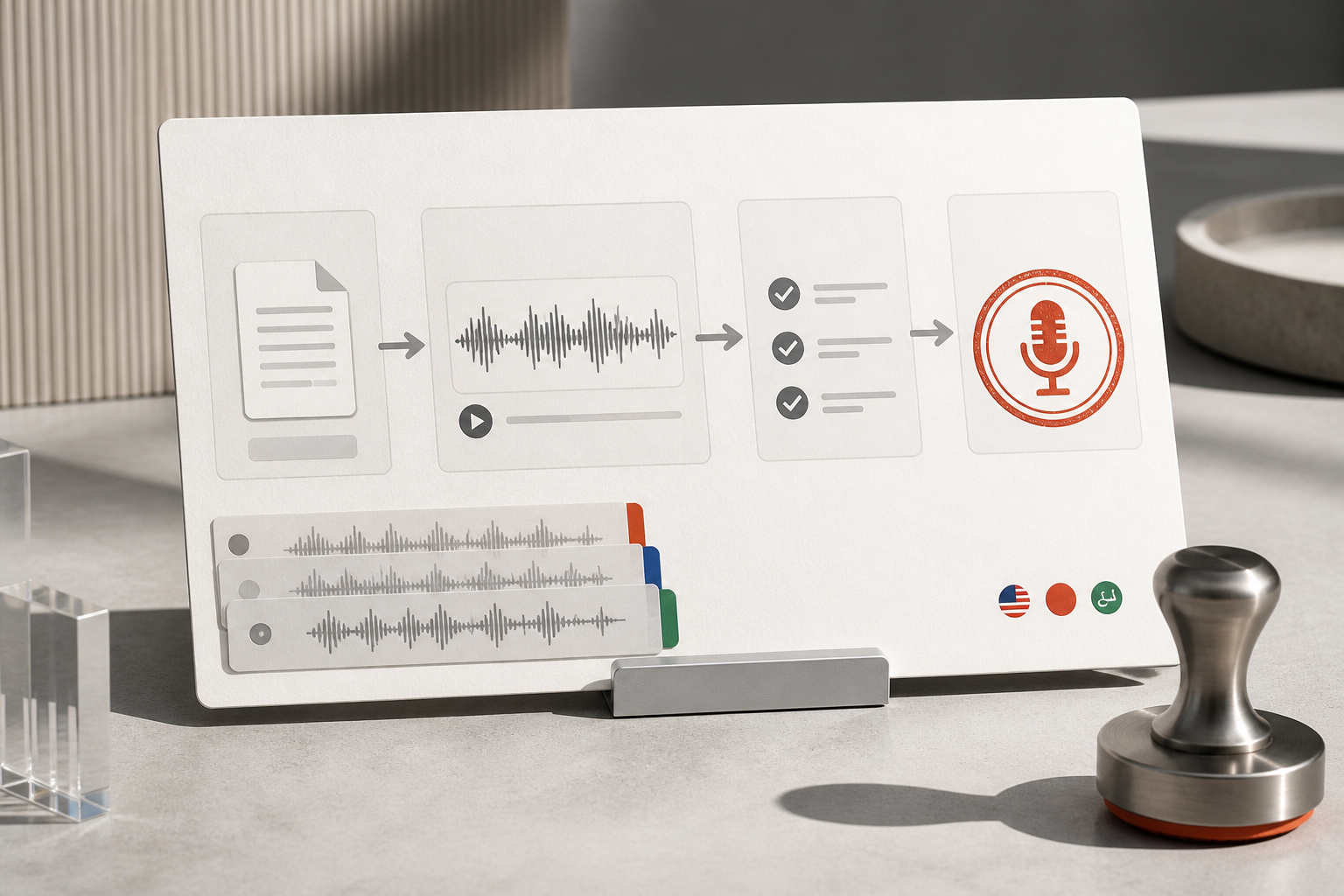
ElevenLabs aims to compress that entire cycle: script → audio → review → publish (and repeat) with fewer delays.
Who Is ElevenLabs Best For?
ElevenLabs tends to be the best business fit when audio quality directly affects revenue, customer experience, or production speed. It’s often the wrong starting point when your voice needs are occasional or when the real problem is call routing, compliance, or agent operations (not narration quality).
For companies evaluating an AI voice generator for business, the key question is not simply whether the voices sound realistic. Businesses should evaluate production volume, brand consistency, integrations, governance, and cost per approved minute.
Best fit: when premium voice quality is part of the product or the sale
- Marketing teams and agencies producing frequent video ads, social content, product explainers, and ad variants.
- SaaS and product teams building voice into onboarding, in-app guidance, or voice-enabled features (API-centric needs).
- Training and enablement teams shipping lots of SOP narration, internal training modules, or customer education audio.
- Multilingual content teams where turnaround time and consistency matter more than hiring voice talent for each language and revision.
Usually not the best fit: when the workflow doesn’t justify “premium”
- Occasional voiceovers (a few minutes a month) where a simpler, lower-cost TTS tool meets the need.
- Phone automation-first teams whose real requirements are telephony integration, call handoff, monitoring, latency control, and compliance workflows.
- Highly regulated use cases where internal policy or legal review makes “upload content to a vendor” difficult—especially if the content includes sensitive data.
Consultant Insight: The most common buying mistake is choosing a voice tool after a great demo, then discovering the team can’t operationalize it—because approvals, QA, script changes, and cost forecasting weren’t designed into the workflow. A voice tool is only “worth it” when it reliably reduces total time to publish or improves a KPI you actually measure.
ElevenLabs Review: Pricing in 2026
⚠️ Important: ElevenLabs uses usage-based pricing and plan limits, so your actual cost depends on the amount of audio generated, regeneration, and other usage. Because pricing and plan structures can change, verify the current plan limits and commercial-use terms on ElevenLabs’ official pricing page before purchasing.
Pricing is one of the biggest reasons businesses hesitate. Across public reviews and summaries, plan names and numbers are reported differently, and real-world cost depends on usage/credits. That means you should treat any snapshot as directional and confirm details on ElevenLabs’ official pricing page before committing.
Pricing reality: plan price is not the same as production cost
Several reviewers call out a predictable pattern: businesses underestimate credits and regeneration. In practice, you rarely generate audio once. You generate, review, fix pacing or emphasis, regenerate, and sometimes run multiple voice options for stakeholders. That “creative iteration” can materially change cost.
Business-focused pricing framework (use this to plan)
Instead of asking only about ElevenLabs cost“, businesses should ask: “What does it cost us to produce one approved minute of usable audio?”
Cost per approved minute formula:
- Subscription cost + usage/overages + QA time + editing time ÷ approved minutes published
This framework is more useful than simply comparing subscription prices because it accounts for the real production workflow.
A simple “pricing reality” calculator (estimate your monthly voice workload)
You don’t need perfect math—you need a defensible estimate. Use this framework:
- Finished minutes per month: How many minutes of published audio do you ship?
- Regeneration factor: On average, how many times do you regenerate each segment? (Many teams discover it’s 1.3× to 2.5× depending on approvals.)
- Localization multiplier: How many languages/variants do you produce per asset?
- Buffer for experimentation: Add a small allowance for testing voices/styles.
Planning formula: Total generated minutes = Finished minutes × Regeneration factor × Localization multiplier + Buffer
Then compare that estimate against plan allowances and overage rules on the official pricing page.
ElevenLabs Features: What Matters for Businesses
This section breaks down the core capabilities that matter for business workflows, combining feature descriptions with practical business evaluation.
AI Voice Generator & Text-to-Speech
What it does: ElevenLabs’ core strength is its AI voice generator and text-to-speech software software, particularly its ability to produce natural, consistent speech at scale. In practical business use, its strongest advantage is the naturalness and consistency of the generated speech.
ElevenLabs TTS is particularly well suited to businesses that need natural narration, multilingual content, product audio, and programmatic voice generation.
For businesses comparing AI text to speech tools, the important differences are naturalness, pronunciation, voice consistency, language support, API access, and production economics.
Business value:
- Highly natural prosody, pauses, and emotional delivery
- Dozens of pre-built voices across genders, ages, and accents
- Control over delivery style (conversational, authoritative, friendly, etc.)
- Adjustable speaking rate without sacrificing quality
- Support for dozens of languages with native-sounding pronunciation
- Fine-tune stability, similarity, and style exaggeration
- Consistent quality across extended narration
Best use cases: Marketing videos, product demos, training modules, podcasts, audiobooks, and any content where voice quality affects perception.
Limitations: Premium realism is valuable, but only if it changes a measurable outcome (conversion rate, completion rate, support containment, production throughput).
Verdict: ⭐⭐⭐⭐⭐ — One of the strongest options for businesses where voice quality directly impacts outcomes.
Voice Cloning
What it does: Voice cloning is one of ElevenLabs’ most searched features and a major differentiator for businesses evaluating AI voice cloning software and AI voice cloning for business use.
Business value:
- Instant voice cloning: Create a synthetic voice from a short audio sample (duration requirements vary—check current documentation)
- Professional voice cloning: Higher-fidelity clones from longer, higher-quality recordings
- Brand voice consistency across videos, product demos, internal training, and updates
- Rapid script updates without re-recording
- Cloned voices can speak multiple languages (quality varies by language)
Best use cases: Consistent narration for recurring content series, standardized training modules across teams and locations, product update videos that need quick re-records.
Limitations:
- May struggle with unusual pronunciations or technical terminology
- Emotional range may not match the original speaker in all contexts
- Not suitable for highly regulated use cases without legal review
- Requires explicit consent, documented permissions, and access controls
Verdict: ⭐⭐⭐⭐⭐ — Excellent for brand consistency, but governance is critical.
AI Dubbing
What it does: ElevenLabs’ AI dubbing (also called AI video dubbing or AI voice dubbing) automates the translation and re-voicing of video content.
Business value:
- Automatically translates spoken content into target languages
- Attempts to maintain the original speaker’s tone and characteristics
- Distinguishes between multiple speakers in the same video
- Syncs dubbed audio to match original pacing and pauses
- Preserves emotional delivery across languages
- Supports dozens of languages for dubbing workflows
Best use cases: Marketing teams localizing ad campaigns, training companies translating courses for global teams, media companies distributing content internationally, SaaS companies localizing product demos and onboarding.
Limitations:
- Lip-sync is not automatically adjusted (requires separate tools for video)
- Translation quality depends on source script and target language
- Complex multi-speaker videos may require manual review
- Cultural nuances may not translate perfectly without human oversight
Verdict: ⭐⭐⭐⭐⭐ — Strong for scaling multilingual content, but pair with human QA for critical content.
Multilingual Voice Generation
What it does: Beyond dubbing, ElevenLabs supports multilingual voice output for content creation across dozens of languages.
Business value:
- Create localized content without hiring voice talent for each language
- Maintain consistent voice delivery across markets
- Rapid iteration when scripts change
- Cost-effective scaling for global businesses
Best use cases: Regional marketing campaigns, international training programs, multilingual product videos, global internal communications.
Limitations: Localization still needs QA. Mispronunciations, cultural phrasing, and legal wording can create real business risk. AI reduces production time, not review responsibility.
Verdict: ⭐⭐⭐⭐⭐ — High ROI for businesses with multilingual content needs.
AI Voice Agents
What it does: This is strategically important for 2026. ElevenLabs voice agents are conversational AI systems that can engage in real-time spoken dialogues for phone-based interactions, website voice interfaces, or in-app experiences.
Business value:
- Answer FAQs, handle inquiries, provide first-line support
- Engage inbound prospects, gather information, route to sales
- Schedule and confirm appointments via voice
- Low-latency responses for natural dialogue
- Connect to CRMs, calendars, databases, and business workflows
- Tailor agent behavior to specific business processes
Best use cases: Customer support automation, lead qualification, appointment booking, internal information retrieval, interactive product experiences.
Limitations:
- Requires additional infrastructure for phone-based deployments (telephony, routing, compliance)
- Latency depends on the full stack (speech-to-text, LLM, voice synthesis, network)
- Monitoring and QA are essential for customer-facing deployments
- May require integration work to connect with existing business systems
Verdict: ⭐⭐⭐⭐½ — Capable and improving, but businesses focused on phone automation should evaluate whether a telephony-first platform better suits their needs.
API & Developer Capabilities
What it does: For businesses building voice into products or automating workflows, the ElevenLabs API is critical because it enables programmatic voice generation and integration into existing applications and workflows.
Business value:
- Text-to-speech API: Generate speech programmatically from text inputs
- Voice cloning API: Create and manage custom voices via API
- Streaming: Real-time audio streaming for low-latency applications
- Integrations: Connect to existing tools, platforms, and workflows
- Application development: Build voice-enabled features into apps, websites, or products
- Automation possibilities: Script generation, batch processing, workflow orchestration
- Scalability: Handle high-volume production with appropriate plan tiers
Best use cases: SaaS companies, product teams, developers building voice assistants, and businesses automating content production at scale.
Limitations: Requires developer resources and ongoing maintenance. Not a no-code solution.
Verdict: ⭐⭐⭐⭐⭐ — Excellent for product teams and developers.
Real-Time Voice & Low-Latency Capabilities
What it does: ElevenLabs offers low-latency voice synthesis optimized for conversational applications. Actual latency depends on model version, architecture, and deployment configuration.
Business value: Enables conversational voice experiences, real-time customer interactions, and responsive voice interfaces.
Important nuance: In production voice agents, your total latency includes more than the voice model: speech-to-text, LLM response time, tool calls, and telephony routing. Voice quality alone doesn’t make an agent successful.
Best use cases: Interactive voice responses, real-time customer support, conversational AI applications.
Limitations: End-to-end latency depends on your entire tech stack, not just ElevenLabs.
Verdict: ⭐⭐⭐⭐ — Strong capabilities, but full-stack optimization is required.
ElevenLabs Review: Ease of Use
Ease of Use Rating: ⭐⭐⭐⭐½
ElevenLabs is generally straightforward for basic voice generation but becomes more complex as you move into advanced features.
Getting started: Most users can create an account, select a voice, and generate their first audio within minutes. The interface is clean and intuitive.
Creating first voice: Voice selection is simple with preview samples. Basic text-to-speech requires minimal configuration.
Voice cloning workflow: Instant cloning is relatively simple (upload audio, wait for processing), but professional cloning requires more careful recording and setup.
Dubbing workflow: Upload video, select target language, and generate. QA is still essential for accuracy.
API complexity: Requires developer expertise. Documentation is available but integration work is non-trivial.
Voice agents: Learning curve is steeper. Requires understanding of conversational AI design, workflow integration, and potentially telephony infrastructure.
Learning curve summary:
- Basic TTS: Easy
- Voice cloning: Easy to moderate
- Dubbing: Easy to moderate
- API integration: Moderate to difficult
- Voice agents: Moderate to difficult
Verdict: ElevenLabs is easy for basic voice generation but becomes considerably more complex when businesses move into APIs, voice agents, governance, and production-scale workflows.
ElevenLabs Integrations & Workflow Compatibility
For businesses evaluating whether ElevenLabs fits into existing workflows, integration capabilities matter.
API & Developer Tools
- REST API: Full access to text-to-speech, voice cloning, and voice agent capabilities
- Webhooks: Event-driven integrations for automated workflows
- SDKs: Available for common programming languages
- Documentation: Comprehensive API docs with examples
Business Workflow Integration
- CRM systems: Can connect to Salesforce, HubSpot, and others via API or middleware
- Automation platforms: Works with Zapier, Make, and similar tools for no-code/low-code workflows
- Content management: Audio files can be exported and integrated into CMS, LMS, or video editing tools
- Custom applications: Build voice into proprietary products or internal tools
Telephony & Voice Agent Integrations
- Phone systems: Requires additional telephony infrastructure (SIP, phone numbers, call routing)
- Voice agent platforms: Can be combined with platforms like Retell AI, Bland AI, or custom solutions
- Call tracking: Integration depends on your telephony stack
Content Production Workflows
- Video editing: Export audio for use in Premiere, Final Cut, Descript, etc.
- Podcast production: Generate narration for podcast episodes
- Training platforms: Integrate with LMS systems for course narration
Does ElevenLabs fit into an existing SMB workflow?
Yes, if: You have developer resources or use automation platforms, and you’re building voice into content production or product experiences.
Maybe, if: You need phone-based voice agents—additional telephony infrastructure will be required.
No, if: You need a fully integrated, out-of-the-box phone automation solution with no technical setup.
Verdict: ElevenLabs integrates well into developer-centric and content production workflows, but phone-based deployments require additional infrastructure.
Security, Privacy & Voice Governance
For businesses using voice cloning, customer support, voice agents, and APIs, security and governance considerations are critical.
Voice Consent & Ownership
- Obtain explicit consent from anyone whose voice you clone
- Document permission and usage rights in writing
- Define ownership of cloned voice assets (who controls the voice?)
- Store proof of permission for compliance and legal protection
Access Controls
- Restrict who can generate customer-facing audio
- Implement role-based access for voice assets
- Audit usage to track who generated what audio and when
- Centralize governance for voice assets at scale
Customer Data & Sensitive Information
- Avoid uploading sensitive data to voice generation (PII, financial info, health data, etc.)
- Use de-identified scripts for regulated industries
- Review data retention policies on ElevenLabs’ platform
- Consider on-premises or private cloud options if available for enterprise needs
Enterprise Controls
- Team management: Control who has access to which voices and features
- Usage monitoring: Track API usage, credit consumption, and generation patterns
- Compliance logging: Maintain records for regulated industries
- Human approval workflows: Require review before publishing customer-facing audio
Regulatory Considerations
- GDPR/CCPA: Ensure compliance with data privacy regulations
- Industry-specific rules: Healthcare, financial services, and other regulated industries may have additional privacy, security, and compliance requirements
- Voice biometrics laws: Some jurisdictions have specific laws around voice data (e.g., Illinois BIPA)
Can a business safely operationalize ElevenLabs?
Yes, with proper governance: Treat cloned voices like brand assets, implement access controls, obtain consent, and establish review processes.
Proceed with caution if: You’re in a highly regulated industry or handling sensitive customer data—consult legal and compliance teams.
Verdict: ElevenLabs can be used safely in business contexts, but governance is not optional. Establish policies before scaling.
ElevenLabs Voice Quality: A Business-Focused Evaluation
A key objective of this ElevenLabs Review is evaluating whether ElevenLabs’ voice quality is strong enough for real business workflows.
Evaluation criteria:
| Test | Result |
|---|---|
| Naturalness | ⭐⭐⭐⭐⭐ |
| Pronunciation | ⭐⭐⭐⭐⭐ |
| Emotional delivery | ⭐⭐⭐⭐½ |
| Long-form narration | ⭐⭐⭐⭐½ |
| Conversational speech | ⭐⭐⭐⭐⭐ |
| Multilingual quality | ⭐⭐⭐⭐½ |
Key observations:
- Naturalness: Natural delivery is one of ElevenLabs’ clearest competitive advantages; minimal robotic artifacts
- Pronunciation: Handles most words well, though technical terms and names may require phonetic adjustments
- Pauses: Natural-sounding breaks; can be fine-tuned via settings
- Emotion: Good range, though not as nuanced as a skilled human voice actor
- Conversational quality: Excellent for dialogue and interactive contexts
- Long-form consistency: Maintains quality over extended narration with minimal drift
- Different accents: Strong support for multiple English accents and other languages
- Difficult words: May require manual correction for unusual terminology
- Numbers: Generally handles well, though formatting can affect delivery
- Technical terminology: May need phonetic spelling or custom pronunciation rules
Bottom line: For most business use cases, ElevenLabs delivers highly realistic speech that can approach professional human narration for many business use cases, although results vary by voice, script, language, and delivery style.
ElevenLabs Voice Cloning: How Good Is It?
In this ElevenLabs Review, ElevenLabs Voice Cloning is one of the most important capabilities to evaluate because it directly affects brand consistency.
Evaluation scenarios:
- Short voice sample: Instant cloning from brief audio samples (exact duration requirements vary—check current documentation)
- Longer voice sample: Professional cloning from extended, high-quality recordings
- Different emotions: Testing whether cloned voice can convey varied emotional tones
- Different languages: Multilingual output from a single cloned voice
- Difficult pronunciation: Handling of technical terms, names, and unusual words
- Long-form narration: Consistency over extended content
Key question: Does the generated voice actually sound like the original speaker?
Answer: In most cases, yes—especially with professional cloning and clean source audio. Instant cloning is impressive but may have minor discrepancies in tone or pacing. For business use, the similarity is typically sufficient for brand consistency and audience recognition, though critical listeners may detect subtle differences.
Best practices:
- Use high-quality source recordings (clean, consistent, well-paced)
- Test the cloned voice across multiple scripts before deploying
- Implement a review process for customer-facing content
- Maintain documentation of who authorized the voice cloning
ElevenLabs Dubbing: Is It Good for Businesses?
This ElevenLabs Review evaluates ElevenLabs Dubbing from a business perspective, focusing on localization speed and content scalability.
Evaluation criteria:
| Factor | Assessment |
|---|---|
| Translation accuracy | ⭐⭐⭐⭐ |
| Voice preservation | ⭐⭐⭐⭐½ |
| Timing/sync | ⭐⭐⭐⭐ |
| Speaker separation | ⭐⭐⭐⭐ |
| Emotional delivery | ⭐⭐⭐⭐ |
| Lip-sync considerations | ⭐⭐⭐ (not a core feature) |
| Number of languages | ⭐⭐⭐⭐⭐ (dozens supported) |
| Workflow simplicity | ⭐⭐⭐⭐½ |
Best for:
- Content creators localizing videos for multiple markets
- Training companies translating courses for global teams
- Marketing teams adapting campaigns for different regions
- Media companies distributing content internationally
- Global businesses communicating with multilingual audiences
Limitations:
- Lip-sync is not automatically adjusted (requires separate tools for video)
- Translation quality depends on source script and target language
- Complex multi-speaker videos may require manual review
- Cultural nuances may not translate perfectly without human oversight
Bottom line: ElevenLabs dubbing is a strong option for businesses that need to scale multilingual video content quickly, but it should be paired with human QA for critical or high-stakes content.
ElevenLabs Voice Agents: Are They Business-Ready?
In this ElevenLabs Review, this section evaluates ElevenLabs Voice Agents specifically for business deployment in 2026.
What it can do:
- Answer questions based on provided knowledge bases
- Conduct multi-turn conversations with contextual awareness
- Access information from integrated systems (CRM, databases, APIs)
- Handle workflows like appointment booking, lead qualification, and support triage
- Support customers with FAQs and first-line assistance
- Qualify leads and route to human agents when needed
Where it fits:
- Customer service: Handle common inquiries, reduce call volume
- Sales: Engage inbound leads, schedule demos, qualify prospects
- Support: Provide 24/7 first-line assistance
- Operations: Automate internal workflows like scheduling or information retrieval
Evaluation:
| Factor | Assessment |
|---|---|
| Conversation quality | ⭐⭐⭐⭐½ |
| Response speed | ⭐⭐⭐⭐ |
| Workflow integration | ⭐⭐⭐⭐ |
| Customization | ⭐⭐⭐⭐ |
| Reliability | ⭐⭐⭐⭐ |
| Scalability | ⭐⭐⭐⭐½ |
| Business readiness | ⭐⭐⭐⭐ |
Important considerations:
- Voice agents require additional infrastructure for phone-based deployments (telephony, routing, compliance)
- Latency depends on the full stack (speech-to-text, LLM, voice synthesis, network)
- Monitoring and QA are essential for customer-facing deployments
- May require integration work to connect with existing business systems
Bottom line: ElevenLabs voice agents are capable and improving, but businesses focused on phone automation should evaluate whether a telephony-first platform better suits their needs.
Business Use Cases (where ElevenLabs can pay for itself)
Below are common SMB use cases where high-quality AI voice software often creates measurable value. The goal is to connect the tool to outcomes: hours saved, revisions reduced, and assets shipped faster.
Marketing narration for ads, explainers, and social content
Workflow: Draft script → generate voice → stakeholder review → revise script → regenerate → publish → run variants
Why ElevenLabs can be a fit: Marketing is perception-sensitive. AI voiceover can help teams create more production-ready variants without scheduling additional recording sessions. A more natural voice can elevate “production quality” without increasing editing overhead. It also makes A/B testing faster because you can generate multiple variants without booking talent.
Watch-outs: Marketing teams often generate many iterations. Your cost risk is not “minutes published,” it’s “minutes generated.”
Product demo and release note voiceovers
If you ship product updates frequently, voiceover updates become a constant tax. AI voice can reduce delays when scripts change at the last minute.
Implementation tip: Standardize your script format (intro, feature, benefit, call-to-action) so regeneration doesn’t cause downstream editing chaos.
Training and SOP narration (internal enablement)
For manufacturing, retail operations, healthcare admin workflows, or multi-location services, narrated SOPs can improve consistency and onboarding speed—especially when literacy levels and language diversity vary.
Compliance note: For regulated industries, keep sensitive details out of prompts and audio generation when possible. Use de-identified scripts and internal review before publication.
Multilingual courses and education content
Workflow: Translate script → generate localized audio → QA → publish in LMS/CMS
This is a classic “scale content without scaling headcount” scenario. AI voice can help you maintain consistent voice delivery across languages (with appropriate QA).
Voice in apps and onboarding experiences
If you’re building a product experience where voice is part of usability (onboarding, accessibility, guided flows), an API-driven voice platform can be a strategic component—not just a content tool.
Trade-off: This pushes you into software delivery: monitoring, fallbacks, testing, and ongoing maintenance.
Customer support voice agents (where ElevenLabs may be only one piece)
Businesses often assume “voice agent” equals “text-to-speech tool.” In reality, voice agents require:
- Telephony integration (SIP/phone numbers/call routing)
- Latency management end-to-end
- Agent monitoring and QA
- Handoff rules to humans
- Compliance and logging (depending on industry)
ElevenLabs can be part of a voice stack, but purpose-built voice-agent platforms may be a better fit when phone operations are the main requirement.
What I Like / What I Don’t Like
What I Like About ElevenLabs
- Exceptional voice realism: Natural delivery is one of ElevenLabs’ clearest competitive advantages
- Strong voice cloning: Excellent for brand consistency when governed properly
- Comprehensive dubbing: Scales multilingual content effectively
- Expanding into voice agents: Strategic direction for 2026 and beyond
- Developer capabilities: API-first approach supports product integration
- Broad business applicability: Works for marketing, training, product, and support
What I Don’t Like
- Usage economics can be difficult to predict: Credits, regeneration, and scaling make cost forecasting challenging
- Feature breadth increases complexity: More capabilities mean more to learn and manage
- Not necessarily the best phone-agent platform: Telephony-first needs may be better served elsewhere
- Governance becomes important at scale: Voice cloning and customer-facing audio require policies and controls
Pros and Cons (business trade-offs, not just feature lists)
Pros
- High realism: Natural delivery is one of ElevenLabs’ clearest competitive advantages, which can improve customer perception and content quality.
- Strong for voice cloning: Useful for consistent “brand voice” and repeatable production.
- Beginner-friendly: Many reviews describe simple controls and fast onboarding for basic TTS workflows.
- Scales into developer use cases: API and platform direction makes it viable beyond one-off voiceovers.
- Business value is clear for high-volume teams: Faster production cycles, fewer scheduling dependencies, and quicker iterations.
Cons
- Pricing predictability issues: Multiple sources warn that real usage can be higher than expected due to credits, iteration, and scaling.
- Glitches and scaling complexity: Some reviews mention occasional issues and that complexity increases with heavier usage.
- Not always the best “voice agent” solution: Telephony-first needs often point to specialized voice-agent platforms.
- Operational risk if governance is weak: Voice cloning and customer-facing audio require review processes and permission management.
- Support sentiment is mixed: Reviews across platforms vary, which means internal capability and implementation planning matter.
ElevenLabs vs Alternatives
Rather than presenting an exhaustive competitor roundup, this section helps you choose the right starting point based on your primary business need.
Quick decision guide
| Business need | Best starting point |
|---|---|
| Premium AI voice | ElevenLabs |
| Voice cloning | ElevenLabs |
| AI dubbing | ElevenLabs |
| Video + audio editing | Descript |
| Read-aloud/accessibility | Speechify |
| Business presentations | Murf |
| Phone-first AI agents | Retell AI / similar platforms |
| Broad AI application stack | OpenAI |
| Enterprise cloud TTS | Google Cloud / AWS |
Key insight: ElevenLabs is best understood as a voice infrastructure platform rather than simply a text-to-speech tool. It excels when voice generation, cloning, dubbing, and voice-specific infrastructure are central to the workflow. However, businesses shouldn’t confuse voice quality with complete voice-agent infrastructure—phone-first deployments typically require telephony-specialized platforms.
ElevenLabs Review: Competitor Comparisons
This section provides structured comparisons with specific competitors.
ElevenLabs vs Speechify
| Factor | ElevenLabs | Speechify |
|---|---|---|
| Voice quality | ⭐⭐⭐⭐⭐ (one of the strongest options) | ⭐⭐⭐⭐ (good, but less natural) |
| Voice cloning | ⭐⭐⭐⭐⭐ (core strength) | ⭐⭐ (verify current capabilities) |
| Narration | ⭐⭐⭐⭐⭐ (production-focused) | ⭐⭐⭐⭐ (consumption-focused) |
| Business use | ⭐⭐⭐⭐⭐ (content creation, APIs) | ⭐⭐⭐ (primarily read-aloud) |
| Pricing | ⭐⭐⭐⭐ (usage-based, can scale) | ⭐⭐⭐⭐ (subscription-based) |
| Ease of use | ⭐⭐⭐⭐½ | ⭐⭐⭐⭐⭐ (very simple) |
Best for:
- ElevenLabs: Businesses creating content, needing voice cloning, or building voice into products
- Speechify: Individuals or teams primarily consuming content (read-aloud for accessibility or productivity)
ElevenLabs vs Descript
| Factor | ElevenLabs | Descript |
|---|---|---|
| AI voice | ⭐⭐⭐⭐⭐ (core focus) | ⭐⭐⭐⭐ (Overdub feature) |
| Voice cloning | ⭐⭐⭐⭐⭐ (advanced) | ⭐⭐⭐ (Overdub, more limited) |
| Video editing | ⭐⭐ (not a video editor) | ⭐⭐⭐⭐⭐ (core strength) |
| Podcast workflows | ⭐⭐⭐ (voice generation only) | ⭐⭐⭐⭐⭐ (full production suite) |
| Content creation | ⭐⭐⭐⭐⭐ (voice-focused) | ⭐⭐⭐⭐⭐ (video/audio editing + AI voice) |
Best for:
- ElevenLabs: Teams that need premium voice generation and cloning as a standalone capability
- Descript: Podcasters and video creators who want editing tools with AI voice as a secondary feature
ElevenLabs vs Murf
| Factor | ElevenLabs | Murf |
|---|---|---|
| Voice quality | ⭐⭐⭐⭐⭐ (one of the strongest options) | ⭐⭐⭐⭐ (very good) |
| Voice cloning | ⭐⭐⭐⭐⭐ (advanced) | ⭐⭐⭐ (available, less sophisticated) |
| Business focus | ⭐⭐⭐⭐⭐ (broad voice AI) | ⭐⭐⭐⭐⭐ (presentations, business videos) |
| Dubbing | ⭐⭐⭐⭐⭐ (dozens of languages) | ⭐⭐⭐⭐ (good multilingual support) |
| Voice agents | ⭐⭐⭐⭐ (growing capability) | ⭐⭐ (limited or not available) |
| API/developer | ⭐⭐⭐⭐⭐ (strong API) | ⭐⭐⭐⭐ (API available) |
| Ease of use | ⭐⭐⭐⭐½ | ⭐⭐⭐⭐⭐ (very business-friendly) |
| Pricing | ⭐⭐⭐⭐ (usage-based) | ⭐⭐⭐⭐ (subscription-based) |
Best for:
- ElevenLabs: Businesses needing the highest voice quality, advanced cloning, dubbing, or voice agents
- Murf: Business users focused on presentations, corporate videos, and e-learning with a business-first interface
ElevenLabs vs OpenAI
| Factor | ElevenLabs | OpenAI |
|---|---|---|
| Voice quality | ⭐⭐⭐⭐⭐ (specialized in voice) | ⭐⭐⭐⭐ (good, but less specialized) |
| Conversational AI | ⭐⭐⭐⭐ (voice agents) | ⭐⭐⭐⭐⭐ (advanced AI with voice capabilities) |
| Developer capabilities | ⭐⭐⭐⭐⭐ (voice-focused APIs) | ⭐⭐⭐⭐⭐ (broad AI APIs) |
| Voice agents | ⭐⭐⭐⭐ (growing capability) | ⭐⭐⭐⭐ (voice capabilities as part of broader AI platform) |
| API | ⭐⭐⭐⭐⭐ (mature, voice-specific) | ⭐⭐⭐⭐⭐ (mature, general AI) |
| Business applications | ⭐⭐⭐⭐⭐ (voice workflows) | ⭐⭐⭐⭐⭐ (broad AI workflows) |
Best for:
- ElevenLabs: Businesses that need best-in-class voice quality and voice-specific features—voice generation, cloning, dubbing, and voice-specific infrastructure are central to the workflow.
- OpenAI: Companies already using OpenAI’s ecosystem and wanting voice as part of a broader AI application involving reasoning, agents, multimodal interaction, and application intelligence.
ElevenLabs Alternatives
This section helps readers decide when to choose ElevenLabs versus when to consider other options.
Choose ElevenLabs if you need:
- Premium voice quality that rivals human narration
- Advanced voice cloning for brand consistency
- AI dubbing for multilingual video content
- Voice agents for conversational experiences
- APIs for building voice into products or workflows
- A broad voice AI platform with multiple capabilities
Consider alternatives if you need:
- Primarily video editing with voice as a secondary feature
- Simpler voice generation without advanced features
- A lower-cost solution for occasional use
- A specialized workflow (e.g., podcast editing, read-aloud for accessibility)
- A different AI ecosystem (e.g., already invested in OpenAI, Google, Microsoft)
Alternatives comparison table
| Platform | Best for | Main advantage | Potential limitation |
|---|---|---|---|
| ElevenLabs | Advanced voice AI | Voice quality + broad platform | Cost/complexity at scale |
| Descript | Audio/video content | Editing + AI voice (Overdub) | Less voice-focused; cloning more limited |
| Speechify | Narration/read-aloud | Easy consumption; accessibility | Different business focus; less creation-focused |
| Murf | Business voiceovers | Presentation/business workflows | Different feature emphasis; less advanced cloning |
| Play.ht | Developer-focused TTS | API-first; good pricing | Less brand recognition; smaller ecosystem |
| Resemble AI | Voice cloning | Specialized cloning capabilities | Narrower feature set |
| Coqui AI | Open-source TTS | Customization; self-hosting | Requires technical expertise |
| Google Cloud TTS / AWS Polly | Enterprise cloud integration | Scalability; cloud ecosystem | Less natural than specialized voice platforms |
Is ElevenLabs the Best AI Voice Generator?
Rather than declaring ElevenLabs universally “the best,” here’s a best-for framework:
| Business requirement | ElevenLabs rating |
|---|---|
| Realistic voices | ⭐⭐⭐⭐⭐ |
| Voice cloning | ⭐⭐⭐⭐⭐ |
| Voiceovers | ⭐⭐⭐⭐⭐ |
| Dubbing | ⭐⭐⭐⭐⭐ |
| Multilingual content | ⭐⭐⭐⭐⭐ |
| Voice agents | ⭐⭐⭐⭐½ |
| API/development | ⭐⭐⭐⭐⭐ |
| Ease of use | ⭐⭐⭐⭐½ |
| Lowest cost | ⭐⭐⭐ |
| Enterprise capabilities | ⭐⭐⭐⭐⭐ |
Verdict: ElevenLabs is one of the strongest AI voice platforms for businesses—but not necessarily the best AI voice solution for every business. The deciding factor is not voice quality alone. It’s whether ElevenLabs improves a workflow enough to justify its usage cost, integration effort, governance requirements, and ongoing QA.
ElevenLabs Review: Is It Worth It for Businesses?
This section applies a workflow economics lens to the “worth it” question.
Evaluate using this framework:
- Business problem: What are you trying to solve? (content throughput, quality, consistency, localization, automation)
- Workflow: How does audio production fit into your current process?
- Time saved: How many hours per week/month does ElevenLabs eliminate?
- Output quality: Does the voice quality measurably affect outcomes (conversion, trust, completion rates)?
- Cost: What’s the total cost (subscription + usage/overages + people time for QA)?
- Scalability: Can this workflow scale without exponential cost increases?
Example calculation:
Important: This is an illustrative example, not a guaranteed ROI. Actual savings depend on labor rates, production volume, revision cycles, and ElevenLabs usage costs.
- Current workflow: 10 hours/week for recording, editing, and revising voiceovers
- With ElevenLabs: 2 hours/week for script prep, generation, and QA
- Time saved: 8 hours/week × 4 weeks = 32 hours/month
- If the team’s fully loaded cost is $50/hour, saving 32 hours/month represents approximately $1,600 in recovered capacity
- Current paid plan cost: verify on official pricing page
- Net value: Approximately $1,500+/month in recovered capacity (plus faster turnaround and more content output)
Key insight: If ElevenLabs reduces a workflow from several hours of recording/editing to minutes of generation and review, the relevant question isn’t simply whether the subscription is expensive. It’s whether the resulting workflow produces enough business value to justify the cost.
Implementation Considerations (how to avoid the common SMB mistakes)
ElevenLabs can be easy to start and still hard to operationalize at scale. Here’s what usually determines success.
Design the “script-to-audio” workflow
Most teams need a repeatable pipeline. A simple version looks like this:
- Script template (approved tone, length, legal lines)
- Voice selection (one primary, one backup)
- Generation settings (pacing, emphasis guidelines)
- QA checklist (pronunciation, timing, compliance)
- Stakeholder approval (who can request changes?)
- Publishing handoff (video editor, LMS, CMS, product)
Why it matters: Without a defined workflow, iteration explodes and so does cost.
Put commercial licensing and permissions in writing
Businesses should treat commercial usage as a policy decision, not a checkbox. At least one source notes the free plan may not include commercial licensing. Even on paid plans, you should confirm the current terms.
Practical approach:
- Confirm which plan covers commercial use
- Document who owns the voice assets
- Store proof of permission for any cloned voice (recommended governance practice)
- Restrict who can generate customer-facing audio
Forecast usage based on iterations, not just final minutes
Teams often plan for “10 minutes of audio” and forget the reality: multiple takes, stakeholder preferences, and localization variants. Build your forecast with a regeneration factor and review buffer (see calculator above).
Decide how much human oversight you need
Even with great quality, AI voice can mispronounce, mis-emphasize, or deliver unintended tone. For internal training, small mistakes may be acceptable. For regulated or customer-facing content, you need stricter review.
Plan for support variability
Reviews suggest sentiment about support can be mixed across platforms. That means your implementation plan should assume you’ll handle some troubleshooting internally: clear owners, documented settings, and a rollback voice option if needed.
Business-First AI Insight: Don’t evaluate ElevenLabs by “best voice.” Evaluate it by cost per approved minute and time to ship. If the tool makes it easy to generate audio but hard to approve and publish it, you’ve automated the wrong part of the workflow.
Start Today / Improve Next / Scale Later (a practical rollout plan)
Start Today (1–2 hours)
- Pick one real script you already use (not a demo paragraph).
- Generate 2–3 voices and run a quick internal review.
- Write a one-page QA checklist: pronunciations, pacing, compliance lines, brand tone.
Improve Next (next 30 days)
- Standardize script templates for your top 2–3 content types (ads, training, demos).
- Create a cost forecast using regeneration and localization multipliers.
- Define approval roles (who can request changes, who signs off).
Scale Later (after you prove value)
- Centralize voice asset governance (naming, ownership, access control).
- Add monitoring if voice becomes product-critical (API usage, error handling, fallbacks).
- If pursuing voice agents, separate the project: choose a telephony/agent platform first, then plug in voice quality where it improves outcomes.
Frequently Asked Questions
Is ElevenLabs worth it in 2026?
Yes, for businesses that need high-quality voice generation, cloning, dubbing, or voice agents. It’s less worthwhile for occasional users or those who only need basic TTS.
Is ElevenLabs the best AI voice generator?
It’s one of the best choices for businesses that need advanced voice capabilities, but “best” depends on the workflow, budget, and level of voice AI functionality required.
Is ElevenLabs free?
ElevenLabs offers a free plan, but it may not include commercial licensing. For business use, a paid plan is typically required.
Is ElevenLabs good for business?
Yes, especially for marketing teams, content creators, training companies, SaaS businesses, and global companies that need scalable, high-quality voice production.
Can ElevenLabs clone a voice?
Yes. ElevenLabs offers both instant voice cloning (from short samples) and professional voice cloning (from longer, higher-quality recordings).
Is ElevenLabs voice cloning safe?
It can be, with proper governance. Obtain consent, document permissions, implement access controls, and use cloned voices responsibly.
Can ElevenLabs dub videos?
Yes. ElevenLabs AI dubbing translates and re-voices video content in dozens of languages while preserving the original speaker’s tone.
Can ElevenLabs create AI voice agents?
Yes. ElevenLabs offers voice agent capabilities for conversational AI, though phone-based deployments may require additional telephony infrastructure.
What are the best ElevenLabs alternatives?
Descript (for video/audio editing + AI voice), Speechify (for read-aloud), Murf (for business voiceovers), Play.ht (for developer-focused TTS), and cloud TTS services like Google Cloud TTS or AWS Polly.
Is ElevenLabs better than Speechify?
For voice creation, cloning, and production workflows, ElevenLabs is generally the stronger fit. For read-aloud and accessibility-focused use cases, Speechify may be the better choice.
Is ElevenLabs better than Descript?
For voice-focused workflows: yes. For video editing and podcast production: Descript is more comprehensive.
Is ElevenLabs better than Murf?
ElevenLabs is generally the stronger choice for advanced voice generation, cloning, dubbing, and voice-oriented development. Murf can be a better fit for business presentations, training, and users who prioritize a presentation-focused workflow.
ElevenLabs Review Final Verdict: Is ElevenLabs the Best AI Voice Tool for Businesses?
This ElevenLabs Review gives the platform an overall rating of 4.5/5
Best for: Businesses that need high-quality AI voice generation, cloning, dubbing, multilingual content, APIs, or conversational voice experiences.
Not best for: Businesses that only need occasional, basic text-to-speech.
Final answer: ElevenLabs is one of the strongest AI voice platforms available in 2026, but whether it is the best choice depends on what your business actually needs. Its combination of voice quality, cloning, dubbing, APIs, and voice agents makes it particularly compelling for businesses building repeatable voice workflows rather than simply generating an occasional voiceover.
Key strategic insight: The strategic value of ElevenLabs isn’t simply that it produces realistic speech. It’s that businesses can build repeatable voice workflows around that capability. ElevenLabs is best understood as a voice infrastructure platform that can support content production, localization, product experiences, and conversational AI. However, businesses shouldn’t confuse voice quality with complete voice-agent infrastructure—phone-first deployments typically require telephony-specialized platforms.
Next step: Pick one real workflow (one marketing video, one training module, or one product demo), estimate your monthly generated minutes using regeneration and localization factors, and run a two-week pilot. The best voice tool isn’t the one that sounds amazing in a demo—it’s the one that reliably reduces your time-to-publish and lowers your cost per approved minute.