
Crew AI Review 2026: Features, Pricing, Use Cases & Is It Worth It for Small Businesses?
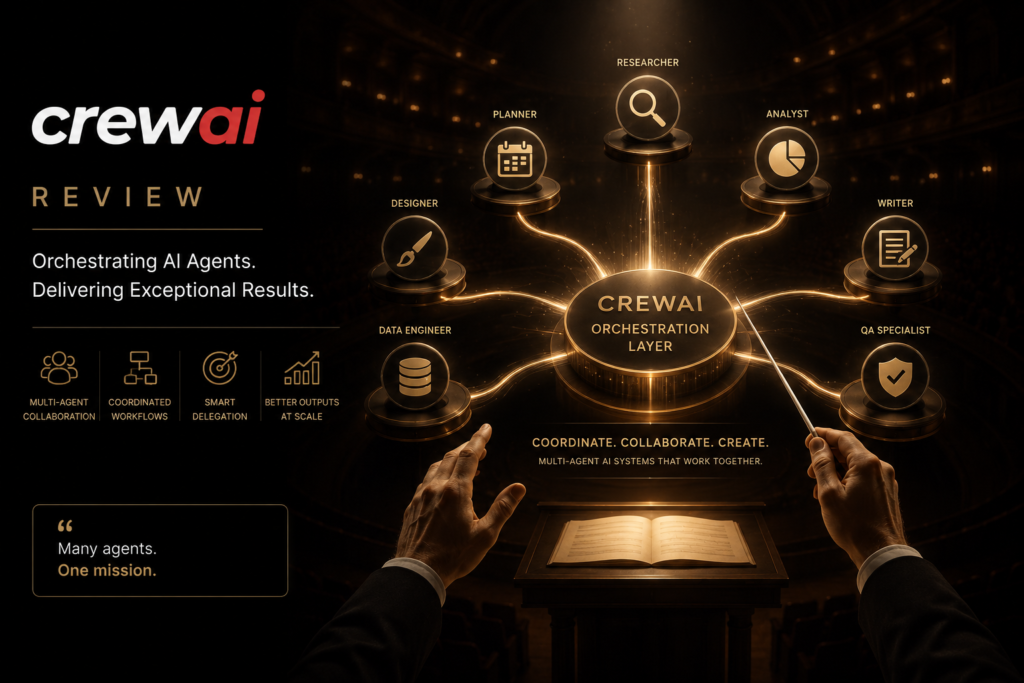
Review type: Research-Based Assessment
Last verified: 20 October 2026
Target audience: AI developers, automation consultants, SaaS startups, technical small businesses, digital agencies, and technology teams
Primary business problem: Coordinating multiple AI agents to complete complex, multi-step knowledge-work processes
Disclosure: This review is based on product documentation, pricing information, and research supplied for this assessment. Intelligent AI Lab has not independently tested CrewAI or benchmarked its performance. Features, pricing, integrations, and policies may change; verify current details with the provider before making a purchasing decision.
Quick Verdict: CrewAI
| Review detail | Assessment |
|---|---|
| Provider | CrewAI |
| Official website | https://crewai.com |
| Product category | Open-source multi-agent AI orchestration framework and platform |
| Primary purpose | Build, orchestrate, and deploy collaborative AI-agent systems |
| Best-fit audience | Developers, technical startups, agencies, and businesses with engineering resources |
| Not ideal for | Non-technical teams needing simple no-code automation |
| Main advantage | Build, orchestrate, and deploy multi-agent AI systems using Crews and Flows |
| Main trade-off | Requires technical implementation, testing, and ongoing operational ownership |
| Starting price | Basic platform plan: Free |
| Free-plan limit | 50 workflow executions per month, according to the supplied research |
| Enterprise pricing | Custom |
| Business-fit verdict | Good Fit for technical teams; Poor Fit for businesses seeking simple, no-code automation |
| Assessment type | Research-Based Assessment |
| Research-based rating | 3.95/5 |
| Last verified | 20 October 2026 |
Our verdict
CrewAI is worth considering if your business needs to build custom AI systems in which several specialized agents collaborate on research, analysis, content production, sales prospecting, or internal operations. Its documented capabilities include role-based agents, Crews, event-driven Flows, memory, tools, guardrails, observability, and human-in-the-loop controls.
The Basic platform plan is free and includes 50 workflow executions per month. Enterprise pricing is custom, while the open-source framework can be used without a CrewAI platform subscription. However, self-managed deployments can still incur hosting, infrastructure, model-provider, development, and maintenance costs.
Our recommendation: Pilot CrewAI if you have Python or engineering resources. Start with one bounded workflow and measure reliability, output accuracy, human-correction effort, and total cost before expanding. If you need straightforward automation without coding, consider a more accessible alternative.
Key takeaways
- Best reason to consider CrewAI: It supports developer-led multi-agent workflows with tools, memory, state management, and operational controls.
- Main limitation: It is primarily a developer-oriented framework, not a general-purpose no-code automation platform.
- Potential business applications: Research, content production, sales prospecting, support triage, and internal knowledge work.
- Pricing consideration: Basic is free with 50 workflow executions per month; Enterprise uses custom pricing.
- Alternatives to evaluate: LangGraph for controlled stateful orchestration, Dify for low-code AI applications, and n8n for workflow automation.
- Recommended next step: Test one use case against a measured baseline before committing to a production deployment.
1. Introduction
Artificial Intelligence is rapidly evolving from single AI assistants to AI agents that can work together as a team. Instead of relying on one AI model to complete every task, businesses can now build multiple specialized AI agents that collaborate to solve complex problems and automate entire business processes.
CrewAI is an open-source framework for building collaborative AI-agent systems. Instead of relying on a single AI assistant for every step, a developer can configure specialized agents—such as a researcher, analyst, writer, or reviewer—and coordinate their work through Crews and Flows.
This approach may be useful when a business process involves several distinct tasks: gathering information, analyzing sources, preparing structured outputs, checking results, and passing approved information to another system. CrewAI provides documented capabilities for agent orchestration, tools, memory, knowledge, guardrails, workflow state, and observability.
However, multi-agent architecture does not automatically produce better or more reliable results. Additional agents can also introduce more model calls, complexity, failure points, and operating costs. The value depends on whether the workflow benefits from multiple specialized steps and whether the resulting system performs reliably enough for the business.
This review examines CrewAI’s features, pricing, business use cases, technical requirements, limitations, alternatives, and suitability for small businesses. It is a research-based assessment, not a hands-on product test.
2. What Is CrewAI?
| Attribute | Finding |
|---|---|
| Provider | CrewAI |
| Product category | Open-source multi-agent AI orchestration framework and platform |
| Core capabilities | Agents, Crews, Flows, tools, memory, knowledge, guardrails, observability, and human-in-the-loop |
| Intended users | AI developers, technical startups, consultants, agencies, and technology teams |
| Availability | Open-source framework and managed platform |
| Deployment options | Self-managed framework; CrewAI Cloud, customer VPC, or customer infrastructure for Enterprise, according to the supplied research |
| Main business problem | Coordinating multiple AI agents to complete complex knowledge work |
| Technical requirement | Python and engineering capability for custom framework implementations |
CrewAI is best understood as an agent-orchestration framework and platform. It gives developers building blocks for coordinating AI agents and connecting their work to tools and systems.
It is not the same as a ready-made business application. A business generally needs to define the problem, design the workflow, configure the agents and tools, test the outputs, and establish appropriate monitoring and approval processes.
How CrewAI works
- Input: A workflow receives a request, event, or other input.
- Processing: One or more agents perform assigned tasks using their configured goals, tools, knowledge, and memory.
- Orchestration: A Crew coordinates collaborative tasks, while a Flow can manage workflow steps, state, routing, and execution.
- Review and monitoring: Developers can use available guardrails, traces, metrics, and human-in-the-loop steps to inspect and control the process.
- Output or action: The workflow produces a report, draft, recommendation, structured result, or configured downstream action.
The precise behavior depends on how the developer configures the agents, models, tools, permissions, and workflow.
Crews versus Flows
| Capability | Crews | Flows |
|---|---|---|
| Primary role | Coordinate specialized agents working toward a shared objective | Orchestrate workflow steps and events |
| Typical use | Collaborative research, analysis, and task execution | Stateful processes, routing, and multi-step execution |
| Business value | May help divide complex work into specialized responsibilities | May help control when and how workflow steps run |
| Main consideration | Agent coordination and output quality must be tested | Workflow design, failure handling, and state management require technical planning |
Research-based interpretation: Crews and Flows address different parts of agentic automation. A business should select the simplest architecture that meets its requirements rather than introduce multiple agents merely because the framework supports them.
3. Research Methodology and Evidence Standards
How this review was prepared
This review uses the CrewAI research summary dated 20 October 2026, including its reported findings from official product documentation, platform pricing information, and feature documentation.
The assessment considers:
- Documented features and technical capabilities.
- Pricing structure and stated usage limits.
- Framework architecture and deployment options.
- Business workflow fit and technical requirements.
- Governance, monitoring, and human-oversight capabilities.
- Alternative products and decision criteria.
- Material gaps in independently verified performance evidence.
This is a research-based assessment. We have not independently run CrewAI workflows, tested its integrations, measured output quality, or verified business outcomes.
Evidence hierarchy
| Priority | Source type | Appropriate use |
|---|---|---|
| 1 | Official product documentation | Documented capabilities, architecture, configuration, and technical requirements |
| 2 | Official pricing page | Plans, limits, prices, and plan-specific features |
| 3 | Official security, privacy, or trust documentation | Data handling, security controls, and compliance information |
| 4 | Official changelog and release notes | Product changes, additions, and deprecations |
| 5 | Reputable independent reporting and benchmarks | Independent evaluations and comparative evidence |
| 6 | User reviews and community discussions | Directional evidence about reported experiences, not proof of performance |
Evidence classification
| Label | Meaning |
|---|---|
| Verified from identified sources | Reported as confirmed against an identified source in the supplied research |
| Research-Based Analysis | Our interpretation of documented capabilities and likely suitability |
| Not Independently Verified | The claim could not be sufficiently confirmed through the available research |
| Illustrative Scenario | A proposed example, not an implemented or tested workflow |
What we could not verify
| Evidence area | Finding |
|---|---|
| Real-world reliability | No independent benchmark of multi-agent reliability, output accuracy, or task-completion rate was supplied. |
| Hallucination and failure rates | No independently measured hallucination rate, workflow-failure rate, or retry rate was supplied. |
| Practical usability | The research describes a visual editor and AI copilot, but does not establish the learning time or usability of the platform. |
| Support quality | The quality of support for Free and Enterprise users was not independently evaluated. |
| Specific LLM providers | The supplied research reports general LLM flexibility but does not independently confirm every named provider, including OpenAI, Anthropic, Google Gemini, and Ollama, from the primary sources reviewed. |
| Integration reliability | The research describes a documented tool library and a broader open-source ecosystem, but does not independently establish the reliability of specific business-app connectors. |
| Business outcomes | Improvements in content production, lead quality, support workload, or productivity have not been independently demonstrated. |
| Enterprise costs | Contract minimums, total deployment costs, and detailed overage pricing require direct vendor confirmation. |
| Detailed data practices | Data retention, subprocessors, model-provider data use, and specific contractual protections require review of current policies and agreements. |
| Independent security certifications | The supplied research describes Enterprise governance features but does not establish independent certification status. |
Sources consulted
The following official source entry points are relevant to the capabilities and pricing described in the supplied research. Specific feature availability, plan conditions, and current page content should be checked before publication or purchase. The research supplied for this review did not include a complete list of exact page URLs for every finding.
| Source | Information Used |
|---|---|
| CrewAI Documentation | Agents, crews, flows, memory, knowledge, guardrails, and observability |
| CrewAI Agents documentation | Agent roles, goals, tools, memory, delegation, and collaboration |
| CrewAI Memory documentation | Unified memory system and memory types |
| CrewAI Flows documentation | Event-driven workflows, state management, and Crews |
| CrewAI open-source page | Tools, memory, checkpointing, async execution, and LLM configuration |
| CrewAI Platform FAQs | Short-term, long-term, entity, and contextual memory |
| CrewAI Platform Tools & Integrations | Third-party app and internal-tool connections |
| CrewAI Pricing | Basic Free plan, Enterprise custom plan, executions, governance, and deployment |
4. Key Features of CrewAI
| Feature | What it does | Potential business value | Limitations to consider |
|---|---|---|---|
| AI agents | Configures agents with roles, goals, tools, and responsibilities | May help automate specialized knowledge work | Agent behavior and output quality require testing |
| Crews | Coordinates multiple agents on collaborative tasks | May support research and other complex workflows | More agents can increase complexity and model costs |
| Flows | Provides event-driven workflow orchestration and state management | May help structure repeatable, multi-step processes | Requires implementation and failure-handling design |
| Memory | Provides a unified memory system, with short-term, long-term, entity, and contextual capabilities described in the supplied research | May help maintain context across tasks | Memory quality, retention, and access require governance |
| Tools | Connects agents to search, websites, databases, code execution, and APIs through available tools | May allow agents to interact with external systems | Tool availability and reliability depend on configuration |
| Knowledge | Provides ways to supply agents with relevant knowledge | May help ground outputs in business information | Poor or outdated source material can undermine results |
| Guardrails | Provides controls for agent workflows | May help enforce validation and execution rules | Guardrails do not eliminate errors or the need for oversight |
| Human-in-the-loop | Supports human input or review steps | May keep people involved in consequential decisions | Approval points must be deliberately designed |
| Observability | Includes documented tracing, metrics, token counting, and related monitoring capabilities | May help diagnose failures and understand usage | Monitoring does not itself prove accuracy or reliability |
| Checkpointing and persistence | Supports workflow continuity features described in the research | May help manage long-running workflows | Recovery behavior should be tested against actual failure scenarios |
| LLM configuration | Allows developers to configure an agent’s LLM | Offers flexibility in model selection | Verify individual providers, compatibility, costs, and limits |
| Enterprise governance | Adds features such as SSO, RBAC, workload identity, PII redaction, and policies, according to the supplied research | May support organizational access and governance needs | Contract terms, implementation details, and compliance status need verification |
The features that matter most to businesses
1. Multi-agent collaboration
CrewAI’s central proposition is that specialized agents can work together rather than forcing one agent to handle every task. This may be useful when the work genuinely benefits from distinct responsibilities, such as research, analysis, drafting, and review.
2. Stateful workflow orchestration
Flows provide a way to structure event-driven processes and manage state. This is relevant when a workflow needs defined steps, routing, persistence, or resumable execution rather than a simple sequence of prompts.
3. Tools and business knowledge
Tools and knowledge capabilities may let agents retrieve information and interact with systems. The business must still validate data sources, API permissions, tool behavior, and the accuracy of resulting actions.
4. Monitoring and human oversight
Tracing, metrics, guardrails, and human-in-the-loop capabilities are important building blocks for operational control. They should be paired with clear ownership, escalation rules, and testing.
5. Deployment flexibility
The supplied research describes the open-source framework and Enterprise deployment options that include CrewAI Cloud, a customer VPC, or customer infrastructure. Confirm which options, support arrangements, and controls are available for your specific contract.
5. How Businesses Can Use CrewAI
The following are potential applications, not independently demonstrated CrewAI customer outcomes.
| Business function | Example problem | How CrewAI may help | Human oversight or requirement |
|---|---|---|---|
| Content marketing | Research, drafting, editing, and publishing preparation require several steps | Coordinate research, writing, editing, and quality-checking agents | Editor verifies facts, tone, claims, and publication readiness |
| Sales prospecting | Researching leads and preparing outreach takes time | Research companies, apply qualification criteria, and draft outreach | Salesperson validates facts, qualification, and messaging |
| Customer support | Tickets require categorization, knowledge retrieval, and responses | Classify requests, retrieve relevant information, and draft replies | Human approval for refunds, sensitive cases, and exceptions |
| Business research | Market and competitor research is fragmented | Gather information, compare findings, and produce a structured report | Validate sources, assumptions, and conclusions |
| Internal operations | SOPs, meeting notes, and documentation are repetitive | Summarize information and draft internal documentation | Process owner approves policy-sensitive material |
| Product development | Software products need custom AI-agent functionality | Build agentic workflows using tools, APIs, and orchestration | Engineering team tests security, quality, reliability, and cost |
Best-fit business use case: Content-production workflow
Business problem: A small agency needs to coordinate topic research, SEO analysis, drafting, editing, and publishing preparation.
Relevant CrewAI capabilities: Agents, Crews, Flows, tools, knowledge, and human-in-the-loop steps.
Inputs and systems required:
- A clear content brief and target audience.
- Approved reference sources.
- Editorial standards and brand guidelines.
- SEO requirements and relevant data sources.
- An editorial review process.
- CMS or API access if publishing preparation is automated.
Proposed workflow: Research the topic, organize findings, draft the article, check factual claims and editorial requirements, then prepare the reviewed draft and metadata.
Risks: Hallucinated claims, outdated sources, inconsistent tone, SEO inaccuracies, unintended publishing actions, and variable model costs.
Pilot metrics:
- Time from brief to publish-ready draft.
- Factual-error rate.
- Editorial-correction rate.
- Cost per completed draft.
- Percentage of drafts accepted after review.
- Workflow failure and retry rate.
The goal is not simply to produce more AI-generated content. It is to determine whether the workflow produces acceptable work at a sustainable cost and with appropriate human review.
6. Intelligent AI Lab Business Decision Analysis
The business problem CrewAI is best suited to address
CrewAI is most relevant when a recurring business process involves complex knowledge work that benefits from multiple specialized AI agents, such as research, analysis, content production, lead qualification, support triage, or internal documentation.
It is a stronger candidate for a technical startup, agency, or business with engineering resources that wants to build a custom agent system. It is a weaker fit when the requirement is straightforward task automation and the team has no interest in maintaining a Python-based solution.
The key business question is not whether a team can build agents. It is whether the resulting workflow can produce reliable outputs, meet the required service level, and justify its total cost.
Is CrewAI the right tool for the job?
| Decision factor | Assessment |
|---|---|
| Primary use case | Custom multi-agent AI systems for complex knowledge work |
| Capability fit | Strong potential fit for developer-led systems; weaker fit for no-code automation |
| Main advantage | Agents, Crews, Flows, tools, memory, guardrails, and observability |
| Main trade-off | Engineering effort, infrastructure ownership, and ongoing maintenance |
| Cost considerations | Platform, model-provider, hosting, engineering, monitoring, and human-review costs |
| Implementation requirements | Agent design, tool integration, testing, permissions, monitoring, and governance |
| Key uncertainty | Whether the workflow meets required accuracy, reliability, and cost targets in practice |
When to choose CrewAI
Consider CrewAI if:
- Your team has Python or engineering capability.
- Multiple specialized agents provide a meaningful advantage over a simpler workflow.
- You need custom tools, APIs, databases, or internal knowledge.
- You need stateful, event-driven, or long-running processes.
- You can establish monitoring, testing, access controls, and human approval.
- You are prepared to maintain the workflow after launch.
When to choose an alternative
| Requirement | Alternative to evaluate | Why |
|---|---|---|
| Highly controlled, stateful agent orchestration | LangGraph | A candidate when explicit graph-based workflow control is central |
| Multi-agent conversations and collaboration | AutoGen | A candidate for conversation-driven multi-agent designs |
| Low-code AI applications and RAG assistants | Dify | A candidate when visual application building is a priority |
| Customer-facing chatbots | Botpress | A candidate when conversational experiences and channels are central |
| Business-user-oriented agents | Relevance AI | A candidate when the users are business teams rather than framework developers |
| Self-hosted workflow automation | n8n | A candidate when integrations and workflow automation are the primary requirement |
| Straightforward no-code business automation | Zapier or Make | A candidate when conventional triggers and actions are sufficient |
These are decision-oriented comparisons, not claims that the alternatives are universally better. Confirm current features, pricing, and deployment options before selecting a product.
When not to use AI
AI may not be necessary if a process is simple, infrequent, deterministic, or already handled reliably by a standard integration or business rule.
Do not make an AI agent the sole decision-maker for consequential actions such as refunds, financial commitments, legal claims, sensitive employee decisions, or regulated communications. Use explicit authorization, human review, and tested fallback procedures.
Our recommended next step: Run a controlled pilot
Choose one bounded workflow and compare it with the existing process over two to four weeks, if that duration is sufficient to gather representative evidence.
Track:
- Task-completion rate.
- Output-accuracy and hallucination rate.
- Human-correction rate.
- Time to reviewed output.
- Model and infrastructure cost.
- Workflow failure and retry rate.
- Maintenance time and incident frequency.
Set acceptance criteria before starting. Continue only if the workflow meets its quality, cost, and governance requirements.
Evidence note: This is a research-based recommendation. Productivity improvements, better content quality, or cost reductions have not been independently demonstrated for CrewAI in the research supplied.
7. Illustrative Business Automation Examples
The following scenarios are illustrative. Intelligent AI Lab has not implemented or tested these workflows.
Example 1: Content-marketing Crew
Business scenario: A small content team wants to coordinate research, drafting, SEO review, and publishing preparation.
Potential components: CrewAI, an approved web-search tool, an LLM provider, relevant SEO data, a CMS/API, and an editorial review process.
Proposed workflow
- Trigger: A content brief is submitted.
- Input: Topic, audience, approved sources, SEO requirements, and brand guidelines.
- AI processing: Research, writing, and review agents prepare a draft and supporting recommendations.
- Human oversight: An editor checks facts, sources, tone, and SEO claims.
- Integration: The system prepares a reviewed draft and publishing metadata.
- Output: A draft ready for the editor’s final decision.
Potential benefits: Less manual coordination and more consistent preparation, if validated in a pilot.
Requirements and limitations: Source quality, factual review, model costs, and publishing permissions must be managed. Do not allow automatic publication until the workflow has passed appropriate testing.
Suggested success metrics: Time to publish-ready draft, factual-error rate, correction rate, cost per article, and acceptance rate.
Evidence label: Illustrative Scenario.
Example 2: Sales-prospecting Crew
Business scenario: A B2B sales team wants to research potential customers and prepare personalized outreach.
Potential components: CrewAI, a CRM, approved research sources, an LLM provider, and a sales-review process.
Proposed workflow
- Trigger: A new lead enters the CRM.
- Input: Company details, domain, existing CRM fields, and qualification criteria.
- AI processing: Research and qualification agents assemble evidence and prepare a recommendation.
- Human oversight: A salesperson validates the company information, fit, and outreach draft.
- Integration: The system prepares a CRM update and follow-up task.
- Output: A reviewed lead assessment and outreach draft.
Potential benefits: More structured research and less manual preparation, if validated.
Requirements and limitations: Research sources must be reliable, personal data must be handled appropriately, and unverified claims must not be sent automatically to prospects.
Suggested success metrics: Research time per lead, CRM completeness, qualification accuracy, cost per lead assessment, and sales-team adoption.
Evidence label: Illustrative Scenario.
Example 3: Customer-support triage
Business scenario: A support team receives requests that need categorization, knowledge retrieval, and escalation.
Potential components: CrewAI, a support-ticket system, an approved knowledge base, an LLM provider, and escalation rules.
Proposed workflow
- Receive a support ticket.
- Classify the issue and retrieve relevant approved knowledge.
- Prepare a response draft and confidence or escalation indicators.
- Route ambiguous, sensitive, or high-impact cases to a human.
- Let an authorized support agent approve or edit the response.
- Record the result for quality monitoring.
Potential benefits: More structured ticket handling and reduced repetitive preparation, subject to testing.
Requirements and limitations: The workflow needs access controls, current knowledge, escalation rules, and a reliable fallback when information is missing. Refunds, account changes, and other consequential actions should require explicit authorization.
Suggested success metrics: Classification accuracy, escalation rate, response-preparation time, human-correction rate, and ticket-resolution quality.
Evidence label: Illustrative Scenario.
8. Pros and Cons of CrewAI
| Pros | Cons |
|---|---|
| Supports collaborative agent workflows through Crews and Flows | Custom framework implementations require Python and developer capability |
| Provides tools, memory, knowledge, and guardrails | Agent design and tool configuration require testing and maintenance |
| Supports event-driven and stateful workflows | Complex workflows can be harder to debug and operate |
| Includes documented observability and human-in-the-loop capabilities | Monitoring does not guarantee accuracy or reliable task completion |
| Offers a Free Basic platform plan with 50 workflow executions per month, according to the supplied research | The execution allowance may not meet the needs of a production workload |
| Open-source framework offers self-managed flexibility | Hosting, model usage, engineering, and maintenance can add material costs |
| Enterprise offers additional governance and deployment options according to the research | Enterprise pricing and detailed contract terms require direct confirmation |
What these pros and cons mean for buyers
For a technical team, CrewAI may offer useful flexibility for building custom multi-agent automation. Its value depends on the complexity of the business problem, the quality of the implementation, and whether the system can meet reliability and cost targets.
For a non-technical small business, the implementation burden may outweigh the benefit. A managed automation platform or low-code AI application builder may be a more practical starting point.
The most important evaluation is not how many agents a system can run. It is whether the system completes the required task correctly, consistently, and economically.
9. CrewAI Pricing and Plans
Pricing verification date in the supplied research: 20 October 2026.
The research describes two current managed-platform plans: Basic (Free) and Enterprise (Custom). It also distinguishes the open-source framework, which can be used without a CrewAI platform subscription.
Check the provider’s current pricing page before publication or purchase: https://crewai.com/pricing
| Plan or option | Price | Key details reported in the research | Best suited for |
|---|---|---|---|
| Basic | Free | Visual editor, AI copilot, GitHub integration, two automations, and 50 workflow executions per month | Initial exploration and limited workflows |
| Enterprise | Custom | Enterprise connectors, custom automations and execution sizing, flexible overages, SSO, RBAC, workload identity, PII redaction, policies, deployment options, and enterprise support | Organizations requiring additional governance and deployment flexibility |
| Open-source framework | No CrewAI platform subscription required | Self-managed use; infrastructure, hosting, model-provider usage, and engineering costs may apply | Developers building and operating their own systems |
Important: The open-source framework and the managed platform are different options. Free framework usage should not be interpreted as a guarantee that a complete production system will have no costs.
What to know before paying
Basic plan: The supplied research reports 50 workflow executions per month and two automations. Confirm how an execution is counted, which features are included, and what happens when the limit is reached.
Enterprise plan: Pricing is custom. Ask the provider for the relevant contract terms, included execution allowance, overage pricing, support commitments, and deployment costs.
Open-source framework: Model-provider fees, hosting, infrastructure, engineering, monitoring, and maintenance can contribute to total cost.
Governance: The research reports SSO, RBAC, workload identity, PII redaction, and policies as Enterprise capabilities. Confirm the exact implementation and availability of each feature.
Human-in-the-loop and observability: The supplied research reports these capabilities on both Free and Enterprise. Confirm the current plan details and practical limits.
Is CrewAI worth the price?
CrewAI may be worth evaluating when custom multi-agent automation solves a meaningful business problem and the organization can manage development and operations.
The true cost is broader than the subscription. Consider:
- LLM-provider usage and token costs.
- Hosting and infrastructure.
- Engineering and integration effort.
- Testing, monitoring, and maintenance.
- Human review and exception handling.
- Security, governance, and support requirements.
A free plan is useful for exploration, but it does not by itself establish that a production workflow will be economical.
Plan recommendation by buyer type
| Buyer type | Starting option | Reason | What to verify |
|---|---|---|---|
| Developer or technical startup | Basic | A free starting point for evaluating workflows | Execution limits, model costs, and reliability |
| Business with engineering resources | Open-source framework or Basic | Choose based on the need for self-management versus managed tooling | Hosting, security, maintenance, and plan differences |
| Enterprise or security-sensitive organization | Enterprise evaluation | The research describes additional governance and deployment features | Contract pricing, data handling, deployment, support, and compliance requirements |
| Non-technical small business | Evaluate Dify, Zapier, Make, or another managed option | May reduce the need for custom framework development | Workflow complexity, integrations, and total cost |
10. Integrations and Technical Requirements
| Integration or requirement | Research finding | What buyers should check |
|---|---|---|
| CRM and sales systems | Connections may be built through tools, APIs, or custom integrations | Verify the specific CRM, supported operations, permissions, and reliability |
| Email and collaboration | Connections depend on available tools and integrations | Confirm the exact service, supported actions, authentication, and limitations |
| Automation platforms | CrewAI provides agent orchestration and can interact with external systems through tools and code | Determine whether CrewAI is needed or a conventional automation tool is sufficient |
| APIs and webhooks | The framework supports tools and custom integrations, according to the supplied research | Verify authentication, rate limits, error handling, and plan restrictions |
| Business data and knowledge | The research describes knowledge capabilities and connections to vector databases | Confirm supported data sources, retrieval quality, and access permissions |
| Security and administration | Enterprise is reported to include SSO, RBAC, workload identity, PII redaction, and policies | Validate actual controls, configuration, and contractual coverage |
| Development and deployment | Custom framework use requires technical implementation | Confirm developer capacity, hosting, observability, and maintenance ownership |
Native, third-party, and custom capabilities
- Framework capabilities: Agents, Crews, Flows, memory, knowledge, guardrails, and observability are described as CrewAI capabilities in the supplied research.
- Plan-dependent capabilities: Enterprise connectors, SSO, RBAC, PII redaction, and certain deployment options are reported as Enterprise features.
- Third-party tools: The research reports 40+ tools in the documented tool library and a broader ecosystem of hundreds of open-source tools. This does not establish that every connector is maintained, supported, or reliable for a particular business.
- Custom integrations: Internal applications, databases, and APIs may be connected through tools and code, subject to implementation effort and technical compatibility.
Implementation considerations
Start with one bounded Crew or Flow. Do not begin by building a large network of agents unless the business case requires it.
Before connecting business systems, define:
- Which data each agent may access.
- Which tools it may call.
- Which actions require human approval.
- What happens when information is missing or conflicting.
- How errors, retries, and unexpected outputs are handled.
- Who monitors the system and owns ongoing maintenance.
Specific integrations, provider compatibility, and plan restrictions should be verified against current documentation before implementation.
11. CrewAI vs. Alternatives
The best alternative depends on the problem you are solving. These products have overlapping capabilities, but they are not interchangeable in every workflow.
| Tool | Best suited for | Main distinction | Consider it when |
|---|---|---|---|
| CrewAI | Developer-led multi-agent systems | Python-oriented framework with Crews, Flows, tools, and memory | You need custom agent collaboration and have engineering resources |
| LangGraph | Stateful AI-agent orchestration | Graph-based workflow control | You need explicit control over state, transitions, and execution paths |
| AutoGen | Multi-agent conversations | Conversation-driven collaboration approach | Your use case centers on agents exchanging information and collaborating |
| Dify | Low-code AI applications and RAG assistants | Visual application-building approach | You want to build AI applications with less custom framework development |
| Botpress | Customer-facing chatbots | Conversational-AI and channel focus | Your main requirement is customer interaction and chatbot deployment |
| Relevance AI | Business-user-oriented AI agents | Business-oriented agent and workforce platform | Business users need to configure agent workflows with less framework-level development |
| n8n | Workflow automation and integrations | Node-based automation with self-hosting options and AI capabilities | You need to connect systems and automate business processes |
| Zapier or Make | Conventional business automation | Managed trigger-and-action workflows | Your process is straightforward and does not require custom multi-agent orchestration |
Pricing note: This table is not a current competitor-price comparison. Verify each vendor’s current plans, usage limits, and deployment terms before making a cost-based decision.
Which tool should you choose?
- Choose CrewAI if you have Python or engineering resources and need custom multi-agent workflows.
- Choose LangGraph if explicit stateful orchestration and workflow control are central requirements.
- Choose AutoGen if conversation-driven multi-agent collaboration is the main design.
- Choose Dify if low-code AI application development is the priority.
- Choose Botpress if your primary use case is customer-facing conversational automation.
- Choose Relevance AI if you want a more business-user-oriented agent platform.
- Choose n8n if connecting systems and managing automated workflows is the main requirement.
- Choose Zapier or Make if conventional automation can solve the problem without custom agent architecture.
Before choosing, compare the actual workflow you need to build—not just feature lists. A simpler product may be the better business decision if it achieves the required result with less operational overhead.
12. Who Should Use CrewAI?
Recommended for
AI developers: Teams building custom multi-agent systems and integrating them into applications.
Automation consultants: Consultants designing tailored AI workflows for clients with suitable technical resources.
SaaS startups: Product teams exploring agentic functionality in their software.
Technical small businesses: Businesses that have engineering support and a clear need for custom AI automation.
Digital agencies: Agencies evaluating agent-based research, content, and operational workflows.
Technology teams: Teams developing internal AI infrastructure and controlled workflow automation.
Not ideal for
Non-technical small businesses: A Python-based framework can require skills and maintenance capacity the business does not have.
Teams seeking simple no-code automation: A conventional automation platform may be easier to configure and operate.
Businesses with only basic automation needs: A native integration, simple script, or standard workflow may be sufficient.
Organizations without governance ownership: Multi-agent systems need clear permissions, monitoring, testing, and escalation procedures.
Best-fit buyer profile
The best-fit buyer is a technical startup, agency, or business with engineering resources and a clearly defined need for custom multi-agent workflows.
The organization should be able to assign responsibility for:
- Agent and workflow design.
- Data access and credentials.
- Quality and reliability testing.
- Monitoring and incident handling.
- Model and infrastructure costs.
- Human review and governance.
- Maintenance and future changes.
If those responsibilities cannot be covered, begin with a simpler managed product or a narrowly scoped proof of concept.
13. How to Get Started With CrewAI
Step 1: Identify one business problem
Select a recurring task with a clear business owner and measurable baseline. Suitable candidates may include research, content preparation, lead qualification, or support triage.
Avoid starting with a broad goal such as “automate the entire marketing department.”
Step 2: Confirm product fit
Review the current CrewAI documentation and determine whether agents, Crews, Flows, tools, memory, and deployment options fit the requirements.
Check whether a single agent or conventional automation workflow would solve the problem more simply.
Step 3: Review data and permissions
Identify the information the system will access, including customer, employee, and confidential business data. Review the applicable CrewAI, hosting, and model-provider terms before connecting sensitive systems.
Step 4: Design a limited pilot
Specify the input, expected output, agent responsibilities, tools, approval points, exception handling, and fallback process.
Keep consequential actions under appropriate human control.
Step 5: Establish a baseline
Measure the existing process before introducing the system. Record time per task, error rate, quality, volume, and relevant costs.
Step 6: Evaluate the pilot
Compare the pilot with the baseline using the same criteria. Include model usage, hosting, engineering, monitoring, retries, and human-review time.
Step 7: Decide whether to expand
Continue, revise, or stop based on evidence. Scale only when the workflow meets the agreed quality, reliability, cost, and governance requirements.
14. Limitations, Risks, and Governance
AI-agent systems can interact with tools, retrieve information, and produce multi-step outputs. These capabilities also introduce risks that must be managed before production use.
| Risk area | What businesses should investigate | Research-based finding |
|---|---|---|
| Accuracy and reliability | Can the system produce incorrect outputs or take an incorrect action? | CrewAI is reported to provide guardrails, observability, and human-in-the-loop capabilities. These do not guarantee correct results. |
| Privacy and retention | What data is collected, stored, retained, or shared? | Practices depend on deployment choices and connected providers. Current policies and contractual terms require review. |
| Model training and data use | Are inputs used for model training, and what controls or terms apply? | Review the relevant model-provider terms separately; the supplied research does not establish every provider’s data-use policy. |
| Security | What access controls and security protections are available? | The research reports Enterprise SSO, RBAC, workload identity, PII redaction, and policies. Independent certification status was not verified. |
| Compliance | Does the deployment meet applicable legal and contractual requirements? | Governance features are not a substitute for a specific compliance assessment. |
| Permissions | Which agents can access data or perform actions? | Define least-privilege access, credential management, and approval boundaries. |
| Usage limits | What happens when execution quotas or model-provider limits are reached? | Basic is reported to include 50 workflow executions per month; confirm the current terms and Enterprise overage arrangements. |
| Human oversight | Which outputs and actions require approval? | Customer-facing, financial, legal, and other consequential actions need appropriate controls. |
| Vendor dependency | Can the system be moved or rebuilt elsewhere? | Open-source use may offer flexibility, but migration of configurations, integrations, and workflows still requires planning. |
| Support and continuity | What support, service commitments, and recovery options are available? | The supplied research reports dedicated support for Enterprise, but support quality and contractual terms were not independently assessed. |
What businesses should check before adoption
Confirm current pricing and limits. Verify plan availability, execution definitions, overage terms, taxes, and regional conditions.
Estimate total cost. Include model usage, hosting, engineering, maintenance, monitoring, and human review—not just platform fees.
Review data handling. Confirm the applicable privacy policy, data-retention terms, subprocessors, model-provider practices, and contractual protections.
Establish operational ownership. Assign responsibility for credentials, access control, monitoring, errors, retries, and incident response.
Define human approval rules. Specify which outputs may be generated automatically and which actions require an authorized person.
Obtain specialist review when needed. Security-sensitive, regulated, or high-impact workflows may require technical, legal, compliance, or privacy review before deployment.
15. Final Verdict: Is CrewAI Worth It?
CrewAI is worth considering for technical businesses, startups, and agencies that want to build custom multi-agent AI systems for research, content preparation, sales prospecting, support triage, or internal knowledge work.
Its strongest documented proposition is the combination of role-based agents, Crews, Flows, tools, memory, guardrails, and observability. The supplied research also describes a free Basic platform plan with 50 workflow executions per month and an Enterprise plan with custom pricing and additional governance and deployment options.
The main trade-off is implementation complexity. CrewAI is not simply a ready-made automation product: a production workflow may require Python development, integrations, testing, monitoring, infrastructure, and continuing maintenance. Model and hosting costs can also make a seemingly free starting point more expensive than expected.
Final buying recommendation: Pilot—technical teams only. Start with the Basic plan or the open-source framework, depending on your requirements. Select one bounded business workflow, establish a baseline, and measure output accuracy, completion rate, human-correction effort, total cost, and failure frequency.
Do not scale merely because a multi-agent demonstration works. Scale when the workflow performs reliably against predefined acceptance criteria and the business can operate it responsibly.
For non-technical small businesses seeking straightforward automation, a no-code automation platform or low-code AI application builder is likely to be a more practical starting point.
16. Intelligent AI Lab Rating and Scorecard
A. Business-fit verdict
Good Fit for technical businesses, startups, and agencies building custom multi-agent AI systems.
Conditional Fit for small businesses that have access to engineering support but need to validate costs and operational readiness.
Poor Fit for teams seeking simple no-code automation without developer or maintenance resources.
B. Assessment type
Research-Based Assessment. This is not a hands-on product test, independent performance benchmark, or customer survey.
C. Evidence confidence
High for the documented capabilities and pricing structure reported in the supplied research. There is material uncertainty around real-world reliability, output accuracy, integration performance, and measured business outcomes.
The confidence rating applies to the existence of documented capabilities—not to the performance of every workflow a buyer might build.
D. Numerical rating
Research-based rating: 3.95/5
Rating date: 20 October 2026
This rating reflects an analyst assessment of CrewAI’s suitability for the selected use case. It is not a measured performance score.
Research-based weighted scorecard
Scoring disclosure: Scores represent Intelligent AI Lab’s research-based judgment of documented capabilities, business fit, implementation requirements, pricing structure, and governance features. They are not based on hands-on testing, independent benchmarks, customer-survey data, or measured business outcomes.
| Criterion | Weight | Score | Evidence and rationale |
|---|---|---|---|
| Core capability fit | 25% | 5/5 | The supplied research describes agents, Crews, Flows, memory, tools, guardrails, and observability. |
| Business workflow fit | 20% | 4/5 | These capabilities align with complex knowledge-work automation, but business impact has not been independently demonstrated. |
| Implementation feasibility | 15% | 2/5 | Custom use requires Python/developer capability, technical integration, and ongoing operational ownership. |
| Integrations and interoperability | 15% | 4/5 | The research reports a documented tool library and broader open-source ecosystem, but specific connector reliability was not independently verified. |
| Pricing and cost suitability | 15% | 4/5 | The Free Basic plan and open-source framework are advantages, but model, hosting, and engineering costs can be significant. |
| Governance and operational readiness | 10% | 4/5 | The research describes guardrails, human-in-the-loop, observability, and Enterprise controls; independent certification was not verified. |
Weighted score calculation:
(5 × 0.25) + (4 × 0.20) + (2 × 0.15) + (4 × 0.15) + (4 × 0.15) + (4 × 0.10) = 3.95/5
Overall assessment summary
- Business-fit verdict: Good Fit for technical teams; Conditional Fit for small businesses with engineering support; Poor Fit for non-technical teams seeking no-code automation.
- Research-based rating: 3.95/5
- Evidence confidence: High for documented capabilities, framework architecture, and reported pricing structure; Moderate for real-world reliability, output accuracy, integration performance, and business outcomes.
- Assessment type: Research-Based Assessment
- Overall conclusion: CrewAI is a strong candidate for developers, technical startups, automation consultants, and digital agencies that need custom multi-agent AI systems. Its documented capabilities include agents, Crews, Flows, tools, memory, guardrails, observability, and human-in-the-loop controls. The reported Free Basic plan offers a low-cost starting point, while Enterprise provides additional governance and deployment options at custom pricing. However, CrewAI requires technical implementation and ongoing operational ownership, and total costs may include LLM usage, infrastructure, development, and maintenance. The 3.95/5 rating reflects its documented capability and potential fit for technical buyers, not independently demonstrated performance. Real-world reliability, output accuracy, integration quality, and measurable business benefits remain unverified and should be evaluated through a controlled pilot before production adoption.
17. Decision Checklist: Should You Choose CrewAI?
Shortlist CrewAI if:
- You have Python or engineering resources.
- Your workflow genuinely benefits from multiple specialized agents.
- You need stateful, event-driven, or long-running workflows.
- You need custom tools, APIs, databases, or business knowledge.
- You need monitoring, guardrails, and human-in-the-loop controls.
- You can test the workflow and manage it after launch.
- You can measure quality, reliability, and total operating cost.
Consider an alternative if:
- You need simple no-code business automation.
- You want a low-code AI application builder.
- Your use case is primarily a customer-facing chatbot.
- A conventional workflow or single AI assistant is sufficient.
- Your organization cannot maintain custom integrations or monitor agent behavior.
Before committing, confirm:
- The current plan and execution limits meet your requirements.
- Your intended model provider and tools are supported in the required configuration.
- Data access, permissions, retention, and model-provider terms are acceptable.
- The workflow has explicit error handling and escalation rules.
- A human is accountable for consequential decisions.
- You have a baseline and measurable pilot acceptance criteria.
- Total costs include model usage, hosting, engineering, maintenance, and review.
Decision guidance: If accuracy, reliability, operating cost, or data governance is critical, resolve those questions through a controlled pilot before committing to production.
18. Frequently Asked Questions About CrewAI
What is CrewAI used for?
CrewAI is used to build collaborative AI-agent systems in which multiple agents work together on multi-step tasks. Potential applications include research, content preparation, sales prospecting, customer-support triage, analysis, and internal operations. Suitability depends on implementation quality and the workflow requirements.
Is CrewAI free?
The supplied research reports that CrewAI’s open-source framework can be used without a CrewAI platform subscription and that its Basic managed-platform plan is free with 50 workflow executions per month. Hosting, infrastructure, model-provider usage, and engineering may still incur costs.
How much does CrewAI cost?
The supplied research lists Basic as Free and Enterprise as Custom pricing. The open-source framework can be used without a platform subscription, but businesses should budget for infrastructure, LLM usage, development, and maintenance. Confirm current prices and terms on the official website.
Does CrewAI require coding?
Custom use of the CrewAI framework generally requires Python and developer capability. The supplied research also describes a platform visual editor and AI copilot, but that does not establish that all use cases can be built or maintained without technical skills.
Is CrewAI better than ChatGPT?
They serve different purposes. ChatGPT is a general-purpose AI assistant, while CrewAI is a framework and platform for building and orchestrating collaborative AI-agent workflows. The better choice depends on whether you need an assistant for direct interaction or a custom system that coordinates multiple agents and tools.
Can businesses automate workflows using CrewAI?
Yes, CrewAI can be used to build multi-step workflows for activities such as research, content preparation, lead qualification, and support triage. Whether a workflow is reliable and cost-effective must be established through testing.
Is CrewAI suitable for small businesses?
It can suit technically capable small businesses that have engineering resources and a clear use case for custom multi-agent automation. It is less suitable for non-technical teams seeking simple, ready-to-use no-code automation.
Is CrewAI suitable for production systems?
The supplied research describes workflow, observability, guardrail, and governance capabilities intended to support operational use. However, this review does not independently verify production reliability. Test the actual workflow—including failure handling, security, cost, and human oversight—before relying on it in production.