
The Future of Business Automation Isn’t One AI Agent—It’s Teams of AI Agents
For years, businesses have used automation to eliminate repetitive work. More recently, AI assistants like ChatGPT, Claude, and Gemini have made knowledge work dramatically faster.
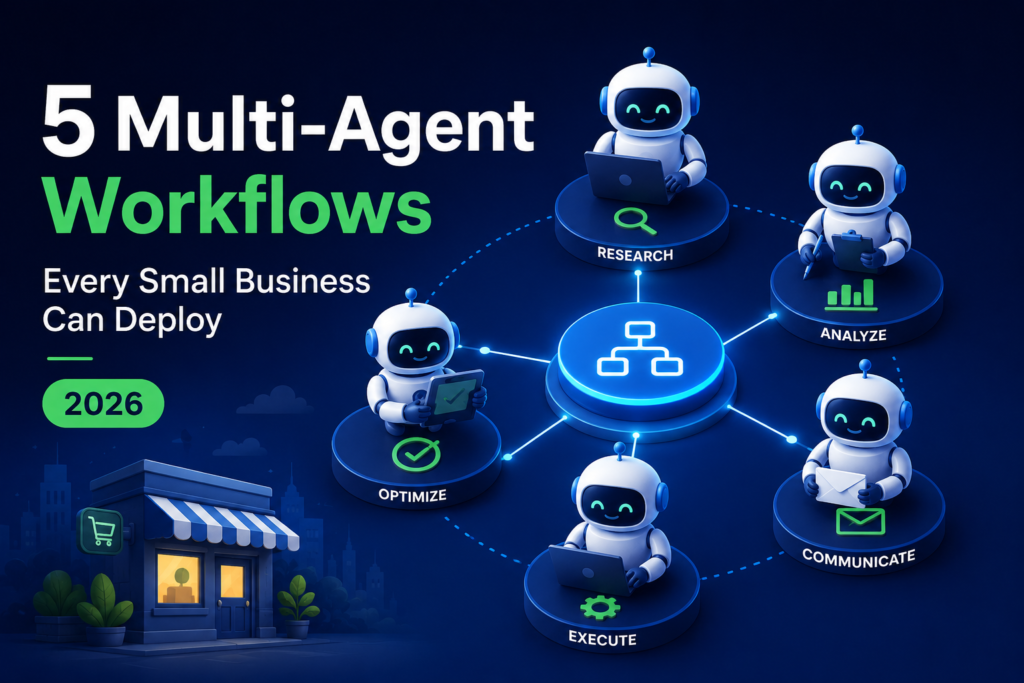
But in 2026, the biggest shift isn’t simply using AI—it’s deploying multiple AI agents that collaborate as a team.
Instead of relying on one AI assistant to perform every task, businesses are creating specialized AI agents, each responsible for a specific role. These agents communicate, exchange information, make decisions, and complete entire business workflows with minimal human intervention.
This concept is known as a Multi-Agent Workflow.
Large enterprises are already adopting multi-agent systems to automate operations, customer support, finance, software development, and marketing. Fortunately, modern no-code platforms like n8n, Zapier, Make, Pabbly Connect, and AI platforms such as OpenAI, Claude, and Google Gemini make these capabilities accessible to small businesses.
In this guide, you’ll discover five practical multi-agent workflows that any small business can deploy in 2026.
What Is a Multi-Agent Workflow?
A multi-agent workflow is an automation where several AI agents collaborate to accomplish a larger business objective.
Rather than assigning every responsibility to one AI model, each agent specializes in a particular function.
For example:
| Agent | Responsibility |
|---|---|
| Research Agent | Collects information |
| Planning Agent | Creates strategy |
| Content Agent | Generates content |
| Review Agent | Validates quality |
| Publishing Agent | Delivers final output |
Each agent focuses on what it does best, producing faster, more reliable, and more accurate results.
Why Multi-Agent Systems Are Better Than Single AI Assistants
| Single AI Assistant | Multi-Agent Workflow |
|---|---|
| Handles every task alone | Multiple specialized agents collaborate |
| Limited context management | Each agent maintains focused expertise |
| Higher chance of errors | Multiple validation stages improve accuracy |
| Difficult to scale | Easily expandable with new agents |
| Manual intervention required | Fully automated end-to-end workflows |
Workflow 1: AI Customer Support Team
Business Problem
Customers expect immediate responses across email, chat, WhatsApp, and websites.
Hiring 24×7 support staff is expensive.
Multi-Agent Solution
Customer Message
        │
        ▼
Intent Classification Agent
        │
        ├─────────────┐
        ▼             ▼
Billing Agent     Technical Agent
        │             │
        └──────┬──────┘
               ▼
Knowledge Base Agent
               │
               ▼
Response Agent
               │
               ▼
Human Escalation Agent (if required)
Agent Responsibilities
Intent Classification Agent
Determines whether the inquiry concerns:
- Billing
- Sales
- Product information
- Technical support
- Returns
- Complaints
Specialist Agent
Routes requests to the appropriate domain expert.
Examples include:
- Billing Agent
- Sales Agent
- Technical Support Agent
Knowledge Base Agent
Searches:
- Product documentation
- FAQs
- Internal documentation
- Policies
Response Agent
Creates:
- Professional responses
- Personalized replies
- Suggested solutions
Escalation Agent
Escalates only complex issues to a human representative.
Benefits
- 24/7 customer support
- Faster response times
- Lower support costs
- Improved customer satisfaction
Workflow 2: AI Marketing Content Factory
Content marketing requires research, planning, writing, editing, SEO optimization, graphics, and publishing.
Instead of performing these manually, deploy an AI content team.
Workflow
Trending Topic Agent
        │
Keyword Research Agent
        │
Content Planner Agent
        │
Writer Agent
        │
SEO Agent
        │
Editor Agent
        │
Image Generation Agent
        │
Publishing Agent
Tools
- ChatGPT
- Claude
- Perplexity
- Canva AI
- WordPress
- n8n
- Zapier
Business Outcome
A small business can produce:
- Blog posts
- Social media posts
- Email newsletters
- LinkedIn articles
- Product descriptions
with minimal manual effort.
Workflow 3: AI Sales Lead Qualification System
Sales teams often waste time on unqualified leads.
A multi-agent workflow automates lead evaluation before human engagement.
Workflow
Lead Capture Agent
        │
CRM Enrichment Agent
        │
Company Research Agent
        │
Lead Scoring Agent
        │
Proposal Agent
        │
Sales Meeting Scheduler
Agent Roles
Lead Capture Agent
Collects inquiries from:
- Website forms
Research Agent
Gathers:
- Company size
- Industry
- Decision-makers
- Revenue estimates
- Technology stack
Lead Scoring Agent
Evaluates prospects using criteria such as:
- Budget
- Business fit
- Purchase intent
- Company size
- Urgency
Proposal Agent
Generates:
- Customized proposals
- Pricing recommendations
- Follow-up emails
Benefits
- Higher-quality leads
- Faster sales cycles
- Better conversion rates
- More efficient sales teams
Workflow 4: AI Finance and Invoice Automation
Finance teams spend countless hours processing invoices and payments.
AI agents can automate the entire workflow.
Workflow
Invoice Reader Agent
        │
Validation Agent
        │
Accounting Agent
        │
Approval Agent
        │
Payment Agent
        │
Reporting Agent
Capabilities
- Read invoices using OCR
- Extract vendor information
- Validate tax details
- Detect duplicate invoices
- Schedule payments
- Update accounting software
- Generate financial reports
Recommended Tools
- QuickBooks
- Zoho Books
- Xero
- n8n
- OpenAI
- Claude
Workflow 5: AI Business Intelligence Team
Small businesses generate valuable data but rarely analyze it effectively.
A multi-agent analytics team transforms raw data into actionable insights.
Workflow
Data Collection Agent
        │
Cleaning Agent
        │
Analytics Agent
        │
Forecast Agent
        │
Visualization Agent
        │
Executive Summary Agent
Responsibilities
Data Collection Agent
Collects data from:
- CRM
- ERP
- Google Analytics
- Shopify
- Stripe
- Excel
- Marketing platforms
Analytics Agent
Calculates:
- Revenue
- Profit margins
- Customer acquisition cost
- Customer lifetime value
- Sales trends
Forecast Agent
Predicts:
- Revenue
- Inventory requirements
- Customer churn
- Seasonal demand
Executive Summary Agent
Creates concise business reports highlighting:
- Key metrics
- Risks
- Opportunities
- Recommended actions
Recommended Tech Stack
| Category | Recommended Tools |
|---|---|
| Workflow Automation | n8n, Make, Zapier, Pabbly Connect |
| AI Models | ChatGPT, Claude, Gemini |
| Research | Perplexity |
| Knowledge Base | Notion AI, Confluence |
| CRM | HubSpot, Zoho CRM |
| Finance | QuickBooks, Zoho Books, Xero |
| Communication | Slack, Microsoft Teams, Gmail |
| Marketing | Canva AI, Buffer, WordPress |
Best Practices for Building Multi-Agent Workflows
- Start with one business process.
- Assign one clear responsibility to each agent.
- Keep prompts focused and consistent.
- Add validation agents to reduce errors.
- Log every workflow step for auditing.
- Include human approval for high-risk decisions.
- Measure performance using business KPIs.
- Continuously refine prompts and workflows based on outcomes.
Common Mistakes to Avoid
| Mistake | Better Approach |
|---|---|
| One agent handles everything | Use specialized agents |
| No quality checks | Add review and validation agents |
| Ignoring security | Protect sensitive business data |
| No monitoring | Track workflow performance |
| Overcomplicated designs | Begin with simple workflows and expand gradually |
Frequently Asked Questions
What is a multi-agent AI workflow?
A multi-agent AI workflow is a system where multiple specialized AI agents collaborate to complete an end-to-end business process, with each agent responsible for a specific task.
Do small businesses need expensive software?
No. Many workflows can be built using affordable or free tools such as n8n, Make, Zapier, and APIs from leading AI providers.
Which departments benefit the most?
The greatest impact is typically seen in:
- Customer Support
- Marketing
- Sales
- Finance
- Human Resources
- Operations
Can humans still review AI decisions?
Yes. Human approval can be added at any stage of the workflow, especially for legal, financial, or customer-facing decisions.
Which AI models work best?
The ideal choice depends on the task. Many businesses combine multiple models, such as OpenAI GPT, Claude, Gemini, and Perplexity, within the same workflow.
Final Thoughts
Multi-agent AI represents the next evolution of business automation. Instead of relying on a single AI assistant, businesses can create collaborative teams of specialized AI agents that research, analyze, decide, validate, and execute complex workflows.
For small businesses, the opportunity is significant. By starting with one well-designed multi-agent workflow—whether for customer support, marketing, sales, finance, or analytics—you can save hours of manual work each week, improve consistency, and scale operations without proportionally increasing headcount.
As AI platforms and automation tools continue to mature throughout 2026, organizations that adopt multi-agent systems early will be better positioned to deliver faster service, make data-driven decisions, and compete more effectively in an increasingly AI-powered marketplace.
Related Articles
- 10 AI Automations Every Small Business Should Implement in 2026
- Best AI Agents for Small Businesses in 2026
- How to Build AI Workflows Using n8n
- AI Tools Every Startup Should Use
Last Updated: July 2026