
WhatsApp AI vs Traditional Chatbots: Which Is Better?
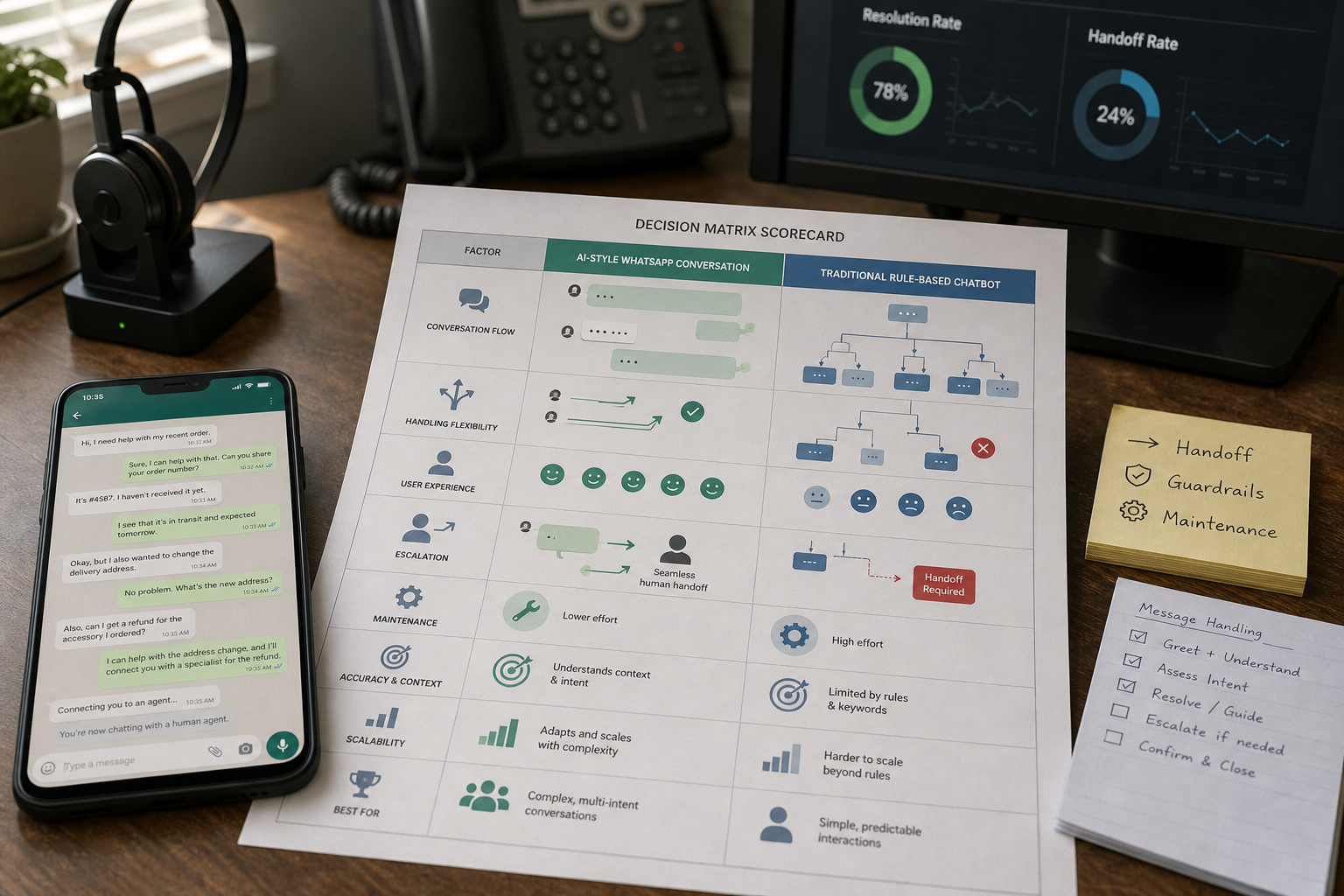
Your WhatsApp inbox isn’t a helpdesk ticket form. Customers ask messy questions, change their mind mid-conversation, send partial details, and expect you to “get it” without forcing them through a menu. That’s why the decision between WhatsApp AI and traditional chatbots matters: the wrong choice can create more handoffs, more frustration, and more manual work—just faster. Choosing between WhatsApp AI vs traditional chatbots depends less on which technology is newer and more on the type of conversations your customers actually have.
Most small businesses don’t need “the most advanced bot.” They need the right automation for the conversations they actually receive: predictable, repeatable flows vs. varied, multi-turn conversations.
Quick Answer (40–60 words): WhatsApp AI is often better when customers ask variable questions, need multi-turn support, or require contextual lead qualification and escalation. Traditional chatbots are better when the workflow is simple, fixed, and highly predictable because they are easier to control and maintain.
What problem are you really trying to solve?
Commercial comparisons often start with features. A better starting point is your operational goal. In most small businesses, WhatsApp automation is adopted for one (or more) of these reasons:
- Reduce repetitive messages that drain staff time (FAQs, hours, pricing basics, “where’s my order?”).
- Improve first response time (especially after-hours or during peak periods).
- Increase conversion from WhatsApp leads that currently go cold.
- Scale support without hiring at the same rate as message volume grows.
- Standardize answers so customers get consistent information.
The key difference: a traditional chatbot works best when you can predict what the customer will say and what you want them to do next. WhatsApp AI works best when you can’t reliably predict that—and you still want the conversation to move forward.
What is WhatsApp AI (in practical business terms)?
WhatsApp AI typically means an AI-driven WhatsApp automation (often called an AI agent) that can interpret natural language, keep context across messages, and handle more “human-style” back-and-forth. In plain English: customers can type normally, and the system tries to understand intent and respond appropriately.
Many WhatsApp AI systems use conversational AI techniques to interpret natural-language messages, maintain context, and respond more flexibly than rule-based bots.
In practice, WhatsApp AI is a stronger fit for:
- Variable questions (customers ask things in many different ways).
- Multi-turn conversations where each answer depends on previous messages.
- Lead qualification that requires nuanced follow-up questions.
- Support at scale where you want fewer unnecessary escalations.
Implementation reality: AI systems usually require more planning—knowledge sources, guardrails, escalation rules, and often integrations (CRM, calendar, helpdesk) to deliver business outcomes reliably.
What is a traditional chatbot?
A traditional chatbot, often called a rule-based WhatsApp chatbot, usually relies on decision trees, predefined buttons/menus, and keyword or intent rules. It’s closer to an interactive form than a conversation: if the user stays within the expected path, it works well; if they go off-script, it can break down.
Traditional chatbots are still a strong choice when you need:
- Tightly controlled flows (language selection, basic routing, confirmations).
- Simple FAQs with limited variation.
- Status checks that follow a clear, predictable pattern.
- Low variance interactions where you want maximum predictability.
Implementation reality: they’re usually simpler to launch, but they can become brittle as your products, policies, or exceptions grow—because every change often means editing flows.
Chatbot vs Conversational AI: What’s the Difference?
The terms chatbot and conversational AI are often used interchangeably, but they are not exactly the same. A chatbot describes the conversational interface or system a customer interacts with, while conversational AI refers to the technology that enables more natural, context-aware conversations.
Traditional Chatbots
Traditional chatbots generally rely on predefined rules, decision trees, buttons, keywords, or scripted responses. They work well when customers follow predictable paths, such as selecting a menu option, checking an order status, or confirming an appointment. However, they can struggle when customers ask unexpected questions or move outside the predefined flow.
Conversational AI
Conversational AI enables systems to understand natural-language input, interpret intent, maintain context, and respond more flexibly. This makes it better suited to varied phrasing, mixed-intent messages, and multi-turn conversations.
Not every chatbot uses conversational AI, but conversational AI can power AI chatbots.
This distinction matters on WhatsApp. A traditional WhatsApp chatbot may guide customers through predefined paths, while a WhatsApp AI chatbot can interpret a wider range of messages and adapt its response based on the conversation. The difference isn’t simply that one is “smarter”; it is that they use different approaches to handling customer conversations.
WhatsApp AI vs Traditional Chatbots: Key Differences That Matter
If you’re doing an AI chatbot comparison for WhatsApp, the most useful differences are the ones that show up on your support dashboard: resolution rate, handoffs, customer satisfaction, and staff workload.
This WhatsApp AI vs traditional chatbots comparison focuses on the factors that affect real business workflows: conversation complexity, maintenance, escalation, customer experience, and scalability.
| Decision Factor | WhatsApp AI (AI agent style) | Traditional chatbot (rule-based) | Why it matters |
|---|---|---|---|
| Conversation variability | Handles varied phrasing and mixed-intent chats better | Best when users follow expected options and wording | Variability is the difference between “deflection” and “constant escalation.” |
| Multi-turn handling | Designed for back-and-forth with context retention | Possible but often fragile unless scripted heavily | Most sales and support outcomes require more than one message. |
| Off-script questions | Usually the strongest advantage | Biggest weakness; can stall or force menus | Off-script is where leads drop and customers get frustrated. |
| Setup effort | Typically more planning (knowledge, guardrails, handoff design) | Often faster to launch for a narrow flow | Time-to-value matters, especially for small teams. |
| Maintenance | Prompt/knowledge/policy tuning; monitor quality and edge cases | Flow edits as products/policies/exceptions change | Long-term ownership cost is often underestimated in both models. |
| Customer experience | More “human” feel, less menu forcing | Clear but can feel rigid or robotic | Experience affects conversion, repeat purchases, and complaint volume. |
| Escalation quality | Can escalate more intelligently based on intent/urgency | Often escalates based on fixed triggers | Bad escalations waste agent time; missed escalations create churn risk. |
| Natural-language understanding | Handles varied wording and intent | Usually depends on predefined rules or paths | Customers rarely phrase questions exactly as expected |
| Scalability of conversation complexity | Can handle more varied interactions without adding every path manually | Complexity increases as more branches are added | Important as products, policies, and customer questions grow |
Consultant Insight: The most expensive WhatsApp automation is the one that “sort of works.” If it resolves only the easiest questions and escalates everything else, you pay for the tool and you still pay the human cost. When evaluating options, look at what percentage of conversations you can realistically resolve without handoff.
Best use cases for WhatsApp AI (where AI usually wins)
In practice, WhatsApp AI is often a stronger fit for business use cases that involve real conversations, variable questions, lead qualification, or support at scale. Here’s what that looks like in operational terms.
1) Lead qualification that doesn’t feel like a form
When prospects arrive on WhatsApp, they rarely present information neatly. They might say, “How much?” or “Do you do this for my situation?” without context. A rule-based bot can ask a sequence of questions, but it often feels rigid—and prospects drop.
WhatsApp AI is a strong fit when:
- You need to capture requirements (budget, location, timeline, service type).
- Prospects ask off-script questions mid-qualification.
- You want to route leads to sales based on quality or urgency.
2) Customer support with mixed-intent conversations
Support on WhatsApp is messy by default: one customer asks about delivery, another about returns, another about a product setup issue. A decision tree bot can route, but it can’t easily keep up when customers mix issues in one thread.
WhatsApp AI is typically better when:
- Customers ask varied questions and don’t use consistent keywords.
- You need context memory (what they ordered, what they already tried, what was promised).
- You want smarter escalation rather than escalating every “unknown” phrasing.
3) Appointment booking and rescheduling conversations
Booking isn’t just “pick a time.” Customers ask about availability, duration, preparation, pricing, location, and then change times. AI is often better at handling the natural back-and-forth, especially when integrated with a calendar system.
4) Multilingual, informal, or mixed-language chats
In many markets, WhatsApp messages mix languages, shorthand, and voice-note style phrasing. In practice, AI-driven systems can be a stronger fit for multilingual, informal, or mixed-language conversations, especially when customers use shorthand or vary their phrasing.
Best use cases for traditional chatbots (where simple wins)
Traditional chatbots aren’t outdated. They’re just specialized. When the workflow is stable and the number of valid paths is small, rule-based bots can be cheaper, easier to launch, and easier to keep compliant.
1) Short menu routing (the “front desk” flow)
- “Press 1 for Sales, 2 for Support, 3 for Store Hours”
- Language selection
- Branch/location selection
These flows are deliberately narrow. That’s why they work.
2) Confirmations and reminders
Appointment confirmations, payment reminders, basic opt-in/opt-out handling—these are predictable and low-variance. Rule-based automation often delivers faster time-to-value.
3) Basic status checks (when your integration is solid)
If the customer can provide an order ID and your system can return a clear status, you may not need AI. A structured flow reduces ambiguity and keeps the interaction controlled.
Can You Combine AI and Rule-Based WhatsApp Automation?
Yes. For many businesses, a hybrid approach can combine the flexibility of AI with the control of rule-based automation.
How a Hybrid WhatsApp Automation Flow Works
A typical hybrid workflow can look like this:
Customer message
↓
AI understands intent and extracts key details
↓
Rules validate the action
↓
System performs the approved action
↓
AI explains the result
↓
Human handoff when required
For example, a customer might ask:
“Can you move my appointment to Friday afternoon?”
The AI can understand the request and identify the customer’s preferred time window. Business rules and the scheduling system can then determine which Friday slots are available and whether the appointment can be rescheduled under the company’s policies.
Once an approved slot is selected, the system can update the appointment and the AI can confirm the new time in a natural way. If no suitable slot is available, the AI can offer alternatives or route the conversation to a human.
This approach is useful when a business needs natural conversations but strict control over actions, policies, and customer-facing decisions.
Pricing and setup considerations (without getting fooled by “cheap”)
In many tool categories, buyers ask “Which is cheaper?” The more useful question is: Which is cheaper to run for 12 months while maintaining a good customer experience?
Pricing varies significantly by vendor, message volume, automation depth, integrations, and the WhatsApp setup you use. Treat headline monthly prices as only one part of the calculation and verify current pricing on official vendor and WhatsApp/Meta pages before choosing a solution.
For implementation guidance, review the official WhatsApp Business resources to understand the available business platform options, features, and requirements before selecting an automation solution.
Cost drivers that often get missed
- Maintenance time: Rule-based bots can require constant flow edits as policies and offerings change; AI systems require ongoing tuning, testing, and knowledge upkeep.
- Escalation load: If your bot escalates too often, your “automation” becomes an expensive routing layer.
- Integration effort: Booking, CRM updates, order status, and helpdesk logging require planning whichever approach you choose.
- Governance and risk: AI requires guardrails and monitoring; rule-based requires careful flow design to avoid dead ends and user frustration.
Implementation and Maintenance: AI vs Traditional Chatbots
Pricing is only part of the decision. The real cost of automation also depends on how much work is required to launch, maintain, and improve the system while keeping the customer experience reliable.
| Area | WhatsApp AI | Traditional chatbot |
|---|---|---|
| Time to initial launch | Often longer because of knowledge setup, guardrails, testing, integrations, and handoff design | Often faster for narrow, well-defined flows |
| Ongoing optimization | Conversation reviews, knowledge and prompt tuning, testing, and edge-case handling | Flow edits, new branches, exception handling, and keyword updates |
| Long-term scalability | Typically stronger as conversation variety and complexity increase | Can become harder to maintain as the number of rules and branches grows |
What This Means in Practice
- Traditional chatbots can launch quickly, but their flows may require regular updates as products, policies, and customer scenarios change.
- WhatsApp AI usually requires more upfront planning, including knowledge sources, guardrails, escalation rules, and testing. However, it can handle greater conversation variety without creating a separate rule for every possible phrasing.
- Integrations and governance matter for both. Booking systems, CRM updates, order-status checks, and helpdesk logging can add implementation effort regardless of the chatbot approach. AI systems also require ongoing monitoring, while rule-based systems need protection against dead ends and outdated flows.
The right choice is therefore not just about which option is cheaper to launch. Consider the total effort required over time to maintain reliable conversations and achieve the business outcome you want.
Businesses evaluating a WhatsApp automation setup should also review the WhatsApp Business Platform documentation for current API capabilities, integration requirements, and implementation details.
WhatsApp AI Chatbot vs Rule-Based Chatbot: Real-World Examples
Below are realistic workflow patterns small businesses implement. Use them as templates for deciding which automation approach fits your workflow.
Workflow A: FAQ deflection for a local retail business
Goal: Reduce repetitive questions: store hours, location, return policy, basic product availability.
Conversation pattern: High volume, low complexity, limited valid answers.
Best fit: Traditional chatbot if the FAQ set is stable and you can keep it tight. If customers frequently ask nuanced questions (compatibility, alternatives, comparisons), WhatsApp AI becomes more attractive.
Hidden trade-off: FAQ bots feel “easy,” but they fail when customers ask the same question in unpredictable wording. If your team sees lots of “can you tell me…” messages with many variants, AI will likely reduce handoffs.
Workflow B: Appointment booking for a clinic or professional services firm
Goal: Reduce manual scheduling and back-and-forth.
Conversation pattern: Multi-turn, frequent rescheduling, customers ask side questions.
Best fit: WhatsApp AI for the conversational layer, especially if you integrate with a calendar and define clear handoff rules for exceptions.
Implementation note: Even with AI, you’ll want a controlled step for collecting key details (name, service type, preferred day/time) to reduce errors.
Workflow C: Lead qualification for a marketing agency or real estate team
Goal: Stop wasting sales time on unqualified leads while improving response speed.
Conversation pattern: Highly variable; prospects ask off-script questions; qualification depends on context.
Best fit: WhatsApp AI. It’s usually better at keeping the conversation moving and capturing details without making the prospect feel like they’re filling out a form.
Operational win: The main value is not “AI replies.” It’s structured routing: qualified leads go to a human fast, and low-fit leads get helpful information without consuming sales time.
Common mistakes to avoid (and what to do instead)
Most WhatsApp automation failures aren’t caused by the tool. They come from choosing automation before defining the workflow and success metrics.
Mistake 1: Buying AI because you want fewer agents (without mapping conversation types)
Why it happens: AI marketing makes it sound like every conversation can be automated.
Consequence: You deploy AI, then discover that a significant share of chats are edge cases requiring human judgment.
Better approach: Categorize your last 200–500 WhatsApp conversations into 5–10 intent buckets. Identify which buckets are predictable enough for rules and which require flexibility.
Mistake 2: Designing a rule-based bot for a variable workflow
Why it happens: Rule-based tools look simpler and cheaper at launch.
Consequence: The bot breaks on off-script questions, creating frustrated customers and constant handoffs.
Better approach: Use rule-based bots only when the workflow can be kept narrow. If your flow keeps expanding, that’s a signal AI may be the better long-term fit.
Mistake 3: No clear human handoff design
Why it happens: Teams focus on automation, not escalation.
Consequence: Customers get stuck in loops, or urgent issues are not prioritized.
Better approach: Define handoff triggers (complaints, payment disputes, high-value leads, repeated confusion) and ensure context is passed to the human.
Mistake 4: Treating the knowledge base as “optional” for WhatsApp AI
Why it happens: AI feels like it should “figure it out.”
Consequence: Inconsistent answers and low trust from customers and staff.
Better approach: Maintain a single source of truth for policies, pricing rules, product details, and escalation rules. If information changes weekly, assign ownership.
Business-First AI Insight (the decision most teams miss)
Business-First AI Insight: Don’t choose WhatsApp AI or a traditional chatbot first. Choose the resolution strategy: what outcomes do you want without a human, what outcomes must always involve a human, and what outcomes can be “AI-assisted” but still supervised. Once that’s clear, the right automation type becomes obvious.
Which WhatsApp Chatbot Is Right for Your Business?
Instead of choosing based on AI buzzwords, use a practical four-step decision framework: score your conversation, match it to the right approach, and then check whether a hybrid model makes more sense.
Step 1 — Score Your Conversation
Pick one of your main WhatsApp conversation types, such as product questions, appointment booking, or lead qualification, and evaluate it against these five factors:
- Predictability: Do 80% or more of customers follow the same path?
- Variation in wording: Do customers ask the same thing in many different ways?
- Exceptions: How often are there edge cases, such as special pricing, custom delivery, or eligibility checks?
- Multi-turn need: Does the conversation require several follow-up questions to complete the task?
- Business risk: Could a wrong answer lead to complaints, compliance issues, refunds, or lost revenue?
Use these characteristics as a quick guide:
Quick Decision Matrix
| Conversation characteristics | Better starting point |
|---|---|
| High predictability + low exceptions | Traditional chatbot |
| Low predictability + varied questions | WhatsApp AI |
| High complexity + multi-turn | WhatsApp AI |
| Simple workflow + strict control | Traditional chatbot |
| Mixed workflow | Hybrid approach |
The goal is not to choose the most advanced technology. It is to choose the approach that can reliably handle the conversation with the right level of control.
Step 2 — Choose a Traditional Chatbot If…
A traditional chatbot is usually the better starting point when:
- Your main use case is a narrow flow, such as routing, confirmations, or basic status checks.
- You need maximum predictability and strict control over responses.
- Your content and business policies are stable and change infrequently.
- Your team wants something relatively simple to launch and maintain.
- Customers generally follow predefined paths.
Step 3 — Choose WhatsApp AI If…
WhatsApp AI is generally a better fit when:
- You have a mixed-intent inbox combining support, sales, bookings, or other requests.
- Customers regularly ask off-script questions.
- Conversations require multiple turns and depend on context.
- You need more flexible lead qualification or customer support.
- You are prepared to monitor conversations, improve the knowledge base, and tune the system over time.
Step 4 — Choose a Hybrid Approach If…
A hybrid approach can be the best option when you need both conversational flexibility and strict business controls.
Choose this model when:
- AI needs to understand customer intent, but business rules must validate the action.
- Your workflow combines predictable steps with variable conversational interactions.
- Actions such as pricing, eligibility checks, bookings, refunds, or account changes require deterministic validation.
- You want AI to explain outcomes naturally while rules control what the system is actually allowed to do.
For example, AI can understand that a customer wants to reschedule an appointment, while the scheduling system and business rules determine which available slots can actually be offered.
Expert Verdict
For many small businesses using WhatsApp as a primary customer channel, WhatsApp AI can be the stronger long-term option when conversations are varied, multi-turn, or difficult to predict.
A traditional chatbot remains the smarter choice when the workflow is short, stable, and highly predictable and you want tight control with less implementation complexity.
For mixed workflows, a hybrid approach can provide the best balance: use AI where conversation requires flexibility and rules where the business needs control.
Start Today / Improve Next / Scale Later
Start Today (1–2 hours)
- Export or review the last 200 WhatsApp conversations and bucket them by intent.
- Mark which buckets are predictable vs. variable.
- Define what “success” means for one workflow (faster response, fewer handoffs, more booked calls).
Improve Next (next 30 days)
- Implement one workflow end-to-end (FAQ deflection or booking or lead qualification).
- Set KPIs: first response time, resolution/deflection rate, handoff rate, lead-to-booking rate, CSAT (where applicable).
- Design escalation rules and ensure context is passed to the human.
Scale Later (after one workflow works)
- Add CRM/helpdesk logging and automation for follow-ups.
- Expand to additional intents only after metrics prove the first workflow is stable.
- Create an ongoing review process for conversation quality and edge cases.
FAQ: WhatsApp AI vs chatbots
What is the difference between a chatbot and conversational AI?
A chatbot is a software system designed to interact with users through conversation, while conversational AI refers to the technologies that enable more natural, context-aware interactions. Conversational AI is a broader technology approach that enables systems to understand natural language, interpret intent, maintain context, and respond flexibly. Not every chatbot uses conversational AI, but conversational AI can power AI chatbots—this is why a WhatsApp AI chatbot handles varied, multi-turn conversations differently from a rule-based WhatsApp chatbot.
What is the difference between WhatsApp AI and a traditional chatbot?
WhatsApp AI is designed to understand natural language and context across messages, making it better for multi-turn conversations. Traditional chatbots usually follow decision trees, buttons, and fixed rules, which work well for narrow, predictable flows but struggle with off-script questions.
Which is cheaper to start with?
Traditional chatbots are usually cheaper and faster to launch for simple workflows. WhatsApp AI often requires more setup (knowledge, guardrails, testing). However, total cost depends on how much human workload remains after launch and how much maintenance your flows require.
Which is better for customer support on WhatsApp?
WhatsApp AI is typically better when support questions are varied, conversational, and require context. If your support need is limited to a small set of stable FAQs or routing, a traditional chatbot can be sufficient.
Which is better for simple FAQs?
If your FAQs are narrow and you can keep the flow tight, a traditional chatbot is often enough. If customers ask the same FAQ in many different ways—or combine questions in one chat—WhatsApp AI tends to reduce dead ends and escalations.
Can WhatsApp AI handle multi-turn conversations?
Yes. Multi-turn handling and context retention are major advantages of AI-driven WhatsApp automation, especially for booking, troubleshooting, and lead qualification.
Do AI chatbots still need human handoff?
Yes. Both approaches should include human handoff for complaints, sensitive cases, high-value leads, and edge cases. The difference is that AI systems can often decide when to escalate more intelligently, while rule-based bots usually escalate based on fixed triggers.
Are traditional chatbots outdated?
No. They’re still a good fit for controlled, low-variance workflows such as confirmations, routing, and simple status checks. The mistake is using them for messy conversations they weren’t designed to handle.
Which is better for lead generation on WhatsApp?
WhatsApp AI is often better when qualification requires nuanced questioning and prospects ask off-script questions. Traditional chatbots can work for very structured lead forms, but they may reduce conversion if the interaction feels too rigid.
Conclusion: the right choice is the one that matches your conversation reality
The best automation strategy usually isn’t “AI everywhere” or “menus everywhere.” It’s aligning the tool to the workflow. Use traditional chatbots where you need tight control and predictable paths. Use WhatsApp AI where the conversation itself is the product—support, qualification, and booking—because variance is the norm.
The right choice in the WhatsApp AI vs traditional chatbots decision is the approach that matches your conversation volume, complexity, risk, and need for human oversight.
If you take one strategic lesson from this comparison, make it this: automation succeeds when you standardize the workflow first and then choose the lightest technology that can reliably deliver the outcome. That’s how small businesses save time now—and scale later without rebuilding everything.
Next step: If you want help choosing the right approach, request a WhatsApp automation assessment or start with a quick internal conversation audit: pick one high-volume WhatsApp workflow, map it, and decide whether it’s predictable enough for rules or variable enough to justify AI.