
AI for Real Estate Agencies: Lead Generation & Sales Automation
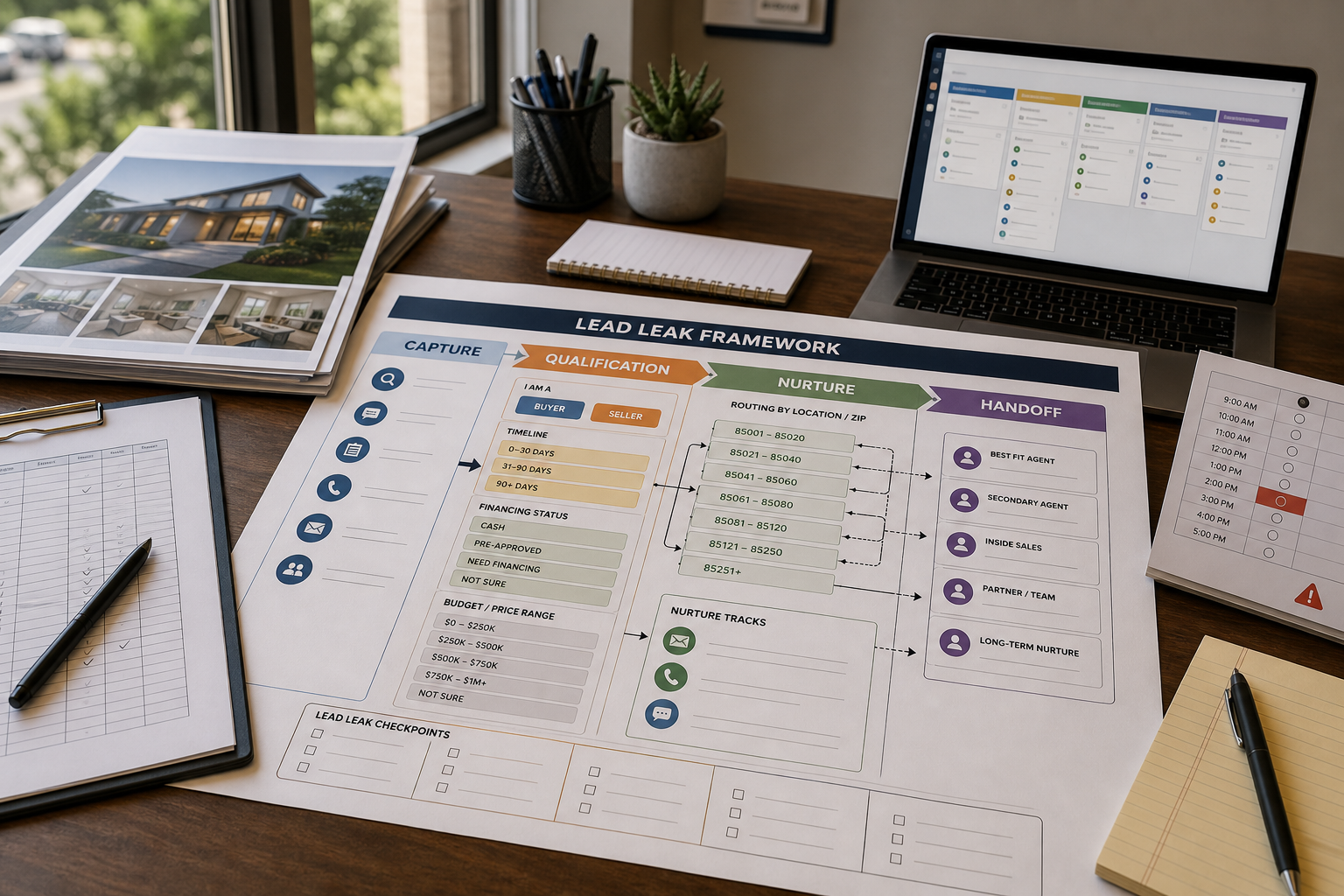
If your agency is paying for leads—or generating them organically—but agents still say, “I’m slammed,” you may not have a lead problem. You may have a lead-handling problem.
AI for real estate agents can help agencies respond faster, qualify leads more consistently, automate follow-up, and reduce CRM administration so agents can spend more time on conversations, showings, negotiations, and closings.
The catch is that successful AI adoption rarely starts with buying another AI tool.
It starts by identifying the workflow bottleneck that is costing the agency opportunities—slow speed-to-lead, weak qualification, inconsistent nurturing, poor routing, or excessive CRM administration—and then automating that specific problem.
Quick Answer: AI for real estate agencies is most useful when it improves speed-to-lead and qualification, then automates follow-up, CRM updates, routing, and appointment booking. Start with one measurable bottleneck, connect the workflow to your CRM and calendar, define clear human handoff rules, and measure business outcomes.
What AI for Real Estate Actually Solves—and What It Doesn’t
Most agencies don’t need “more AI.” They need fewer dropped leads and less manual administration. AI for real estate is most valuable when it improves a specific sales or operational workflow rather than simply adding another technology layer.
The National Association of REALTORS® also identifies predictive analytics, generative AI, and computer vision as practical AI applications in real estate. NAR: Artificial Intelligence in Real Estate
In real estate sales operations, AI typically helps in several practical areas:
- Faster response: Respond to inbound inquiries immediately, including outside normal business hours.
- Better qualification: Capture information such as budget, location, timeline, financing status, property requirements, and seller motivation.
- Consistent follow-up: Automate reminders, nurture sequences, and re-engagement.
- Better routing: Send leads to the appropriate agent based on geography, specialty, property type, or availability.
- Less CRM administration: Create records, update fields, create tasks, and record conversation information automatically.
- Appointment booking: Move qualified prospects from interest to a scheduled conversation.
Where AI is not a substitute for fundamentals:
- Replacing trust-building: Showings, negotiations, pricing discussions, and sensitive client situations still require human involvement.
- Fixing a weak offer: Automation cannot compensate for poor service, weak listings, or a poor customer experience.
- Fixing bad data: Poor CRM hygiene can undermine lead scoring, routing, reporting, and automation.
- Creating demand from nothing: If an agency has insufficient traffic or weak distribution, automating the existing funnel will not solve the underlying acquisition problem.
The principle is simple:
Business problem first. AI second.
How Real Estate Agencies Are Using AI
AI can support the entire lead-to-close workflow, from generating opportunities to qualifying prospects, managing follow-up, updating the CRM, scheduling appointments, supporting marketing, and assisting agents.
AI for real estate can support this workflow across lead generation, qualification, follow-up, CRM management, scheduling, and sales assistance.
The important question is not whether an agency should “use AI.”
It is:
Where can AI remove a measurable bottleneck?
1. AI for Lead Generation
AI for real estate can help agencies identify and surface buyer and seller opportunities through predictive analytics, behavioral signals, advertising optimization, and database re-engagement.
AI can also support broader real estate lead generation strategies, particularly when agencies combine prospecting, paid acquisition, database re-engagement, and behavioral signals.
Common applications include:
- Predictive seller prospecting
- Behavioral lead scoring
- Identifying high-intent prospects
- Paid campaign optimization
- Re-engaging existing database contacts
When it matters: When an agency needs more opportunities or wants to make outbound prospecting more targeted.
More leads, however, do not automatically mean more business. If existing leads are being lost because of slow response or inconsistent follow-up, improving conversion may be more useful than increasing lead volume.
2. AI for Lead Qualification
AI can capture the information an agent needs before deciding how and when to engage with a prospect.
Depending on the workflow, it can ask about:
- Buyer or seller intent
- Location
- Budget or price range
- Timeline
- Financing status
- Property requirements
- Seller motivation
Instead of collecting only “Name, Email, Message,” conversational qualification can turn an inquiry into structured lead information that can be routed into the CRM.
When it matters: When an agency has inbound traffic but agents spend too much time discovering basic lead requirements.
3. AI Real Estate Chatbots
A real estate chatbot can provide immediate responses to website or messaging inquiries, capture lead information, answer approved questions, qualify prospects, route conversations, and support appointment booking. This is one practical application of AI for real estate, particularly when an agency needs faster response and more consistent lead qualification.
A well-designed chatbot can:
- Respond outside business hours
- Ask qualification questions
- Provide approved property or process information
- Route leads to the appropriate agent
- Offer appointment times
- Escalate conversations to a human
When it matters: When response time, incomplete forms, or inconsistent qualification are causing leads to be lost.
The chatbot itself is not the business outcome. Its value comes from connecting conversation → qualification → CRM → routing → appointment → human handoff.
4. AI for Lead Follow-Up
AI and workflow automation can help maintain consistent follow-up across email, SMS, messaging, and other channels.
Common applications include:
- Follow-up after an initial inquiry
- Long-cycle buyer or seller nurturing
- Re-engagement of inactive leads
- Behavior-triggered follow-up
- Agent reminders when human intervention is required
When it matters: When leads are captured successfully but go cold because follow-up depends entirely on individual agent habits.
5. CRM Automation
CRM automation reduces repetitive administration and helps keep lead information, tasks, stages, and follow-up actions up to date.
Common applications include:
- Creating or updating lead records
- Assigning leads
- Creating follow-up tasks
- Updating pipeline stages
- Recording conversation information
- Triggering nurture workflows
- Maintaining required lead fields
When it matters: When agents do not consistently update the CRM and managers cannot rely on pipeline information.
A reliable CRM is also the foundation for more advanced real estate automation. AI cannot compensate for missing, duplicated, or inconsistent data.
6. Appointment Scheduling
AI-enabled workflows can help move qualified prospects from conversation to a booked meeting, consultation, showing, or call.
They can:
- Offer available appointment times
- Synchronize with calendars
- Confirm appointments
- Send reminders
- Handle rescheduling
- Escalate scheduling exceptions
When it matters: When qualified prospects stall because scheduling requires unnecessary back-and-forth.
The business objective is straightforward:
Reduce the gap between demonstrated intent and human conversation.
7. Real Estate Marketing Automation
Real estate marketing automation software can support repetitive marketing workflows such as:
- Listing descriptions
- Property marketing copy
- Email campaigns
- Social media content
- Local market content
- Neighborhood guides
- Lead re-engagement campaigns
When it matters: When agents or marketing teams spend significant time producing repetitive content.
Marketing automation should generally follow the fundamentals of lead capture, response, qualification, and follow-up. More content does not compensate for a broken sales workflow.
8. AI Sales Assistance
An AI assistant for real estate agents can reduce administrative work and help agents prioritize their pipeline
Common applications include:
- Conversation and call summaries
- Automated CRM notes
- Response drafting
- Lead prioritization
- Next-action recommendations
- Task creation
- Pipeline summaries
- Administrative assistance
When it matters: When agents spend too much time on administrative tasks or lack sufficient context when deciding which prospects require attention.
The objective of an AI sales assistant for real estate is not to replace the agent. It is to give the agent better context and more time for high-value conversations.
The eight use cases above form the foundation. The following sections examine the areas where these capabilities can be combined into practical workflows.
AI for Real Estate Lead Generation
AI for real estate lead generation can support two different objectives:
- Create or surface new opportunities
- Convert more of the demand an agency already has
AI for real estate leads is particularly useful when the agency needs to improve how quickly leads are captured, qualified, routed, and followed up. Before investing in real estate lead generation software, agencies should identify where leads are being lost in the existing funnel.
AI for real estate leads is most useful when it improves either lead acquisition or the conversion of existing demand.
The Lead Leak Map
Map the journey from traffic to appointment before selecting an AI tool.
- Traffic leak: Not enough inbound demand from advertising, SEO, referrals, portals, or other sources.
- Capture leak: Visitors arrive but do not submit because forms are too long, too generic, or provide little immediate value.
- Qualification leak: Leads are captured without enough information about buyer/seller intent, timeline, budget, location, or motivation.
- Nurture leak: Leads go cold because follow-up is inconsistent or manual.
- Handoff leak: Qualified leads do not reach the right agent quickly enough.
This map helps distinguish a lead generation problem from a lead management problem. These real estate lead generation strategies should be evaluated alongside the agency’s lead response, qualification, and follow-up processes rather than in isolation.
For example, an agency receiving hundreds of website inquiries but responding slowly may not need more traffic. It may need faster response, conversational qualification, better routing, and consistent follow-up.
AI Lead Generation vs. CRM Automation
These two categories are related but solve different problems.
Real estate lead generation tools, including AI-powered solutions, can help increase or surface demand through activities such as:
- Predictive seller targeting
- Paid campaign optimization
- Prospect identification
- Database re-engagement
CRM automation focuses on what happens after a lead enters the pipeline:
- Routing
- Lead scoring
- Follow-up tasks
- Nurture sequences
- Pipeline updates
- Reporting
If agents are not contacting leads quickly or consistently, adding more leads can create more operational pressure without solving the underlying conversion problem.
The right question is therefore:
Do we need more opportunities, or do we need to convert existing opportunities more effectively?
How AI Chatbots Capture and Qualify Real Estate Leads
A real estate chatbot can turn a website visitor into a structured sales opportunity by having a conversation, collecting relevant information, answering approved questions, and routing the lead to the appropriate next step.
The important distinction is between a basic FAQ chatbot and an AI-powered conversational workflow. An AI chatbot for real estate can go beyond answering FAQs by collecting qualification data, updating the CRM, routing leads, and supporting appointment booking.
A basic chatbot may answer questions.
A more integrated real estate AI chatbot can:
Capture intent → qualify → update CRM → route → book → hand off to a human
The business value comes from improving the journey from:
Website visitor → qualified lead → appointment → agent conversation
A chatbot for real estate agents is most useful when it is connected to the CRM, routing rules, appointment scheduling, and human handoff process.
Conversational Intake
Traditional forms often ask visitors to enter:
Name → Email → Message
That captures contact information but may provide little context about the opportunity.
Conversational AI for real estate can collect information through a guided interaction while allowing agencies to qualify prospects before an agent becomes involved.
Real estate chatbot example: A simple qualification conversation might ask about buyer or seller intent, location, budget, timeline, and financing status before routing the lead to an agent.
For example:
Bot: Are you looking to buy, sell, or rent a property?
Visitor: Looking to buy.
Bot: What type of property are you interested in?
Visitor: A house.
Bot: What price range are you considering?
Visitor: Around $400k–$500k.
Bot: Which areas are you interested in?
Visitor: North side, preferably near good schools.
Bot: How soon are you hoping to move?
Visitor: Within three months.
Bot: Are you already pre-approved for financing?
Visitor: Yes.
Bot: Thanks. I can connect you with an agent who specializes in that area. Would you like to schedule a conversation?
The result is a structured lead rather than an anonymous inquiry.
When it matters: When website traffic exists but forms produce incomplete information or agents spend too much time discovering basic requirements.
24/7 Lead Response
Real estate inquiries can arrive outside normal office hours.
A chatbot can provide an immediate first response while the agent is unavailable.
Depending on the workflow, it can:
- Capture contact details
- Record the property of interest
- Collect buyer or seller requirements
- Answer approved frequently asked questions
- Create or update a CRM record
- Notify the appropriate agent
- Schedule a follow-up
- Escalate urgent or high-intent conversations
The goal is not to replace the agent.
It is to reduce the delay between initial interest and meaningful human engagement.
When it matters: When leads frequently arrive during evenings, weekends, or other periods when agents are unavailable.
Qualification
Qualification allows an agency to determine what should happen next without requiring an agent to manually ask every basic question.
For buyers, qualification may include:
- Purchase timeline
- Budget
- Financing status
- Preferred location
- Property type
- Existing agent relationship
For sellers:
- Selling timeline
- Property location
- Property type
- Price expectations
- Selling motivation
- Current listing status
The answers can be used according to the agency’s own qualification rules.
| Lead Signal | Possible Action |
|---|---|
| Near-term timeline + financing ready | Prioritize rapid agent follow-up |
| Active seller + near-term listing | Route to listing specialist |
| Longer-term buyer | Add to appropriate nurture workflow |
| Early-stage research | Provide information and continue nurturing |
| Complex or sensitive request | Escalate to human |
The exact qualification criteria should be defined by the agency rather than assumed by the AI.
Routing
Qualification only creates value if the information reaches the right person.
Routing rules can consider:
- Geographic territory
- Property type
- Price range
- Buyer versus seller
- Language preference
- Lead source
- Agent specialization
- Availability
For example:
North Side → Buyer Team
Luxury Property → Luxury Specialist
Seller Lead → Listing Team
Spanish-Language Inquiry → Spanish-Speaking Agent
The handoff package can include:
- Lead name and contact details
- Buyer or seller intent
- Property requirements
- Budget or price range
- Timeline
- Financing status, where relevant
- Conversation summary
- Conversation transcript
- Recommended next action
This allows the agent to continue the conversation without restarting qualification.
Appointment Booking
Once a lead is qualified, the next step is often a meeting or consultation.
A connected workflow can:
- Check available appointment times.
- Offer suitable slots.
- Allow the prospect to select a time.
- Create the appointment.
- Update the CRM.
- Send confirmation and reminders.
- Notify the assigned agent.
For example:
Bot: Based on what you’ve told me, a buyer consultation with one of our North Side specialists would be useful. Would you like to schedule one?
Visitor: Yes.
Bot: I have Thursday at 2:00 PM or Friday at 3:30 PM available. Which works better?
Visitor: Thursday at 2:00 PM.
Bot: You’re booked for Thursday at 2:00 PM. I’ll send the confirmation details now.
This creates a clear transition from lead qualification to human conversation.
Human Handoff
A chatbot should not attempt to handle every situation autonomously.
Agencies should define explicit human handoff rules before deployment.
Common triggers include:
- The visitor asks for an agent.
- The visitor requests a showing.
- The conversation involves negotiation.
- The visitor asks for legal or contractual advice.
- The question falls outside the chatbot’s approved knowledge.
- The lead has an urgent timeline.
- The visitor becomes frustrated.
- The conversation involves a sensitive or high-value situation.
A useful handoff preserves context.
For example:
Lead: John
Intent: Buyer
Location: North Side
Budget: $400k–$500k
Timeline: Within 3 months
Financing: Pre-approved
Next action: Buyer consultation requested
The agent can then continue the conversation with context instead of repeating the qualification process.
Where the Real Estate Chatbot Fits in the Sales Workflow
A chatbot should not operate as an isolated AI tool.
Its value increases when it connects to the broader sales workflow:
Website / Social Channel
↓
Conversational Intake
↓
Lead Qualification
↓
CRM Record
↓
Lead Routing
↓
Appointment Booking or Nurture
↓
Human Agent
↓
Sales Process
The chatbot is therefore one component of a broader real estate workflow automation and sales automation process.
When Should a Real Estate Agency Use a Chatbot?
A chatbot is worth considering when:
- The website already receives meaningful traffic.
- Leads frequently arrive outside working hours.
- Agents spend significant time answering repetitive questions.
- Lead qualification is inconsistent.
- Contact forms capture too little information.
- Qualified leads are not routed quickly enough.
- Appointment scheduling creates unnecessary back-and-forth.
A chatbot may not be the first priority when:
- The agency lacks sufficient traffic.
- CRM data is incomplete or unreliable.
- Agents have no defined follow-up process.
- The underlying sales workflow is unclear.
Business-first rule: Deploy a chatbot when there is a specific lead-capture, qualification, response, routing, or scheduling problem that it can measurably improve.
Real Estate Sales Automation
AI for real estate can connect individual AI capabilities into workflows that move prospects from initial interest toward a human sales conversation.
The objective is not to automate everything.
The objective is to remove unnecessary friction while preserving human involvement where it matters.
AI Use Cases Across the Real Estate Lead-to-Close Workflow
| Workflow Stage | AI Use Case | Why It Matters | Example KPI |
|---|---|---|---|
| Capture | Conversational intake | Captures intent data and reduces friction | Qualified lead rate |
| Qualification | Automated questions + routing | Protects agent time and speeds handoff | Lead-to-appointment rate |
| Response | 24/7 first response | Reduces delays for after-hours inquiries | Speed-to-lead |
| Nurture | Behavior-triggered follow-up | Maintains consistency over weeks or months | Follow-up completion |
| Prioritization | Lead scoring | Focuses agent attention | Pipeline velocity |
| CRM | Auto-log notes and tasks | Reduces administration | CRM completeness |
| Marketing | AI-assisted content | Supports consistent marketing activity | Content cadence / inquiries |
| Appointment | Automated scheduling | Reduces scheduling friction | Appointment booking rate |
The correct use case depends on where the agency’s pipeline is leaking.
High-Value Real Estate AI Workflows
Workflow 1: Inbound Website Lead Qualification
Business problem: Website inquiries contain limited information and agents spend time chasing basic details.
What changes: A conversational experience asks a small number of relevant questions—such as buyer/seller intent, location, budget, timeline, and financing—and routes the lead appropriately.
Where AI tools can fit:
- Ask qualification questions
- Capture structured lead fields
- Route leads based on predefined rules
- Create CRM records
- Offer appointment booking
Use it when: You already have meaningful traffic and the problem is weak capture or qualification.
Do not start here when: The primary issue is insufficient traffic.
Trade-off: Asking too many questions can create friction. Start with the minimum information required to determine the next step.
Workflow 2: 24/7 Lead Response With Human Handoff
Business problem: Leads arrive when agents are unavailable.
What changes: A conversational layer provides an immediate response, captures intent, and escalates appropriate leads.
The workflow can:
- Answer approved questions
- Capture essential details
- Create or update a CRM record
- Notify an agent
- Book an appointment
- Trigger nurture when immediate handoff is not appropriate
Handoff design matters: Define exactly when an agent is notified and what information they receive.
A common failure is creating an “always-on” automation that keeps messaging a lead when the lead is already ready for a human conversation.
Workflow 3: Seller Lead Nurturing
Business problem: Seller leads often have longer timelines and follow-up becomes inconsistent.
What changes: The CRM segments leads by timeline and engagement, then triggers appropriate nurture actions and agent reminders.
For example:
- Now
- 1–3 months
- 3–6 months
- 6+ months
The system can also notify agents when engagement increases—for example, after a reply, click, or booking request.
Use it when: The agency has a meaningful database of past or inbound leads.
Do not start here when: The CRM contains duplicated, incomplete, or unreliable records.
Workflow 4: Predictive Seller Prospecting
Business problem: Listing-focused teams want to prioritize homeowners who may be more likely to sell.
What changes: Predictive analytics can be used to prioritize outbound prospecting.
Tools in this category include platforms such as SmartZip and Offrs.
This type of automation should generally come after basic response, qualification, CRM, and nurture processes are working reliably.
Otherwise, the agency may simply create more prospects than its sales process can handle.
Workflow 5: CRM Administration Reduction
Business problem: Agents do not consistently update CRM records, so pipeline reporting and follow-up become unreliable.
What changes: Automation can create tasks, update stages, capture notes, and standardize next actions based on events such as:
- Form submission
- Appointment booking
- Lead reply
- No response
- Follow-up completion
CRM software for real estate agents can support different parts of this workflow, including lead management, routing, follow-up, reporting, and automation. Platforms such as Zoho CRM, Wise Agent, and Realvolve offer different approaches, so current capabilities and integrations should be checked before implementation.
AI + CRM for Real Estate Agencies
A CRM should remain the source of truth for the sales pipeline. For AI for real estate workflows, this is particularly important because qualification, routing, follow-up, and reporting depend on reliable CRM data.
Real estate lead management software should therefore support reliable lead capture, routing, follow-up, pipeline management, and reporting rather than simply adding another layer of technology.
AI should improve the quality and speed of information entering the CRM—not create another disconnected system. An AI CRM for real estate can be useful when AI-assisted capture, qualification, routing, follow-up, and reporting are integrated into the same sales workflow.
A useful AI-enabled real estate CRM workflow looks like:
Lead Source → AI Capture → Qualification → CRM → Routing → Follow-Up → Appointment → Agent → Pipeline
What AI Can Automate Around the CRM
AI and workflow automation can help with:
- Lead creation
- Required-field completion
- Lead categorization
- Lead assignment
- Task creation
- Conversation summaries
- Stage updates
- Follow-up triggers
- Nurture sequences
- Engagement alerts
- Appointment records
- Pipeline reporting
CRM Data Hygiene Still Matters
Automation does not remove the need for clean data.
At minimum, agencies should standardize fields such as:
- Lead type
- Buyer / seller / renter / investor
- Timeline
- Location
- Price range
- Financing status
- Motivation
- Lead source
- Assigned agent
- Current pipeline stage
Structured information makes routing, scoring, reporting, and follow-up more reliable.
Real Estate AI Tools: What Should You Automate?
Tool selection should follow the workflow—not the other way around. AI tools for real estate agents can support different parts of that workflow, from lead capture and qualification to CRM automation, follow-up, scheduling, and sales assistance.
Features change quickly, and vendor pricing and integrations can vary by plan and market. Real estate automation software should be evaluated the same way: start with the workflow it improves, then assess integrations, implementation effort, and ongoing maintenance. The more durable question is:
What business bottleneck does this tool solve, and how well does it fit the existing workflow?
Business Impact Comparison
| Tool / Category | Primary Use | Typical Fit | Implementation Consideration |
|---|---|---|---|
| Perspective AI | Conversational lead qualification | Agencies with inbound website traffic | Useful when static forms are the bottleneck |
| Lindy | AI agent workflows | Teams needing flexible qualification, booking, or CRM actions | Requires testing of workflows and handoffs |
| Ylopo | Real estate marketing and lead follow-up | Teams and brokerages | Evaluate current integrations and capabilities |
| CINC AI | Integrated real estate CRM and AI workflows | Teams and brokerages | Useful where an integrated platform is preferred |
| SmartZip | Predictive seller prospecting | Listing-focused teams | More relevant after core lead handling works |
| Offrs | Predictive seller targeting | Listing-focused agents and teams | Verify current capabilities and integration options |
| Gupshup | Conversational and messaging workflows | Teams and brokerages | Implementation complexity depends on channel requirements |
| Zoho CRM | CRM and workflow automation | Small and mid-size agencies | Flexible but less real-estate-specific |
| Wise Agent | Real estate CRM workflows | Agents and small teams | Verify current AI and automation capabilities |
| Realvolve | Workflow-driven real estate CRM | Agents and teams | Strong workflow orientation; verify current integrations |
How to Prioritize Your First AI Investment
There is no universal first AI tool for every real estate agency.
A practical sequence is:
1. Identify the bottleneck
Is the problem:
- Insufficient leads?
- Slow response?
- Poor qualification?
- Inconsistent follow-up?
- Weak CRM discipline?
- Inefficient prospecting?
2. Select the smallest automation that addresses it
For example:
- Slow response → 24/7 response workflow
- Weak qualification → conversational intake
- Poor follow-up → CRM automation and nurture
- Manual administration → CRM workflow automation
- Insufficient seller opportunities → predictive prospecting
3. Connect the automation to the existing operating model
The tool should work with the agency’s CRM, calendar, messaging channels, lead sources, and human handoff process.
4. Measure before expanding
Do not add additional AI capabilities simply because the first workflow exists.
Prove that the workflow is useful first.
Decision Matrix: Which AI Tool Category Should You Buy First?
| Primary Bottleneck | Relevant Tool Category | Business Objective | Consider Later |
|---|---|---|---|
| Leads respond too slowly | 24/7 response + qualification + booking | Reduce response delay and capture intent | Predictive prospecting |
| Leads are low quality | Conversational qualification | Capture better lead information | More paid lead spend |
| Follow-up is inconsistent | CRM automation + nurture | Improve follow-up consistency | Additional messaging platforms |
| Agents waste time on cold leads | Lead scoring + engagement triggers | Prioritize agent attention | Complex AI agents |
| Need more listing opportunities | Predictive seller targeting | Prioritize outbound prospecting | Advanced predictive workflows before fundamentals work |
What Should Stay Human?
Good real estate automation does not mean removing humans from the customer journey.
Some activities are better handled—or at least supervised—by people.
These include:
- Negotiation
- Pricing discussions
- Property showings
- Sensitive seller conversations
- Complex client objections
- Legal or contractual questions
- Relationship management
- High-value or unusual situations
The role of AI is to remove repetitive work around those conversations.
A useful operating principle is:
Automate the preparation. Preserve the relationship.
How to Implement AI in a Real Estate Agency
Implementation is where many AI projects lose momentum. A practical AI for real estate implementation should therefore begin with one measurable workflow rather than a broad technology rollout.
The issue is often not the AI technology. It is deploying automation without deciding how agents will actually work with it.
Business-First AI Framework™
Intelligent AI Lab’s approach is:
Business Value First. AI Second.
Apply the framework in six steps:
- Business Problem: Identify one measurable bottleneck.
- Workflow Improvement: Map the exact process from lead source to appointment.
- Choose the Right Solution: Select the smallest technology layer that fixes the problem.
- Implement With Human Oversight: Define handoff rules and exceptions.
- Measure Business Outcomes: Track metrics tied to the bottleneck.
- Standardize and Scale: Expand only after the workflow is proven.
Step 1: Define Handoff Rules
Before implementing software, define:
- What counts as a hot lead?
- Who receives the lead?
- What happens if the first agent does not respond?
- When should a manager be notified?
- What information should the agent receive?
- When must the AI stop and hand over?
Step 2: Connect the Minimum Integrations
At minimum, consider:
- CRM: Source of truth for lead and pipeline information
- Calendar: Appointment scheduling
- Email/SMS or messaging: Follow-up communication
- Lead sources: Website, portals, advertising, and landing pages
The objective is to avoid creating another disconnected system.
Step 3: Standardize Data
Define consistent fields for:
- Lead type
- Timeline
- Location
- Price range
- Financing status
- Motivation
- Source channel
- Assigned agent
- Pipeline stage
Without structured information, AI-assisted routing and scoring can become unreliable.
Step 4: Run a 14-Day Pilot
Do not launch five automations simultaneously.
Start with one workflow.
Days 1–2: Choose one bottleneck and define success metrics.
Days 3–4: Map the current lead flow and identify where it breaks.
Days 5–7: Implement the first automation and connect CRM/calendar where needed.
Days 8–10: Add routing rules and a simple nurture fallback.
Days 11–12: Review conversations, records, and edge cases.
Days 13–14: Compare results against the baseline and decide whether to standardize, iterate, or stop.
Step 5: Build Human-in-the-Loop Operations
AI workflows need ongoing oversight.
A practical operating rhythm can include:
- Weekly: Review a sample of conversations and handoffs.
- Monthly: Review lead scoring and routing rules.
- Quarterly: Review templates, scripts, integrations, and market messaging.
Assign clear ownership.
If “everyone” owns the automation, nobody necessarily maintains it.
Measuring ROI From Real Estate AI
AI for real estate projects should be evaluated using business outcomes rather than activity.
The right KPIs depend on the bottleneck being addressed.
Core KPIs
Speed-to-lead
Time from inquiry to first meaningful response.
Lead-to-appointment rate
Useful for evaluating qualification, routing, and booking workflows.
Lead-to-client conversion
A longer-cycle measure of overall sales impact.
Follow-up completion rate
Shows whether planned nurture and agent tasks are actually happening.
Pipeline velocity
Measures how quickly leads move through the sales process.
CRM data completeness
Measures whether required lead information is being captured consistently.
Practical ROI Logic
Use your own baseline rather than relying on universal improvement claims.
Industry research can also provide useful context when establishing an AI baseline. NAR’s REALTORS® Technology Report reports on technology adoption and AI use among REALTORS®. NAR REALTORS® Technology Report
Ask:
- Did response time decrease?
- Did appointment bookings change?
- Did agents spend less time on unqualified leads?
- Did follow-up completion improve?
- Did CRM completeness improve?
- Did qualified opportunities move through the pipeline more efficiently?
Short-cycle metrics such as response time and appointment booking can usually be evaluated sooner.
Longer-cycle metrics such as lead-to-client conversion require more time.
The important principle is:
Measure the business outcome that the automation was designed to improve.
Common Mistakes to Avoid
1. Buying Too Many Tools Too Early
Agencies can end up with overlapping inboxes, disconnected workflows, and duplicated functionality.
Better approach: Establish one CRM backbone and solve one workflow problem before adding more tools.
2. Automating Before Defining the Problem
You can create plenty of automated activity without creating business value.
Better approach: Start with a measurable bottleneck.
3. Skipping CRM Hygiene
Poor data undermines lead scoring, routing, reporting, and automation.
Better approach: Define required fields and capture them at the point of intake.
4. No Human Handoff Plan
A lead can become trapped in an automated sequence when it is actually ready for an agent.
Better approach: Define explicit handoff triggers and escalation rules.
5. Assuming Predictive Analytics Replaces Fundamentals
Predictive seller targeting cannot compensate for poor response, weak qualification, or inconsistent follow-up.
Better approach: Build the core lead-handling workflow first, then add predictive capabilities where they solve a specific problem.
FAQs
What is AI for real estate agencies?
AI for real estate agencies uses conversational tools, predictive analytics, and workflow automation to support lead generation, lead qualification, follow-up, CRM management, appointment scheduling, and sales assistance.
It works best when connected to a specific business workflow rather than treated as a general “AI upgrade.”
Can AI generate real estate leads?
Yes. AI can support lead generation through predictive seller targeting, advertising optimization, prospect identification, and database re-engagement.
AI can also improve the conversion of existing inbound traffic through conversational capture and faster response.
The right approach depends on whether the agency’s primary problem is lead volume or lead conversion.
What AI workflow should a real estate agency implement first?
There is no single workflow that fits every agency.
If the agency has meaningful inbound traffic but weak qualification, conversational intake may be appropriate.
If follow-up is inconsistent, CRM automation and nurture may be more relevant.
If seller prospecting is the main gap, predictive targeting may be considered after the core sales process is working reliably.
Start with the bottleneck rather than the technology.
Do I need a real estate-specific CRM?
Not necessarily.
A real estate CRM can provide industry-specific workflows and integrations, while a general CRM may provide greater flexibility.
The important question is whether the CRM supports the agency’s required:
- Lead routing
- Task management
- Follow-up
- Data fields
- Reporting
- Integrations
- Automation
Which AI tools can support seller leads?
Predictive seller prospecting platforms such as SmartZip and Offrs are examples of tools in this category.
They should be evaluated based on current capabilities, integrations, data coverage, cost, and how well they fit the agency’s existing follow-up process.
Which AI tools can support inbound website leads?
Conversational intake tools and AI agent platforms can support website lead qualification, response, routing, booking, and CRM updates.
Examples discussed in this article include Perspective AI and Lindy.
The appropriate option depends on whether the agency needs primarily conversational qualification or a broader workflow automation layer.
Can AI replace a real estate assistant?
AI can reduce repetitive administrative work such as:
- First-response messaging
- Qualification questions
- Appointment booking
- Reminders
- CRM updates
- Conversation summaries
- Task creation
Human support remains important for judgment, relationship management, negotiation, sensitive client communication, and exception handling.
What metrics should we track to prove AI is working?
Start with metrics connected to the workflow you are changing.
Common measures include:
- Speed-to-lead
- Lead-to-appointment rate
- Lead-to-client conversion
- Follow-up completion
- Pipeline velocity
- CRM data completeness
Establish a baseline before the pilot so you can compare the workflow before and after automation.
Implementation Priority: What to Do Now vs. Later
Start Today
- Map your lead leak: traffic, capture, qualification, nurture, or handoff.
- Define what qualifies as a hot lead.
- Define escalation rules.
- Choose two or three KPIs.
- Establish a baseline using recent pipeline data.
Improve Next
- Replace one weak static form with conversational qualification.
- Connect CRM, calendar, and messaging.
- Standardize lead fields.
- Implement one nurture workflow.
- Assign clear ownership for the automation.
Scale Later
Once the first workflow is working reliably:
- Add lead scoring.
- Add engagement-based prioritization.
- Expand 24/7 response across additional channels.
- Add multilingual workflows where relevant.
- Consider predictive seller targeting.
- Expand automation to additional stages of the sales process.
Scaling should follow evidence—not enthusiasm for another AI tool.
Conclusion: The Real Estate AI Strategy Is a Conversion Strategy
The most practical way to think about AI for real estate is not:
“Which AI tool is the smartest?”
It is:
“Where is my pipeline leaking, and what is the smallest automation that can stop the leak?”
AI can help real estate agencies become faster, more consistent, and easier to do business with.
But the technology is only one part of the equation.
The stronger approach is to:
Identify the bottleneck → improve the workflow → automate the repetitive parts → preserve human handoff → measure the outcome → standardize what works.
For many agencies, a useful starting point is a focused pilot around inbound lead qualification, routing, and follow-up. Once the agency can reliably move inquiries toward qualified conversations and booked appointments—with clean CRM data—it has a stronger foundation for expanding into more advanced AI workflows.
Next step: If you want a structured way to identify your biggest lead leak and prioritize the right automation, consider a short pipeline bottleneck review or workflow audit focused on response time, qualification, follow-up, and CRM handoff.