
Build a WhatsApp Lead Generation Funnel with AI (Step-by-Step for Small Businesses)
You don’t usually lose leads because your offer is bad. You lose them because the first reply takes too long, qualification is inconsistent, and follow-ups happen “when someone has time.” WhatsApp lead generation fixes the friction, but only if you build a funnel that’s designed for conversation—not a form disguised as chat.
In this tutorial, you’ll learn how to build a WhatsApp sales funnel that attracts prospects, uses AI to qualify them in 3–5 questions, syncs the lead into your CRM, and triggers follow-ups—so your team spends time closing, not copying and pasting.
Quick Answer (40–60 words): The fastest way to improve WhatsApp lead generation is to start with one entry point (like a Click-to-WhatsApp ad or website button), deliver an immediate “why chat now” offer, use an AI-assisted 3–5 question qualification flow, score and route hot leads to a human fast, and sync everything to your CRM for tracking and follow-up.
What Is WhatsApp Lead Generation (and What It Isn’t)?
WhatsApp lead generation means using WhatsApp as the primary channel to capture contact details, qualify intent, and move a prospect toward a booking, quote request, or purchase. Instead of sending someone to a long form, you invite them into a short, high-trust conversation.
What it isn’t:
- “Ads to chat” only (without qualification, routing, and tracking).
- A chatbot that talks forever (automation should accelerate sales, not replace it).
- A separate inbox silo (if the lead never reaches your CRM or pipeline, you can’t manage it).
The simplest way to think about it is a conversation-first funnel:
- Attract prospects into WhatsApp (ads, website widget, QR, social bio link).
- Qualify quickly (3–5 questions, AI-supported where appropriate).
- Route hot leads to the right human fast (with full context).
- Nurture colder leads with opt-in compliant follow-ups.
- Measure qualified conversations, bookings, and revenue contribution (not “messages sent”).
The Real Business Problems a WhatsApp Funnel Should Solve
Before tools, start with the operational pain. Most small businesses invest in WhatsApp lead generation because at least one of these operational problems is true:
- Slow response time: leads go cold while your team is busy.
- Manual qualification: sales spends time on low-fit inquiries.
- Poor tracking: you can’t attribute which sources produce qualified opportunities.
- Fragmented workflow: WhatsApp messages, spreadsheets, and CRM don’t match.
- Generic follow-ups: messages feel copy-pasted instead of contextual.
AI can improve WhatsApp lead generation here because it can handle repetitive intake work (first response, FAQ, basic qualification, tagging, routing triggers) while keeping humans focused on pricing, objections, and closing
Why AI Improves WhatsApp Funnels (and Where It Can Backfire)
AI helps WhatsApp funnels most in the first 5 minutes of the relationship—when speed and clarity decide whether the lead continues.
Where AI adds the most value
- Instant first response: confirms the user is in the right place and sets expectations.
- Consistent 3–5 question qualification: no skipped questions, no “we’ll ask later.”
- Lead scoring support: categorize by intent, budget, timeline, and fit.
- Routing: assign to the right rep/team and pass full context.
- Personalized follow-ups: based on what they asked and what they answered.
Where AI can hurt conversions
- High-ticket, high-trust sales: automating too much can feel evasive.
- Over-questioning: long interrogations before delivering value increases drop-off.
- Unclear handoff: the lead doesn’t know when a human will respond.
- Compliance mistakes: nurture messages without clear opt-in can create deliverability and trust problems.
Consultant Insight: In most small businesses, the best ROI comes from automating intake and coordination (speed, qualification, routing, reminders), not automating the relationship. Your funnel should make it easier for a human to sell—not give the lead a reason to doubt they’ll ever reach a human.
The Business-First AI Framework™ for WhatsApp Lead Generation
WhatsApp automation can scale quickly, which is exactly why you should anchor it to business outcomes first. Use this sequence to avoid building an impressive system that doesn’t move pipeline.
- Business problem: What exactly is breaking today? (Slow replies, low lead quality, no tracking, poor follow-up.)
- Workflow improvement: What step can you shorten or standardize? (First response, qualification, routing, booking.)
- Choose the right solution: Manual vs no-code vs API-based automation—based on volume and complexity.
- Implement with human oversight: clear handoff rules and escalation paths.
- Measure business outcomes: qualified lead rate, cost per qualified lead, bookings, conversions.
- Standardize and scale: only after one funnel works end-to-end.
Business-First AI Insight: If you can’t clearly define what a “qualified WhatsApp conversation” is in your business, AI will amplify confusion. Define qualification and handoff rules first; then use AI to enforce them consistently at scale.
How to Generate WhatsApp Leads From Ads
Paid social advertising can turn WhatsApp into a direct lead-generation channel. Instead of sending prospects from an ad to a landing page and then asking them to fill out a form, Click-to-WhatsApp ads can start a conversation directly in WhatsApp.
The basic flow is:
Ad → WhatsApp conversation → AI-assisted qualification → Lead score → CRM → Sales rep
This reduces the number of steps between seeing an offer and starting a conversation. But the goal should not be to generate as many WhatsApp conversations as possible. The goal is to generate qualified WhatsApp leads that can move into your sales process.
Click-to-WhatsApp Ads
Click-to-WhatsApp ads give prospects a direct path from an advertisement into a WhatsApp conversation. The ad creates the initial interest, while your WhatsApp workflow handles qualification and the next step.
A practical setup looks like this:
- Ad: Present a specific offer or reason to start a conversation.
- WhatsApp: Open a conversation with an appropriate pre-filled message or clear prompt.
- Qualification: Ask 3–5 questions to understand intent, timeline, budget, or fit.
- Scoring: Classify the lead as hot, warm, cold, or non-fit.
- Routing: Send qualified leads to the appropriate sales representative or booking flow.
- CRM: Store the source, qualification data, lead score, and owner.
- Follow-up: Continue the appropriate follow-up sequence when the prospect does not convert immediately.
For example, an ad could promise a “2-minute digital marketing eligibility check” and open WhatsApp with a message such as:
“Hi, I’d like to get a digital marketing eligibility check.”
That initial message gives the WhatsApp AI chatbot useful context before qualification begins.
Facebook and Instagram Campaigns
Facebook and Instagram campaigns can be designed to move prospects directly from social content into a WhatsApp conversation instead of sending every visitor through a traditional landing page.
This can be useful when the offer is easier to understand through a short conversation—for example:
- Requesting a quote
- Checking service eligibility
- Asking about product availability
- Getting a price range
- Booking a consultation
- Requesting a personalized recommendation
The important distinction is that the ad generates the conversation, while the WhatsApp funnel determines what happens after the conversation starts.
Your ad therefore needs to set an accurate expectation. If the ad promises a quick quote but the WhatsApp chatbot asks ten questions before providing any useful response, the funnel creates friction after the click.
Optimize for Qualified Leads, Not Conversations
A campaign that generates more WhatsApp conversations is not automatically a better campaign.
Imagine two campaigns:
- Campaign A: 1,000 WhatsApp conversations → 50 qualified leads
- Campaign B: 200 WhatsApp conversations → 80 qualified leads
Campaign B generated fewer conversations but more qualified opportunities.
That is why your advertising and WhatsApp funnel should ultimately be measured against qualified leads and business outcomes, not message volume alone.
Use:
Cost per qualified lead = Ad spend ÷ Qualified WhatsApp leads
You can then compare campaigns, ad sets, or traffic sources based on the quality of the leads they produce.
Track metrics such as:
- WhatsApp conversations started
- Qualification completion rate
- Qualified leads
- Cost per qualified lead
- Hot leads by campaign
- Bookings or opportunities generated
- Conversion rate from qualified lead to customer
Business takeaway: Your advertising should optimize the top of the funnel, but your WhatsApp workflow must tell you whether that traffic is actually producing qualified opportunities. More conversations are useful only when they contribute to the pipeline.
The WhatsApp Lead Generation Journey in 60 Seconds
Here’s the flow you’re building: A prospect clicks your ad, website button, QR code, or social link and lands in WhatsApp → an AI-assisted welcome flow responds instantly with 3–5 qualification questions → the lead is scored (hot/warm/cold) and routed to the right rep, booking flow, or nurture path → all data syncs to your CRM → automated follow-ups recover non-responders → you measure qualified conversations and bookings, not just messages sent.
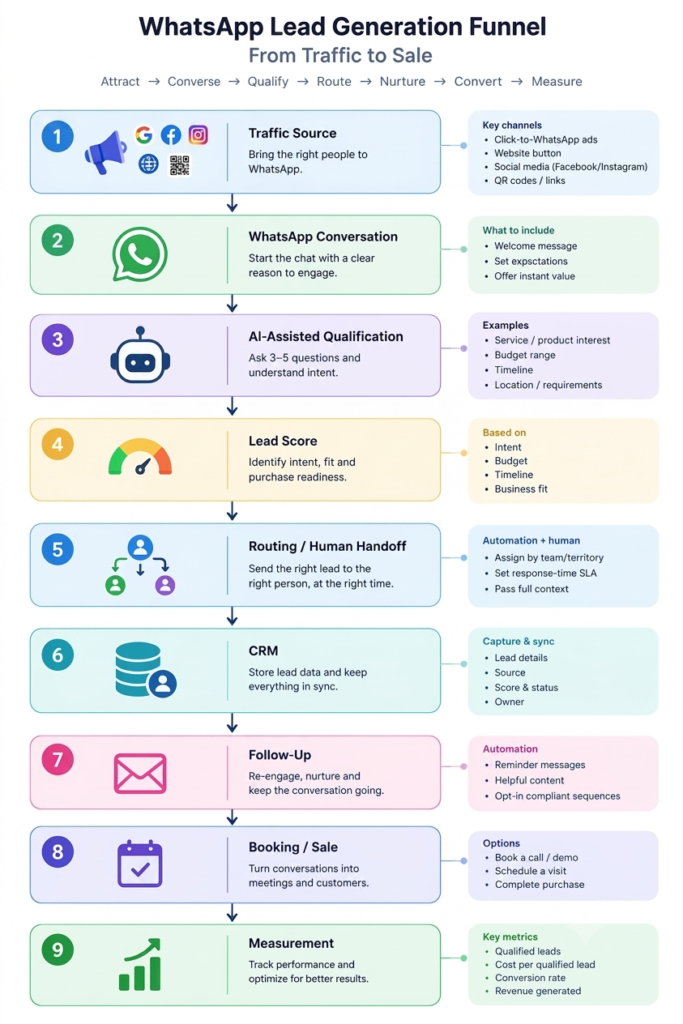
The goal is simple: use WhatsApp and AI to move the right prospects from first message to the right next step with less manual work.
Now let’s look at the six stages of the funnel and what should be automated versus kept human.
Funnel Blueprint: The 6 Stages You’re Building
Most WhatsApp sales funnels that perform well share the same stages. You can implement them with different tools, but the logic stays similar.
Note: These stages separate four distinct operations that businesses often conflate: capture (getting a prospect into WhatsApp and collecting basic information), qualification (determining fit and intent), scoring (assigning priority based on qualification signals), and routing (sending the lead to the right person or workflow). Each has different automation rules and success metrics.
| Stage | Goal | What to Automate | What Stays Human | Example |
|---|---|---|---|---|
| 1) Entry + Capture | Get prospects into WhatsApp and capture basic contact information | Click-to-WhatsApp ads, website button, QR, social links, contact capture | Offer strategy and targeting decisions | Ad: “Get a 2-minute eligibility check” → WhatsApp |
| 2) First Response | Reduce drop-off with speed and clarity | Welcome message, expectation setting, menu/Flow start | Handling unusual questions or high-stakes contexts | “I’ll ask 3 quick questions, then connect you with the right person.” |
| 3) Qualification | Determine fit and intent with 3–5 questions | Structured questions, Flows, AI-assisted Q&A | Nuanced fit judgment | Service → timeline → budget → location |
| 4) Scoring + Routing | Prioritize leads and send them to the right rep or workflow | Tags, lead score, assignment, notifications, CRM creation | Pricing, objections, relationship building | Hot lead → sales specialist |
| 5) Nurture | Recover silent leads and educate colder ones | Compliant reminders and follow-up sequences | Personal replies when interest increases | Helpful reminder → booking option |
| 6) Measurement | Improve qualified lead and conversion rates | Dashboards, attribution fields, SLA tracking | Funnel optimization decisions | Compare qualified leads by source |
Step-by-Step: Build a WhatsApp Lead Generation Funnel with AI
This is the practical build sequence. If you follow it in order, you reduce rework—especially around routing and CRM data.
Step 1: Pick ONE entry point and ONE conversion goal
Start narrow. A funnel is easier to optimize when there’s one primary source and one next step. For WhatsApp lead generation, this keeps attribution simple and makes it easier to identify which traffic source produces qualified conversations.
- Good entry points: Click-to-WhatsApp ads, website widget/button, QR code in-store, social bio link.
- Good conversion goals: book a call, request a quote, confirm service eligibility, schedule a visit, get a price range (with human follow-up).
Implementation trade-off: More entry points increases volume but also increases tracking complexity. Until you have solid reporting, multiple sources blur what’s working.
Step 2: Create a “reason to chat” (your lead magnet or instant value)
WhatsApp is high attention. Don’t waste it. Give prospects a clear payoff for starting the conversation.
- Service businesses: “Get a 2-minute eligibility check” or “Get a rough estimate range.”
- Agencies: “Get a quick audit checklist” or “Get a campaign idea pack.”
- Retail: “Check availability,” “Get recommendations,” “Claim an offer with opt-in.”
Common mistake: asking questions before giving any value. A better pattern is: deliver something small immediately, then ask 3–5 questions to personalize the next step.
Step 3: Decide your automation level (Manual vs No-Code vs API)
This decision prevents tool sprawl and helps you avoid building an automation system you can’t maintain.
| Option | Best For | Pros | Trade-offs |
|---|---|---|---|
| Manual (WhatsApp Business App) | Very low volume, single rep, simple process | Fast to start, minimal setup | Limited automation and scalability; harder tracking; bottlenecks form quickly |
| No-code platform | SMBs and agencies needing automation without engineering | Faster workflows, routing, analytics, easier iteration | Platform limitations; ongoing subscription; integration depth varies |
| API-based + automation layer | Higher volume, multi-step routing, custom CRM logic | Maximum flexibility and data control | More technical; higher maintenance; needs monitoring and documentation |
What the API actually does: The WhatsApp Business App is primarily designed for manual conversations. The WhatsApp Business Platform (API) allows software systems—such as automation platforms, AI tools, and CRMs—to interact with WhatsApp programmatically. This enables capabilities such as automated workflows, multi-agent routing, CRM sync, structured Flows, and follow-ups at scale.
The typical stack: WhatsApp Business Platform/API → automation platform → AI layer (optional) → CRM → routing → follow-up. You don’t necessarily need to build this infrastructure yourself; many businesses use a WhatsApp platform that handles the API connection and provides a visual workflow builder.
Expert decision point: If you need multiple agents, reliable automation, structured workflows, and CRM sync, you’ll typically need WhatsApp Business API via a platform. Relying on the free app is one of the most common scaling mistakes.
Step 4: Design your 3–5 qualification questions (keep it short)
The goal is to separate fit from non-fit with minimal friction. In many businesses, 3–5 questions is enough.
Use the classic scoring dimensions:
- Intent: what are they trying to do?
- Timeline: how soon?
- Budget (or price sensitivity): range is often enough initially.
- Fit: location, industry, size, requirements, constraints.
Example question structures you can adapt:
- Service business: “What are you looking for help with?” → “When do you want to start?” → “What’s your approximate budget range?” → “Which area are you located in?”
- B2B/Manufacturing: “What product/category?” → “Estimated quantity?” → “Delivery location?” → “When needed?” → “Are you evaluating suppliers now or researching?”
- Agency: “Which service?” → “Monthly budget range?” → “Timeline?” → “Do you already have tracking/CRM?”
Business Tip: If a question doesn’t change what happens next (route, book, nurture, disqualify), remove it. Qualification questions should be operational, not curiosity.
Step 5: Choose how you’ll collect data (WhatsApp Flows vs free-text chat)
Structured collection reduces errors and makes CRM sync easier.
- WhatsApp Flows / structured menus: best when you need clean fields (service type, location, budget range).
- AI-assisted free-text: useful when leads describe complex needs; AI can summarize and classify.
Trade-off: Flows improve data quality but can feel rigid. Free-text feels natural but needs stronger AI/ops rules to avoid messy CRM data. Many businesses use a hybrid: 2–3 structured questions, then one open question for context.
Step 6: Add AI where it reduces labor (not where it adds risk)
“ChatGPT WhatsApp” usually means ChatGPT is connected through an automation layer or a WhatsApp platform that supports AI/agents. The practical goal isn’t to make ChatGPT talk a lot—it’s to make intake faster and handoff cleaner.
High-value AI actions:
- Summarize the conversation into a short brief for the sales rep.
- Classify intent (e.g., pricing request vs support vs partnership).
- Extract fields (budget range, location, timeline) to populate CRM properties.
- Generate a recommended next step (book call, send brochure, route to team).
Where to be cautious:
- Pricing promises or contractual language
- Regulated industries without review controls
- Edge-case eligibility decisions that require a human check
WhatsApp AI Chatbot Conversation Example
A WhatsApp AI chatbot can qualify a prospect through a short conversation before handing the lead to a sales representative. The goal is not to make the conversation long—it is to collect the information that determines the next step.
Customer: Hi, I want a quote for digital marketing.
AI: Absolutely. I can help you get started. Which service are you most interested in?
Customer: Google Ads.
AI: Got it. When would you like to start?
Customer: This month.
AI: And roughly how much are you planning to spend per month?
Customer: ₹50,000.
AI: Thanks. Based on your answers, I’m connecting you with our Google Ads specialist. Here’s the information I’m passing to them: Google Ads, ₹50,000/month budget, starting this month. They’ll reply here shortly.
Behind the scenes: The automation classifies the lead as potentially hot based on high intent, near-term timing, and a clear budget. It can create or update the CRM record, assign the lead to the appropriate sales representative, trigger an SLA notification, and generate a short conversation summary for the rep.
WhatsApp → AI chatbot → Qualification → Lead score → CRM → Sales rep
The customer gets an immediate response and a clear next step, while the sales representative receives the relevant context without having to ask the same qualification questions again.
Step 7: Implement lead scoring + routing rules
A WhatsApp funnel becomes “sales-grade” when it routes correctly in real time. Keep the first version simple.
Example scoring model (customize to your business):
- Hot lead: high intent + near timeline + fits your criteria → immediate human handoff
- Warm lead: fits but later timeline or uncertain budget → schedule follow-up + nurture
- Cold/Non-fit: doesn’t fit or purely information-seeking → deliver resource + opt-in nurture (if appropriate)
Routing rules to define:
- Who gets assigned (round-robin, territory, product line, language)
- Response-time SLA (e.g., hot leads must receive a human reply quickly)
- What context is passed (answers, summary, source, tags, score)
Consultant Insight: Most funnel “leakage” happens at the handoff. If the rep has to ask the same questions again, your automation didn’t save time—it just annoyed the prospect. Always pass a clean summary and the key fields into the rep’s view.
Step 8: Sync to your CRM (so WhatsApp isn’t a separate universe)
CRM sync is not a “nice to have” for WhatsApp lead generation. It’s how you measure pipeline impact and avoid losing leads in chat history..
Minimum CRM fields to capture:
- WhatsApp number (unique identifier)
- Source (Click-to-WhatsApp ad, website, QR, referral)
- Qualification answers (service/category, timeline, budget range, location)
- Lead score (hot/warm/cold or numeric)
- Owner (assigned rep)
- Status (new, contacted, booked, no-show, won/lost)
Implementation consideration: Field mapping is where many builds break. Decide your CRM properties first, then design the WhatsApp Flow/questions to match those properties.
Step 9: Build an automated follow-up sequence (opt-in compliant)
Silent leads are normal. A structured reminder sequence recovers opportunities without relying on memory.
A simple follow-up pattern:
- Reminder #1: a short nudge after a short delay when they stop responding.
- Reminder #2: a value-based follow-up later (resource, checklist, quick answer).
- Nurture: only if you have appropriate opt-in and your messaging is compliant.
Important: WhatsApp outreach should be permission-based. Use clear opt-in flows and approved templates where required, and review the official WhatsApp Business Messaging Policy before launching nurture campaigns. If you’re unsure what’s allowed in your region and account setup, verify in official WhatsApp/Meta documentation and your chosen platform’s guidance.
Step 10: Launch with a monitoring plan (the first week is where quality is won)
Plan for real-world messiness: unusual questions, typos, wrong selections, and people who treat WhatsApp like a support channel.
What to monitor daily at launch:
- First response time (automation + human)
- Drop-off point in qualification (which question causes exits)
- Handoff success rate (did reps actually respond fast?)
- CRM sync accuracy (are fields filled correctly?)
- Lead quality by source (which entry point drives qualified conversations?)
Tooling: What You Actually Need (and How to Choose)
Most businesses don’t need a complex stack on day one—but you do need the right “categories” of tools. The research points to strong implementations using Click-to-WhatsApp ads, WhatsApp Flows, AI chatbots/agents, CRM sync, and automated follow-ups.
Business-focused comparison: common WhatsApp automation platforms
Pricing and exact feature depth can change and wasn’t consistently available in the provided sources, so treat this as a business-fit comparison and verify current details on each vendor’s official pages.
| Tool | Best For | Ease of Use | Time to Value | Business Size | Notes |
|---|---|---|---|---|---|
| AiSensy | SMBs building WhatsApp funnels with guided setup | Low to medium | Fast | Small to mid-size | Purpose-built for WhatsApp funnels; confirm integrations and current pricing/features |
| SleekFlow | Lead qualification, scoring, routing, multi-agent workflows | Medium | Medium | Growing SMBs, agencies | Strong on routing and handoff; may be more than a starter setup |
| Infobip | Scalable business messaging with integration focus | Medium to high | Medium | Growing SMBs to enterprise | Often suited when infrastructure/integrations matter; can be complex for very small teams |
| Respond.io | Inbound lead management and AI agent-style handling | Medium | Medium | Sales/support teams | Focused on managing lead chats and handoff; confirm specific CRM connections |
| Landbot | No-code conversational lead capture design | Low to medium | Fast | Small teams | Good for building conversational flows; may need additional tooling for advanced routing/CRM logic |
| Twixor | End-to-end WhatsApp automation + tracking | Medium | Medium | SMBs and service businesses | Emphasizes flows and integration; verify current capabilities for your CRM and website stack |
| n8n | Custom automation and CRM/data sync across tools | Medium to high | Medium | Agencies, ops, technical teams | Flexible; more setup/maintenance; best when you need custom logic and control |
Expert verdict: which direction should most small businesses choose?
Expert Verdict: Most small businesses should start with a WhatsApp API platform that supports structured flows, routing, and CRM sync (often no-code or low-code) before attempting a fully custom build. Use an automation layer like n8n when your routing, data mapping, or multi-system workflow needs exceed what the platform can do reliably.
Why this recommendation is usually the best fit:
- Faster time to value: you can launch and iterate without engineering bottlenecks.
- Lower operational risk: fewer moving parts to break during a live campaign.
- Better adoption: sales teams can work inside a designed workflow instead of juggling scripts.
What Does a WhatsApp Lead Generation Funnel Cost?
The cost of a WhatsApp lead generation funnel depends on your message volume, automation level, AI usage, CRM, and advertising budget. Instead of looking at one fixed price, think of the funnel as several cost categories:
- WhatsApp Business Platform: Messaging costs depend on Meta’s current pricing structure, message category, destination market, and usage. Check the current official WhatsApp Business Platform pricing before estimating your monthly messaging costs.
- Automation platform: No-code and low-code platforms typically charge based on features, users, message volume, contacts, or automation usage. Basic setups cost less than multi-agent or advanced workflow implementations.
- AI layer: AI costs depend on how much you automate and which model or platform you use. Simple summarization and classification generally require less usage than fully conversational AI agents.
- CRM: You may have no additional CRM cost if your existing system is sufficient. Paid plans can add per-user or feature-based costs as your sales operation grows.
- Ad spend: This is often the largest variable cost. Your budget depends on your market, audience, offer, competition, and campaign goals.
For a small business, the right question isn’t simply “How much does WhatsApp lead generation cost?” It’s “How much does it cost to generate one qualified lead?” Track your advertising, messaging, platform, AI, and CRM costs alongside the number of qualified leads they produce.
Cost per qualified lead = Total funnel costs ÷ Qualified WhatsApp leads
Start with the simplest stack that can reliably capture, qualify, route, and track leads. Add more AI, automation, or advertising only when the existing funnel produces measurable business results.
Important: WhatsApp, automation-platform, AI, CRM, and advertising prices can change frequently. Verify current pricing with the relevant provider before building your budget.
Three Reference Architectures (Choose Your Build Path)
Use these as “known good” patterns. Your exact tools may differ, but the workflow logic should stay the same.
Path A: Starter funnel (fastest launch)
- Traffic: Click-to-WhatsApp ads or website WhatsApp button
- Conversation: welcome + 3 qualification questions (menu/Flow)
- Handoff: notify a single rep + manual booking link
- Tracking: basic tags (source, service, hot/warm/cold) + spreadsheet/CRM entry
Use when: you need results quickly and can tolerate some manual work as you learn which questions and offers convert.
Path B: Sales team funnel (routing + CRM sync)
- Traffic: ads + website widget + QR codes
- Conversation: WhatsApp Flow + AI summary of the lead
- Routing: assign by team/territory + SLA notifications
- CRM: auto-create/update lead, set owner, log conversation summary
- Follow-up: reminder sequence for non-responders
Use when: multiple reps handle leads and you need pipeline visibility.
Path C: Agency / advanced funnel (multi-client or multi-step automation)
- Traffic: multiple campaigns/sources with strict attribution
- Qualification: AI-assisted classification + structured field capture
- Automation layer: custom routing, enrichment, and reporting (often via an automation platform)
- CRM + reporting: standardized fields and dashboards per campaign/client
Use when: you need repeatable deployments and consistent KPI reporting across accounts.
Example WhatsApp Sales Funnel Workflow (Copy This Logic)
Here’s a practical, business-friendly flow you can implement in most WhatsApp automation platforms.
Example: Click-to-WhatsApp ad → AI qualification → booking
This example shows how a Click-to-WhatsApp ad can turn an initial customer message into a qualified sales opportunity. The AI chatbot handles the early conversation, extracts intent and qualification signals, and passes structured information into the CRM so the right sales rep can take over at the right time. The goal is not simply to automate the conversation, but to move each lead toward a clear business outcome—such as a booking, opportunity, or sale.
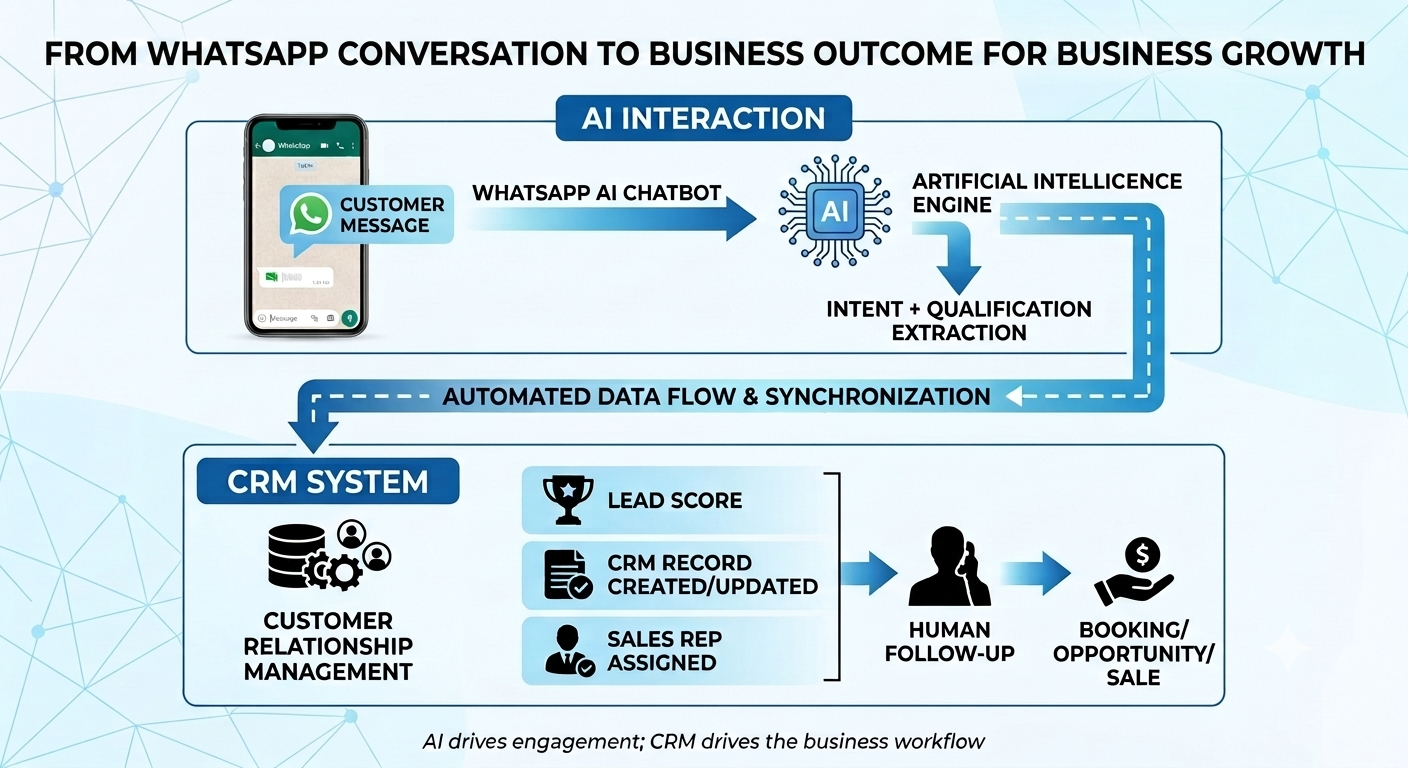
- Ad click opens WhatsApp with a pre-filled intent message (e.g., “I’d like a quote”).
- Instant welcome message sets expectations: “I’ll ask 3 quick questions, then we’ll book you in or connect you to the right person.”
- Question 1 (intent): choose service/type.
- Question 2 (timeline): choose timeframe.
- Question 3 (fit): location/requirements.
- Optional open question: “Anything important we should know?”
- AI summary + tags: creates a short brief and assigns hot/warm/cold.
- Routing: hot leads ping a rep immediately; warm leads get a booking link; cold leads get a helpful resource and opt-in nurture (if appropriate).
- CRM sync: lead created/updated with source + answers + score + owner.
- Follow-up automation: if no booking/no reply, trigger reminders.
Handoff message templates (simple but effective)
- Hot lead: “Thanks—based on your answers, I’m connecting you with a specialist now. They’ll reply here shortly. In the meantime, what’s the best time today?”
- Warm lead: “You look like a fit. The next step is a quick call—here’s the booking link. If you prefer, reply with two times that work.”
- Cold/non-fit: “Thanks for the details. We may not be the best match for that exact request, but here’s a resource that should help. If you want updates and tips here, reply YES to opt in.”
Why these work: they keep momentum, clarify the next step, and reduce uncertainty about when a human appears.
KPIs: How to Measure WhatsApp Lead Generation Without Fooling Yourself
Message volume is not success. A mature funnel is measured by qualified conversations and pipeline contribution.
The KPI stack that actually reflects ROI
| KPI | What It Tells You | Why It Matters |
|---|---|---|
| Median time to first response | How fast leads get acknowledged | Speed reduces drop-off and sets trust |
| Qualification completion rate | How many finish the 3–5 questions | Shows friction in your flow |
| Lead-to-qualified rate | % of chats that meet your criteria | Measures lead quality, not chatter |
| Cost per qualified lead | Ad spend divided by qualified leads | Better than cost per message |
| Booking rate | % of qualified leads who book | Indicates offer strength + handoff quality |
| Human handoff rate | % that require a rep | Helps staffing and automation scope |
| CRM sync accuracy | How often records are correct/complete | Bad data breaks follow-up and reporting |
A practical KPI dashboard checklist
- Qualified leads by source (ad set, website, QR, social)
- Qualified leads by category/service
- Time-to-human for hot leads
- Bookings and show-up rate (if applicable)
- Pipeline stage movement (CRM)
Optimization rule of thumb: Fix response time and handoff before you obsess over AI wording. Speed and routing usually produce bigger gains than rewriting prompts.
Common Mistakes (and What to Do Instead)
Most WhatsApp funnels fail for predictable operational reasons—not because the business chose the “wrong AI.”
Mistake 1: Building the funnel in the free app when you need API-level automation
- Why it happens: the free app is familiar and feels “good enough.”
- Consequence: you can’t scale routing, automation, tracking, or multi-agent workflows reliably.
- Better approach: use WhatsApp Business API via a platform when you need automation, multiple agents, Flows, and CRM sync.
Mistake 2: Asking 10 questions before delivering value
- Why it happens: businesses want to “collect everything upfront.”
- Consequence: drop-off increases and lead quality appears worse than it is.
- Better approach: deliver a small win immediately, then 3–5 questions that directly control routing and next steps.
Mistake 3: No clear human handoff rules
- Why it happens: teams assume someone will “pick it up.”
- Consequence: hot leads wait, get re-asked questions, or disappear.
- Better approach: define hot/warm/cold rules, assignment logic, and a response-time SLA for hot leads.
Mistake 4: Not syncing to CRM (or syncing messy fields)
- Why it happens: CRM mapping feels tedious compared to chat setup.
- Consequence: you can’t measure pipeline impact; follow-up becomes inconsistent.
- Better approach: design CRM fields first, then build the WhatsApp flow to fill them cleanly.
Mistake 5: Nurturing without clear opt-in compliance
- Why it happens: teams treat WhatsApp like email marketing.
- Consequence: trust issues, complaints, and message deliverability problems.
- Better approach: build explicit opt-in steps and verify template/message rules using official guidance and your platform’s documentation.
Decision Tree: What Should You Build First?
Use this quick decision tree to choose the first version of your WhatsApp lead generation funnel without overbuilding.
- If you have low lead volume and one rep: start with a simple entry point + 3 questions + manual follow-up, but set up tracking tags from day one.
- If you have multiple reps or you miss leads: prioritize routing + CRM sync + SLA alerts before adding advanced AI.
- If your leads are unqualified and ad costs feel wasted: tighten the offer + qualification questions and optimize for cost per qualified lead, not cost per message.
- If your process is unique or multi-system: add an automation layer (e.g., custom workflows) only after your baseline funnel performs.
Implementation Priority: Start Today / Improve Next / Scale Later
Start Today (low effort, high leverage)
- Pick one entry point (Click-to-WhatsApp ad or website button).
- Write your welcome message and 3 qualification questions.
- Define what “qualified” means (hot/warm/cold) in one paragraph.
Improve Next (next 30 days)
- Implement structured data capture (Flow/menu) for clean CRM fields.
- Set routing rules and a response-time SLA for hot leads.
- Build a basic follow-up sequence for non-responders.
- Track cost per qualified lead by source.
Scale Later (once you have proof the funnel works)
- Add AI summarization and classification to reduce rep admin work.
- Expand to additional entry points (QR, bio links, more campaigns) with attribution.
- Standardize a reusable funnel template (especially for agencies or multi-location businesses).
FAQs (WhatsApp Lead Generation + AI)
How do I generate leads on WhatsApp?
Use a clear entry point (Click-to-WhatsApp ads, website button, QR code, or social bio link), offer an immediate reason to message you, then run a short qualification flow that routes qualified leads to a human or booking step. Measure success by qualified conversations and bookings—not just message volume.
What is a WhatsApp sales funnel?
A WhatsApp sales funnel is a conversation-based journey that moves a prospect from first message to qualification, handoff to sales, follow-up, and conversion. The best funnels combine fast first response, 3–5 qualification questions, routing rules, and CRM tracking.
Do I need WhatsApp Business API for lead generation?
If you need scalable automation, multiple agents, structured workflows (like Flows), analytics, and reliable CRM sync, you’ll typically need WhatsApp Business API via a platform. The free WhatsApp Business App can work for low-volume, single-user setups but becomes limiting as you scale.
Can ChatGPT be used with WhatsApp?
Yes—usually through a WhatsApp platform or an automation layer that connects WhatsApp to an AI model. In practice, “ChatGPT WhatsApp” is most useful for summarizing conversations, classifying intent, extracting key fields, and supporting qualification—not for fully automating complex sales conversations.
How many questions should my WhatsApp qualification flow ask?
For many small businesses, 3–5 questions is the sweet spot. Ask only what changes the next step (route, book, nurture, disqualify). If a question doesn’t change what happens next, remove it or move it to a later human conversation.
What should I automate first in a WhatsApp lead gen funnel?
Start with first response, qualification, tagging, routing, and reminders. These steps reduce lead drop-off and rep workload quickly. Add deeper AI capabilities later once the basic funnel is producing qualified leads reliably.
How do I measure ROI from WhatsApp lead generation?
Track median response time, qualification completion rate, lead-to-qualified rate, cost per qualified lead, bookings, and conversion rate. If you use a CRM, measure how many WhatsApp leads become opportunities and customers. Avoid judging success by “messages sent” alone.
How do I avoid WhatsApp follow-up messages feeling spammy?
Keep follow-ups clearly tied to the user’s request, limit frequency, and ensure you have appropriate opt-in for ongoing nurture. Use value-based reminders (helpful resource, next step) rather than repeated “checking in” messages, and verify compliance requirements using official guidance and your messaging platform’s rules.
Conclusion: Build the Funnel Like an Ops System, Not a Chat Widget
The businesses that win with WhatsApp lead generation don’t just “add WhatsApp.” They build a small, measurable operating system: one clear entry point, a short qualification flow, fast human handoff for hot leads, reliable CRM sync, and follow-ups that happen on time.
If you remember one principle, make it this: speed and clarity beat clever automation. Get the first response and handoff right, measure cost per qualified lead, and only then expand AI and additional traffic sources.
Next steps: map your current intake workflow, define what “qualified” means, and build a first version with one entry point and 3–5 questions. If you want a second set of eyes on your flow, consider requesting a WhatsApp funnel audit so you can fix handoff, tracking, and qualification before spending more on ads.