
HeyGen Review 2026: Features, Pricing, Use Cases & Is It Worth It for Small Businesses?
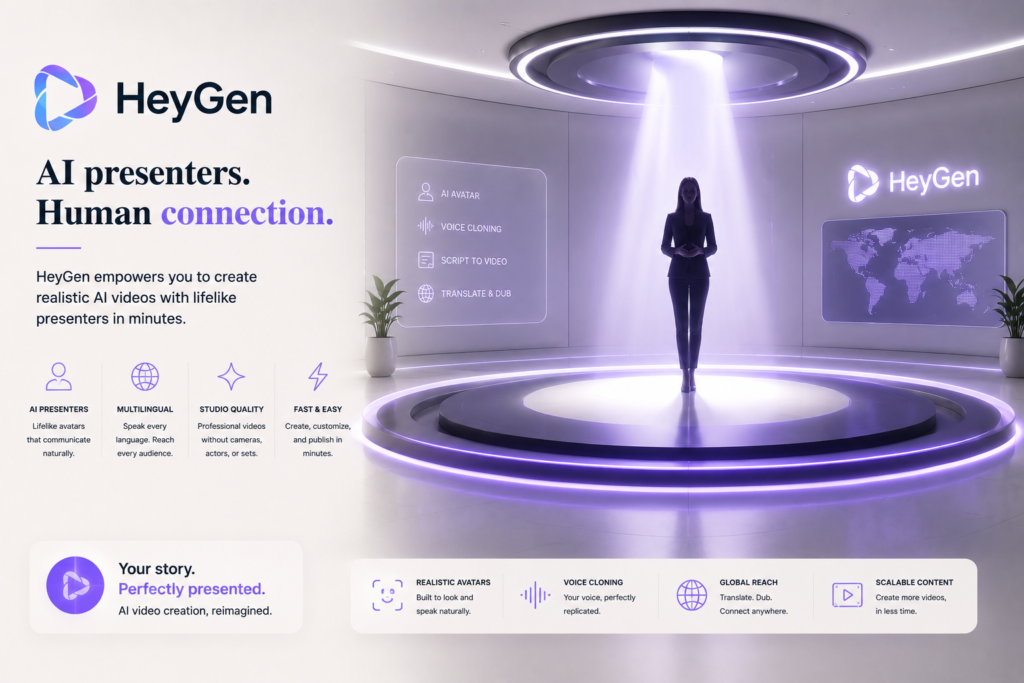
Review type: Research-Based Assessment
Last verified: 17 October 2026
Target audience: Small businesses, marketers, sales teams, HR and training departments, customer-support teams, educators, agencies, and content creators who need presenter-style videos.
Primary business problem: Traditional video production can be time-consuming and difficult to scale across products, audiences, languages, and communication channels.
Disclosure notice: This review is based on publicly available product documentation, pricing information, and other relevant research. Intelligent AI Lab has not independently tested HeyGen. Features, pricing, integrations, and policies may change; verify current details with HeyGen before making a purchase decision.
Quick Verdict: HeyGen
| Review detail | Assessment |
|---|---|
| Primary business problem | Producing presenter-style videos repeatedly without traditional filming and editing for every version |
| Best-fit audience | Small businesses and teams creating recurring marketing, sales, training, support, and multilingual videos |
| Not ideal for | Cinematic filmmaking, highly expressive human performances, or fully autonomous publishing without review |
| Main purpose | Create AI avatar videos from scripts, with voice cloning, translation, templates, and API-based generation |
| Strongest documented advantage | Combining avatar-led video generation, multilingual capabilities, and programmatic video creation |
| Main trade-off | Credit consumption varies by avatar engine and feature, making production costs harder to predict |
| Starting price | Free plan available; Creator listed at $29/month or $24/month with annual billing |
| Free plan | Up to 3 videos per month, videos up to 1 minute, and 1080p export, according to the research reviewed |
| Business-fit verdict | Good Fit for repeatable presenter-style video |
| Research-based rating | 4.15/5 |
| Assessment type | Research-Based Assessment |
| Last verified | 17 October 2026 |
Our Verdict
HeyGen is an AI video-generation platform that turns scripts into presenter-style videos using AI avatars, synthetic voices, voice cloning, translation, templates, and API-based automation. Its strongest potential business application is producing repeatable content such as product explainers, employee onboarding modules, sales presentations, and customer-support tutorials. Its Free plan offers a way to evaluate basic video creation, while paid plans provide additional credits, longer video limits, and more advanced capabilities. The main purchasing consideration is cost control: credit consumption varies significantly by avatar engine and feature. HeyGen deserves consideration when a business regularly needs presenter-style videos, but output quality, localization accuracy, consent requirements, and total cost should be validated before scaling.
Key Takeaways
- Best reason to consider it: Create script-based avatar videos and adapt them for different audiences and languages.
- Main limitation: Premium avatar engines can consume credits much faster than lower-cost options.
- Best business application: Repeatable product explainers, onboarding videos, and customer-support tutorials.
- Pricing consideration: Creator includes 600 credits per month; Business includes 1,500 shared credits for its first seat.
- Alternative to consider: Synthesia for enterprise training, Pictory for long-form video repurposing, or Runway for creative video production.
- Our recommendation: Pilot one repeatable video workflow and measure cost per finished minute, revision effort, and audience quality before committing to higher-volume production.
1. Introduction
Video has become one of the most effective ways for businesses to market products, educate customers, train employees, and engage audiences. However, producing business videos traditionally involves writing scripts, arranging presenters, recording footage, editing, and sometimes repeating the process for different languages or audiences. For a small business without a dedicated production team, these requirements can make regular video communication difficult to maintain.
HeyGen is an AI video-generation platform that creates presenter-style videos using AI avatars, voices, scripts, and visual templates. Its documented capabilities include voice cloning, video translation, collaboration features, and API access for programmatic video generation.
These capabilities may be useful when a business needs to produce recurring content, such as product explainers, employee onboarding, customer tutorials, or localized marketing videos. Rather than filming every version, a team may be able to update an approved script and generate a revised video.
This review evaluates HeyGen’s features, pricing, business applications, integrations, limitations, alternatives, and suitability for small businesses. It is a research-based assessment, not a hands-on product test, and it does not claim that production savings or business outcomes have been independently demonstrated.
2. What Is HeyGen?
HeyGen, developed by HeyGen Inc., is a cloud-based AI video-generation platform focused on presenter-style video creation. Users can create videos using scripts, AI avatars, voices, and visual assets without necessarily recording a human presenter for every video.
| Attribute | Finding |
|---|---|
| Provider | HeyGen Inc. |
| Product category | AI avatar video-generation platform |
| Core functionality | Text-to-video, AI avatars, voice cloning, video translation, templates, collaboration, and API access |
| Target audience | Businesses, marketing and sales teams, HR departments, educators, agencies, and creators |
| Availability | Cloud-based service; verify current web and mobile feature availability |
| Business problem addressed | Repeated production of presenter-style videos and localized versions |
| Deployment model | Cloud-based, with API access for supported programmatic workflows |
HeyGen is best understood as a tool for scalable presenter-style video production. It is not automatically a replacement for a full video-editing suite, a professional film crew, or human-led storytelling.
How It Works
- Input: The user prepares a script and selects an avatar, voice, template, and other supported assets.
- Processing: HeyGen generates a presenter-style video using the selected avatar engine and settings.
- Output: The platform produces a video that can be reviewed and exported using the options available under the user’s plan.
- Review: A person checks factual accuracy, pronunciation, avatar presentation, branding, accessibility, and any legal or compliance claims.
- Integration or action: Where supported and appropriately configured, teams can use templates, collaboration features, or API-based workflows to incorporate video generation into their processes.
Availability, duration, resolution, credit usage, and automation options depend on the plan, avatar engine, and feature. Businesses should confirm these details before designing a production workflow.
3. Research Methodology and Evidence Standards
How This Review Was Prepared
This review is based on the supplied Perplexity research, reported official HeyGen product and pricing information, and business-workflow analysis. Intelligent AI Lab has not directly tested the product.
The assessment considers:
- Documented features and plan restrictions.
- Pricing, credits, video duration, and resolution limits.
- API availability and integration requirements.
- Published privacy, security, and compliance information.
- Potential business applications and operational dependencies.
- Alternatives and the suitability of the product for small businesses.
- Important uncertainties that could affect a purchasing decision.
Evidence Classification
| Label | Meaning |
|---|---|
| Verified from identified sources | Reported as confirmed against identified product or provider sources in the supplied research |
| Research-Based Analysis | An interpretation of documented capabilities and their possible business relevance |
| Not Independently Verified | Not independently tested or sufficiently confirmed by Intelligent AI Lab |
| Illustrative Scenario | A proposed workflow, not an implemented or tested solution |
Important: “Verified” in this article refers to the findings reported in the supplied research. It does not mean Intelligent AI Lab independently repeated every verification. Pricing and feature details should be checked again immediately before publication.
What We Could Not Verify
| Evidence area | Finding |
|---|---|
| Avatar realism and video quality | No independent benchmark was provided for realism, lip-sync accuracy, or emotional expressiveness. |
| Translation quality | Multilingual capabilities are documented in the supplied research, but translation accuracy was not independently evaluated. |
| Ease of use | The script-based workflow is documented; actual learning time and usability were not measured. |
| Support quality | Support quality across Free, Creator, Pro, Business, and Enterprise plans was not independently established. |
| API reliability | API access is documented, but production reliability and error rates were not independently tested. |
| Integration behavior | The practical behavior of specific CRM, email, and automation connectors was not independently tested. |
| Business performance | Improvements in engagement, conversion, comprehension, or training effectiveness were not independently demonstrated. |
| Complete credit rates | The supplied research does not establish the exact cost of every avatar, translation mode, template, asset, or feature. |
| Security and compliance | HeyGen’s reported certifications and compliance claims are provider statements; Intelligent AI Lab has not independently audited them. |
Sources Consulted
The supplied research identifies the following HeyGen source categories:
| Source | Information Used |
|---|---|
| HeyGen Pricing | Business plan pricing, seats, and team positioning |
| HeyGen credit-based pricing help article | Plans, credits, credit consumption, and supported AI features |
| HeyGen API pricing help article | API pricing, avatar types, and credit consumption |
| HeyGen mobile getting-started guide | Free plan quota, Creator pricing, voice cloning, and language support |
| HeyGen FAQs | Plan limits, video durations, resolution, and pay-as-you-go option |
| HeyGen Security Practices | SOC 2 Type II, GDPR, CCPA, DPF, and EU AI Act claims |
| HeyGen Privacy Policy | Data-retention and privacy practices |
| HeyGen Trust & Safety | Compliance and responsible-AI positioning |
4. Key Features of HeyGen
| Feature | What it does | Potential business value | Availability and limitations |
|---|---|---|---|
| AI avatar videos | Creates presenter-style videos using AI avatars | May reduce the need to film every video version | Avatar options and credit consumption vary |
| Text-to-video | Converts scripts into presenter-style videos | May simplify production of recurring content | Duration and output options depend on plan |
| Voice cloning | Creates a synthetic voice based on a person’s voice | May help maintain consistent narration | Usage and consent requirements apply |
| Video translation | Produces localized versions of supported videos | May help adapt content for different language markets | Translation modes and credit costs vary |
| Templates | Provides reusable video layouts | May reduce repetitive setup work | Confirm the templates and options available for the selected workflow |
| Collaboration | Supports team-based video work | May help coordinate marketing, HR, and agency production | Seats and team features may affect cost |
| API access | Enables programmatic video-generation workflows | May support integration into internal systems | API pricing, permissions, and implementation requirements must be checked |
| Video Agent capabilities | Supports certain agent-style video experiences | May enable guided or interactive video use cases | Availability and plan eligibility require confirmation |
The Features That Matter Most for Businesses
1. Repeatable presenter-style video production
HeyGen’s core capability is generating avatar-led videos from scripts. This may be useful when the content structure stays relatively consistent across product updates, onboarding modules, or support explanations.
The business value depends on whether the resulting videos meet the company’s quality standards and require less total effort than the existing process.
2. Multilingual localization
HeyGen’s paid Creator plan is reported to support more than 175 languages and dialects. The platform also offers video translation capabilities.
For businesses serving multiple markets, localization may reduce the need to record each language version separately. However, translated scripts, pronunciation, cultural references, and technical terminology still need appropriate review—especially for customer-facing or regulated content.
3. API-based video generation
HeyGen documents API-based capabilities for supported video-generation workflows. These may help businesses incorporate video creation into an application or automated process.
For example, a business might generate videos from approved product information or standardized onboarding scripts. The feasibility depends on API access, the chosen avatar type, implementation work, and the cost of usage.
4. Credit-based cost management
Credit usage is a major purchasing consideration. The supplied research reports the following examples:
| Avatar engine or video look | Reported credit consumption |
|---|---|
| Avatar III Video Look | 4 credits/minute |
| Avatar IV Video Look | 31 credits/minute |
| Avatar V | 48 credits/minute |
These examples illustrate why subscription price alone is not enough to assess value. Credit consumption can vary substantially, and a business should verify the current rate for its specific workflow before calculating production costs.
5. How Businesses Can Use HeyGen
| Business function | Example problem | How HeyGen may help | Human oversight or requirement |
|---|---|---|---|
| Marketing | Campaign videos take time to produce and update | Create product explainers, announcements, and promotional videos | Review claims, branding, accessibility, and platform requirements |
| Sales | Repeated outreach and product explanations consume staff time | Create standardized prospect, proposal, or follow-up videos | Validate recipient details and avoid misleading personalization |
| HR and training | Onboarding content becomes outdated | Regenerate videos after approved script changes | HR and legal approval for policy-sensitive material |
| Customer support | Customers need repeated explanations of common issues | Create FAQ, walkthrough, and troubleshooting videos | Check accuracy and update content when the product changes |
| Global communication | Separate language versions require repeated production | Translate or localize supported video content | Native-speaker review for accuracy and cultural fit |
| Agencies | Client video production requires repeated setup | Use reusable scripts and templates for recurring deliverables | Client approval, brand governance, and rights management |
Best-Fit Business Use Case: Product Explainers and Onboarding Videos
Business problem: A company regularly creates similar videos and needs to update them when product features, policies, or procedures change.
Relevant capability: HeyGen supports script-based avatar videos, templates, voices, translation, and API access.
Inputs required: Approved scripts, brand assets, avatar and voice selections, and a defined review process.
Proposed workflow:
- Prepare and approve the script.
- Select an approved avatar, voice, and template.
- Generate the video.
- Review factual accuracy, presentation, and accessibility.
- Publish the approved version to the relevant website, help center, or learning platform.
- Track production time, revision effort, and total cost.
Risks: Outdated information, unnatural presentation, translation errors, consent issues, and uncontrolled credit usage.
Suggested pilot metrics: Production time per approved video, cost per finished minute, number of revisions, update turnaround time, and viewer comprehension or completion rate.
These are proposed metrics, not demonstrated HeyGen outcomes.
6. Intelligent AI Lab Business Decision Analysis
The Business Problem HeyGen Is Best Suited to Address
HeyGen is most relevant when a business needs to produce presenter-style videos repeatedly but wants to reduce dependence on recording a presenter for every version.
Consider a small business that creates onboarding videos, product walkthroughs, and customer tutorials. When a product or policy changes, traditional production may require arranging another recording and editing session. A script-based avatar workflow may make some updates easier to produce.
The business objective should not be simply to create more AI videos. It should be to deliver accurate, useful, approved video content at an acceptable cost and turnaround time.
Is This the Right Tool for the Job?
| Decision factor | Assessment |
|---|---|
| Primary use case | Repeatable presenter-style video for marketing, sales, training, support, and localization |
| Capability fit | Strong potential fit for standardized presenter videos; weaker fit for cinematic storytelling |
| Main advantage | Combines avatar videos, voice cloning, translation, templates, and API access |
| Main trade-off | Credit consumption varies by avatar engine and feature |
| Cost consideration | Subscription, credits, extra seats, API usage, revisions, and review labor |
| Implementation consideration | Requires script approval, voice and likeness permissions, brand standards, and quality control |
| Key uncertainty | Whether avatar realism, translation quality, and generation reliability meet the buyer’s requirements |
When to Choose HeyGen
HeyGen deserves consideration when:
- You regularly produce presenter-style videos.
- Your content follows repeatable formats, such as onboarding, product explainers, or support tutorials.
- You need localized versions of the same core message.
- You want to explore programmatic video generation through an API.
- Your team can review scripts and finished videos before publication.
- You can estimate credit consumption and monitor the cost per approved video.
When to Choose an Alternative
Consider Synthesia if enterprise training and corporate communication are the primary requirements. Compare its current features, pricing, governance, and output quality for your specific workflow.
Consider Pictory if your main task is repurposing existing long-form content into short videos.
Consider Runway if creative video generation, visual effects, or more flexible visual editing matter more than presenter-led content.
Consider CapCut if you mainly need conventional social-video editing with AI-assisted features.
Consider ChatGPT if the main bottleneck is writing scripts, developing content ideas, or planning video campaigns rather than producing finished avatar videos.
When Not to Use AI
HeyGen may be unnecessary when a business publishes only a few videos a year, already has an efficient filming process, or relies on authentic founder, employee, or customer storytelling.
A template, screen recording, conventional video editor, or short written explanation may be more practical for simple tasks.
AI-generated videos should not be the sole authority for legal, medical, financial, safety-critical, or regulated communications. Qualified people should review and approve such content.
Our Recommended Next Step
Conduct a limited pilot.
Choose one repeatable video type, such as a product explainer or onboarding module. Create a small set of videos using a consistent script structure and approved visual style.
Measure:
- Time from approved script to publishable video.
- Cost per finished minute, including credits and review labor.
- Credit consumption by avatar engine.
- Number of corrections and revisions.
- Translation accuracy, where relevant.
- Viewer comprehension or completion, if measurable.
Establish a baseline using your current production process before comparing results. Expand only if the finished output meets quality requirements and the total cost is acceptable.
Evidence note: This is a research-based recommendation. Intelligent AI Lab has not conducted this pilot or demonstrated production-time savings.
7. Illustrative Business Automation Examples
These are proposed workflows, not solutions implemented or tested by Intelligent AI Lab.
Example 1: Multilingual Product-Explainer Workflow
Business scenario: A small software company needs product-explainer videos for several language markets.
Tools involved: HeyGen, approved scripts, brand assets, and the company’s review and localization process.
Before
The team writes a script, records a presenter, edits the footage, and creates separate language versions.
Proposed workflow
- Trigger: A product feature or campaign is approved.
- Input: The approved script, product visuals, branding, and target-language list.
- AI processing: HeyGen generates the presenter-style video and produces supported localized versions.
- Human review: Product and language reviewers check claims, terminology, pronunciation, and cultural fit.
- Publication: The team publishes the approved versions to its website, help center, or marketing channels.
Potential benefits
- Potentially simpler production of localized videos.
- More consistent messaging across markets.
- Easier script-based updates.
Requirements and limitations
- Native-speaker review may be needed for each target language.
- Credit consumption varies by generation and translation mode.
- Product claims and visuals require approval.
- Publishing integrations may require separate services or custom configuration.
Suggested success metrics
- Time from approved script to publication.
- Cost per finished minute.
- Number of languages produced.
- Translation revision rate.
- Viewer engagement or comprehension.
Example 2: Employee Onboarding Video Library
Business scenario: A growing business needs onboarding videos for policies, tools, and role-specific processes.
Tools involved: HeyGen, approved HR scripts, company branding, and HR/legal review.
Before
HR records videos manually and repeats production when policies or procedures change.
Proposed workflow
- Trigger: A policy or onboarding procedure changes.
- Input: The revised, approved script and relevant brand assets.
- AI processing: HeyGen generates an updated avatar-led video.
- Human review: HR and, where needed, legal reviewers validate the content.
- Publication: The approved video replaces the outdated version in the onboarding portal or learning system.
Potential benefits
- Potentially faster content updates.
- More consistent presentation across onboarding modules.
- Reduced dependence on arranging repeated recordings.
Requirements and limitations
- Policy-sensitive content requires appropriate review.
- Voice and likeness rights must be managed.
- The organization needs a clear process for retiring outdated versions.
- Credit consumption should be monitored for large video libraries.
Suggested success metrics
- Time required to update a video.
- Percentage of onboarding content that is current.
- Employee completion and comprehension.
- Production and revision effort per module.
Evidence note: Both examples are illustrative. Their feasibility, output quality, and business impact should be evaluated in a controlled pilot.
8. Pros and Cons of HeyGen
| Pros | Cons |
|---|---|
| Supports script-based avatar video generation, voices, translation, templates, and API access | Credit consumption can vary substantially by avatar engine and feature |
| Offers a Free plan for initial evaluation | Free-plan video quotas and duration limits restrict more extensive use |
| Creator includes a reported allowance of 600 credits per month | Buyers need to estimate usage before deciding whether the allowance is sufficient |
| Business supports a reported allowance of 1,500 shared credits and 4K output | Additional seats and high usage add cost |
| API access may support automated generation workflows | API pricing and integration requirements need separate evaluation |
| Publishes security and compliance information | Provider statements do not replace a buyer’s own security and contractual review |
What These Pros and Cons Mean for Buyers
HeyGen’s main attraction is the possibility of producing repeatable presenter-style videos without recording every version. This is particularly relevant for businesses with recurring product, onboarding, or support content.
The main purchasing risk is assuming that the subscription price represents the total production cost. Credit consumption, additional seats, API charges, review effort, and revisions can all affect the economics.
For occasional video needs, a conventional editor, screen recording, or external production service may be sufficient. For regular production, HeyGen deserves evaluation—but only against actual quality requirements and the cost of the existing process.
9. HeyGen Pricing and Plans
Pricing verification date: 17 October 2026
The following prices and limits are reported in the supplied research from HeyGen’s official pricing and help-center information. They should be rechecked before publication because plans, prices, and usage rules may change.
| Plan | Reported price | Billing basis | Best for | Reported limits and notes |
|---|---|---|---|---|
| Free | $0 | Free quota | Initial evaluation | Up to 3 videos/month, videos up to 1 minute, 1080p export, one custom video avatar, and 3 Video Agent videos/month |
| Creator | $29/month or $24/month billed annually | Monthly or annual subscription | Individual creators and professionals | 600 credits/month, videos up to 30 minutes, 1080p export, watermark removal, voice cloning, and 175+ languages/dialects |
| Pro | Starts at $49/month | Subscription with credit allowance | Individuals needing more generation capacity | Reported starting allowance of 1,000 credits/month; confirm the current plan structure |
| Business | $149/month for the first seat; additional seats $20/seat/month | Subscription plus additional seats | Teams producing business videos | 1,500 shared credits/month, 4K output, and videos up to 60 minutes |
| Enterprise | Custom pricing | Custom contract | Organizations with larger or specialized requirements | Confirm available security, administration, support, and usage arrangements |
Official website: HeyGen. Use the current pricing page and help-center documentation linked from the official website to confirm exact plan terms.
What to Know Before Paying
1. The Free plan uses a video quota, not the paid credit allowance.
The supplied research reports a limit of up to three videos per month, each up to one minute, with 1080p export. Confirm any restrictions on avatars, watermarks, exports, and Video Agent access.
2. Creator and Pro are separate plans.
Creator is reported at $29 monthly or $24 monthly with annual billing, with 600 credits per month. Pro is reported to start at $49 monthly with 1,000 credits per month. Confirm the current credit allowance and eligible features before choosing.
3. Business uses shared credits.
The reported Business allowance is 1,500 shared credits for the first seat, with additional seats priced at $20 per month each. Confirm how credits are shared, whether unused credits roll over, and what happens when the allowance is exhausted.
4. Avatar choice affects cost.
The supplied research reports these example rates:
| Avatar engine or look | Reported consumption |
|---|---|
| Avatar III Video Look | 4 credits/minute |
| Avatar IV Video Look | 31 credits/minute |
| Avatar V | 48 credits/minute |
These rates should not be applied to every feature or video mode. Confirm the rate card for the exact avatar, look, duration, and workflow you plan to use.
5. API usage may have separate costs.
The supplied research reports the following API examples:
| API avatar type | Reported cost |
|---|---|
| Avatar IV Photo Avatar | $2.31/minute |
| Avatar IV Digital Twin or Studio Avatar | $4.83/minute |
| Avatar V Digital Twin | $7.20/minute |
Verify current API pricing, billing units, minimum commitments, and any plan or access requirements directly with HeyGen. Do not assume that consumer-plan credits and API charges are interchangeable.
Is HeyGen Worth the Price?
HeyGen may be worth paying for if your business regularly creates presenter-style videos and can reuse approved scripts, templates, avatars, and production standards.
The relevant comparison is total cost per approved video, not subscription price alone. Include credits, seats, API usage, translation, staff review, revisions, and maintenance.
If you publish only a few videos annually, a conventional editor or occasional outsourced production may be more economical. If you create videos frequently, a pilot can help determine whether HeyGen offers an acceptable combination of output quality, turnaround time, and total cost.
Best Plan Recommendation
| Buyer type | Starting point to evaluate | Why | What to verify |
|---|---|---|---|
| Business evaluating the product | Free | Allows initial exploration without a subscription | Video quota, duration, export, and avatar restrictions |
| Solo creator or marketer | Creator | Reported 600-credit allowance and additional capabilities | Expected monthly credit consumption |
| Individual with heavier usage | Pro | Higher reported starting credit allowance | Exact plan features and credit needs |
| Small team | Business | Shared credits, 4K output, and additional seats | Total seat cost and shared-credit usage |
| High-volume or automated production | API or Enterprise evaluation | May support specialized workflow requirements | API rate card, security, access requirements, and contract terms |
These are starting points for evaluation, not unconditional recommendations. The best plan depends on actual video volume, avatar choice, quality requirements, and budget.
10. Integrations and Technical Requirements
HeyGen’s API is relevant for businesses that want to incorporate video generation into their own applications or automated processes. However, API availability should not be confused with a ready-made native connector for every CRM, email platform, or automation service.
| Integration or requirement | Findings | What to verify |
|---|---|---|
| CRM and sales systems | API access is documented in the supplied research; specific native CRM connectors were not established | Supported CRM, API actions, data fields, and authentication |
| Email and collaboration | Team collaboration is documented; detailed native email or messaging integrations were not established | Supported services and available actions |
| Automation platforms | API-based automation may be possible | Whether a native connector exists, or middleware/custom development is required |
| API and webhooks | Programmatic video generation is documented | Current API endpoints, rate limits, pricing, and plan requirements |
| Data and assets | Scripts, voices, avatars, and media assets form part of the workflow | Supported formats, upload restrictions, export options, and usage rights |
| Security and administration | HeyGen publishes security information and offers team-oriented plans | Roles, permissions, audit controls, contractual terms, and enterprise requirements |
| Implementation | Standardized scripts and review processes are likely to be important | Setup effort, maintenance, error handling, and staff ownership |
Native vs. Third-Party Integrations
- Native capabilities: AI avatar generation, script-to-video workflows, voice features, translation, templates, and API access are documented in the supplied research.
- Plan-dependent capabilities: Video length, resolution, credit allowance, and team features depend on the plan.
- Custom integration: Connecting video generation to a CRM, HR platform, or internal application may require API development or middleware.
- Unverified integrations: Specific connectors for a buyer’s CRM, email platform, Zapier, or Make should be confirmed before designing a workflow.
Implementation Considerations
A practical starting point is a standardized video template with an approved script structure, avatar, voice, and review checklist.
Before automating generation, establish ownership for script accuracy, consent, brand compliance, credit monitoring, and publishing approval. The more customer-facing the content, the more important exception handling and human review become.
11. HeyGen vs. Alternatives
The best alternative depends on whether the primary need is avatar-led video, enterprise training, video repurposing, creative editing, or content planning.
| Tool | Best for | Key difference | Pricing position | Consider it instead when |
|---|---|---|---|---|
| HeyGen | Avatar videos, voice features, and multilingual presenter content | Script-to-avatar video with API-based generation | Free quota; paid plans and usage-based considerations | You need repeatable presenter-style videos |
| Synthesia | Enterprise training and corporate communication | Strong candidate for structured corporate video and learning workflows | Verify current pricing | Enterprise training, governance, and corporate communication are central |
| Pictory | Repurposing long-form content | Focuses on converting existing content into shorter videos | Verify current pricing | You want to turn webinars, podcasts, or long videos into short content |
| Runway | Creative AI video generation and editing | Focuses on generative visual production and creative editing | Verify current pricing | Visual effects, creative experimentation, or generative footage matter most |
| CapCut | Social-video editing | Offers conventional editing with AI-assisted features | Verify current pricing and feature availability | You need hands-on editing for social platforms |
| ChatGPT | Scriptwriting and content planning | General-purpose AI assistance rather than avatar-video production | Check current plans | Your main need is writing, research, or video strategy |
Which Tool Should You Choose?
- Choose HeyGen if you need repeatable presenter-style videos, multilingual localization, or API-based video generation.
- Choose Synthesia if enterprise training and corporate communication are your primary requirements.
- Choose Pictory if you want to repurpose long-form content into short videos.
- Choose Runway if you need creative AI video generation and visual editing.
- Choose CapCut if you primarily need conventional social-video editing.
- Choose ChatGPT if your bottleneck is scriptwriting and planning rather than video rendering.
No single tool is the universal winner. Compare the output, workflow, cost, and governance requirements that matter to your business.
12. Who Should Use HeyGen?
Recommended For
- Small-business owners: For repeatable product explainers, announcements, and customer education.
- Marketing teams: For campaign videos, landing-page content, and localized messaging.
- Sales teams: For standardized prospect presentations and follow-up content.
- HR and training teams: For onboarding and internal communication videos.
- Customer-support teams: For FAQ, troubleshooting, and product walkthrough videos.
- Educators and agencies: For recurring presenter-style content and client video workflows.
Not Ideal For
- Cinematic production: Businesses needing extensive live-action footage, complex cinematography, or actor-led performances.
- Highly expressive storytelling: Brands for which authentic human delivery and emotional nuance are central.
- Fully autonomous publishing: Organizations unable to review accuracy, branding, rights, and compliance.
- Very high-volume production on a tight budget: Credit consumption may make premium avatar workflows expensive.
- Occasional video creation: A simpler editor or existing recording workflow may be sufficient.
Best-Fit Buyer Profile
The strongest candidate is a business that regularly produces presenter-style videos, has repeatable content formats, and can maintain a consistent review process.
The buyer should be willing to measure cost per approved video, validate avatar and translation quality, and manage credit usage rather than judging value by the advertised subscription price alone.
13. How to Get Started With HeyGen
Step 1: Identify One Business Problem
Choose a repeatable, measurable task, such as an onboarding module, product explainer, or FAQ video.
Step 2: Confirm Product Fit
Verify that the required avatar engine, video duration, resolution, translation mode, and API capabilities are available under the intended plan.
Step 3: Review Data and Permissions
Identify the scripts, brand assets, personal data, and voice or likeness information the workflow requires. Review current privacy terms and obtain appropriate consent before using a person’s voice or likeness.
Step 4: Design a Limited Pilot
Define the inputs, expected output, review steps, exception handling, and fallback process. Retain human approval for customer-facing and sensitive content.
Step 5: Establish a Baseline
Record the current production process before introducing HeyGen.
Useful measures include:
- Time per approved video.
- Cost per finished minute.
- Number of revisions.
- Production turnaround time.
- Translation correction effort.
- Viewer comprehension or completion rate.
Step 6: Evaluate the Pilot
Compare the results with the baseline. Include subscription fees, credits, additional seats, API costs, translation, and staff review time.
Step 7: Decide Whether to Expand
Continue, revise, or stop based on evidence. Scale only when the output meets the required quality standard and the business case is supported by the pilot.
14. Limitations, Risks, and Governance
| Risk area | Research findings | What businesses should check |
|---|---|---|
| Accuracy and reliability | Real-world avatar quality, lip-sync, and translation performance were not independently benchmarked | Test representative scripts, accents, languages, and output types |
| Privacy and data retention | HeyGen publishes privacy information; specific retention terms should be reviewed directly | Review the current privacy policy and data-processing agreement |
| Model training and data use | The supplied research does not establish every current model-training setting or term | Confirm whether submitted content may be used for training and what controls are available |
| Security | HeyGen states it is SOC 2 Type II certified and publishes other security claims | Obtain current documentation and conduct the required vendor assessment |
| Compliance | Provider statements do not establish suitability for every regulated workflow | Obtain legal and compliance review where required |
| Access and permissions | Team and seat features are reported; detailed administrative controls require verification | Confirm roles, permissions, auditability, and workspace administration |
| Usage limits | Paid plans use credits, with consumption varying by feature and avatar engine | Confirm the current rate card and overage or additional-purchase terms |
| Human oversight | Generated content can contain inaccurate or unsuitable material | Require script approval and finished-video review |
| Voice and likeness rights | Voice cloning and synthetic likenesses create consent and rights considerations | Obtain explicit authorization and maintain consent records |
| Vendor dependency | Video export is documented in the supplied research; portability of avatars, voices, and configurations is less clear | Check export formats, retention, migration options, and contract termination terms |
| Support and continuity | Support quality was not independently established | Confirm support channels, service commitments, and escalation options |
What Businesses Should Check Before Adoption
- Pricing and usage: Verify current regional pricing, credits, duration limits, and the rates for the exact avatar engine and translation mode.
- Privacy and security: Review HeyGen’s current privacy policy, security documentation, data-processing terms, and subprocessors where relevant.
- Consent and rights: Establish approval for voice cloning, likeness use, scripts, and any third-party content.
- Quality controls: Define who approves factual claims, translations, branding, accessibility, and publication.
- Operational readiness: Determine how errors, failed generations, outdated videos, and credit overruns will be handled.
- Vendor assurance: For security-sensitive deployments, request relevant current documentation rather than relying solely on marketing statements.
HeyGen reports SOC 2 Type II certification and compliance-related commitments involving GDPR, CCPA, the EU-U.S. Data Privacy Framework, and the EU AI Act. These statements should be checked against current provider documentation and the requirements applicable to the buyer. Intelligent AI Lab has not independently audited HeyGen’s security posture.
15. Final Verdict: Is HeyGen Worth It?
HeyGen is worth considering for small businesses and teams that regularly need presenter-style videos and want an alternative to recording every version manually. Its documented capabilities include script-to-avatar video creation, voice cloning, translation, templates, collaboration, and API access.
The strongest reason to consider HeyGen is the ability to standardize and potentially simplify recurring video production. This is especially relevant to product explainers, onboarding modules, and customer-support tutorials that need regular updates.
The biggest trade-off is cost and quality control. Credit usage varies by avatar engine and feature, while avatar realism, translation accuracy, and generation reliability need to be evaluated against the business’s own standards. The subscription price alone does not reveal the full cost of producing an approved video.
Businesses that primarily need cinematic storytelling, highly expressive human performances, or occasional low-volume videos may prefer a different production approach. Before committing, verify the current pricing and credit rate card, test representative content, and review the applicable privacy, consent, and security requirements.
Final Buying Recommendation: Pilot
Start with a small, repeatable video workflow. Compare the results against the existing production process using cost per approved minute, turnaround time, revision effort, and audience-quality measures. Expand only if the pilot demonstrates acceptable quality and business value.
16. Intelligent AI Lab Rating and Scorecard
A. Business-Fit Verdict
Good Fit for businesses that need repeatable presenter-style videos, localization, or programmatic video generation.
Conditional Fit for cinematic storytelling, highly expressive human-led content, or high-volume production where credit costs must remain tightly controlled.
These assessments apply to the use cases described in this review, not to every possible HeyGen application.
B. Assessment Type
Research-Based Assessment. No hands-on product testing or business pilot was conducted by Intelligent AI Lab.
C. Evidence Confidence
Moderate overall.
Confidence is relatively strong for core capabilities, plan structure, credit model, API pricing, and security claims, because these are documented by official HeyGen sources. Confidence is lower for real-world avatar quality, translation accuracy, API reliability, support quality, and business outcomes because these were not independently tested.
Security and compliance statements are attributed to HeyGen and should not be interpreted as an independent audit.
D. Numerical Rating
Research-based rating: 4.15/5
Rating date: 17 October 2026
This rating represents Intelligent AI Lab’s structured assessment of suitability for repeatable presenter-style business video. It is not a hands-on performance benchmark.
Weighted Scorecard
The weights below are Intelligent AI Lab’s proposed evaluation rubric, not a validated industry standard.
| Criterion | Weight | Score | Evidence and rationale |
|---|---|---|---|
| Core capability fit | 25% | 5/5 | The supplied research documents script-to-video, AI avatars, voice features, translation, templates, and API access. Real-world quality remains untested. |
| Business workflow fit | 20% | 4/5 | Strong potential fit for recurring marketing, sales, HR, and support videos; less suitable for cinematic or highly expressive human-led storytelling. |
| Implementation feasibility | 15% | 4/5 | Standardized scripts and templates may support repeatable production, but governance, consent, review, and credit monitoring are required. |
| Integrations and interoperability | 15% | 3/5 | API access is documented, but the supplied research does not establish the availability and behavior of specific native CRM or automation connectors. |
| Pricing and cost suitability | 15% | 3/5 | An accessible entry point is reported, but credit consumption varies substantially and high-volume production may become expensive. |
| Governance and operational readiness | 10% | 4/5 | HeyGen publishes security and compliance information; buyer-specific controls and independent security validation remain to be confirmed. |
Weighted calculation:
(5 × 0.25) + (4 × 0.20) + (4 × 0.15) + (3 × 0.15) + (3 × 0.15) + (4 × 0.10) = 4.15/5
Overall Assessment Summary
- Business-fit verdict: Good Fit
- Research-based rating: 4.15/5
- Evidence confidence: Moderate overall
- Assessment type: Research-Based Assessment
What the rating means: HeyGen appears to be a promising option for repeatable presenter-style video production, based on the documented capabilities and reported plan structure. Its suitability depends on the buyer’s quality requirements, actual credit consumption, integration needs, and governance processes. The rating should not be interpreted as proof that HeyGen will improve engagement, reduce costs, or deliver a particular return on investment.
17. Decision Checklist: Should You Choose HeyGen?
Choose or Shortlist HeyGen If:
- You regularly create presenter-style videos.
- You need to update scripts and generate revised versions.
- You need multilingual versions of core content.
- You want to explore API-based video generation.
- You can maintain voice consent, script approval, and human review.
- You can estimate and monitor credit consumption.
- You can measure the results of a limited pilot.
Consider an Alternative If:
- Your main need is enterprise training or compliance video.
- Your primary task is converting long-form content into short videos.
- You need creative visual effects or advanced editing.
- You publish videos infrequently and a simpler process is sufficient.
- Credit costs do not fit your expected production volume.
- Required security, integration, or governance conditions cannot be confirmed.
Decision guidance: If avatar realism, translation accuracy, credit cost, or compliance is critical, resolve those uncertainties through testing and vendor verification before committing to a larger plan.
18. Frequently Asked Questions About HeyGen
What is HeyGen used for?
HeyGen is used to create AI avatar-led videos from scripts. Potential applications include marketing, sales, training, onboarding, customer support, education, and multilingual communication.
Is HeyGen free?
Yes. The supplied research reports a Free plan with up to three videos per month, videos up to one minute, and 1080p export. Verify current restrictions and eligible features on HeyGen’s official website.
How much does HeyGen cost?
The supplied research reports Creator at $29/month or $24/month with annual billing, Pro starting at $49/month, and Business at $149/month for the first seat, with additional seats at $20/month each. Enterprise pricing is custom. Confirm current prices, credit allowances, and billing conditions before subscribing.
Is HeyGen suitable for small businesses?
It may be suitable for small businesses that regularly produce presenter-style videos but lack a dedicated production team. The main considerations are credit costs, output quality, staff review, consent, and localization accuracy.
Is HeyGen better than ChatGPT?
They serve different purposes. HeyGen focuses on avatar-video generation, while ChatGPT can help with scriptwriting, research, content planning, and related tasks. A business may use a general-purpose AI assistant to prepare scripts and HeyGen to generate the videos, subject to its quality and governance requirements.
Does HeyGen support voice cloning?
The supplied research reports voice-cloning capabilities, with broader functionality on paid plans. Before cloning a voice, verify current plan restrictions and obtain the required consent and authorization.
Can businesses automate video creation using HeyGen?
HeyGen documents API access for supported video-generation workflows. Integrating it into a CRM, HR platform, or marketing system may require API development or middleware. Confirm access requirements, usage limits, and current API pricing before implementation.
Does HeyGen support multilingual videos?
The supplied research reports translation capabilities and support for more than 175 languages and dialects on eligible plans. Actual translation quality and available modes should be tested for the intended language pair and content type.
Is HeyGen safe for business data?
HeyGen publishes privacy, security, and compliance information, including provider-reported SOC 2 Type II certification and regulatory commitments. These statements are not a guarantee that every deployment meets a buyer’s requirements. Review current contractual terms, data-handling policies, access controls, and applicable compliance obligations before uploading sensitive information.