
Relevance AI Review 2026: Features, Pricing, Use Cases & Is It Worth It for Small Businesses?
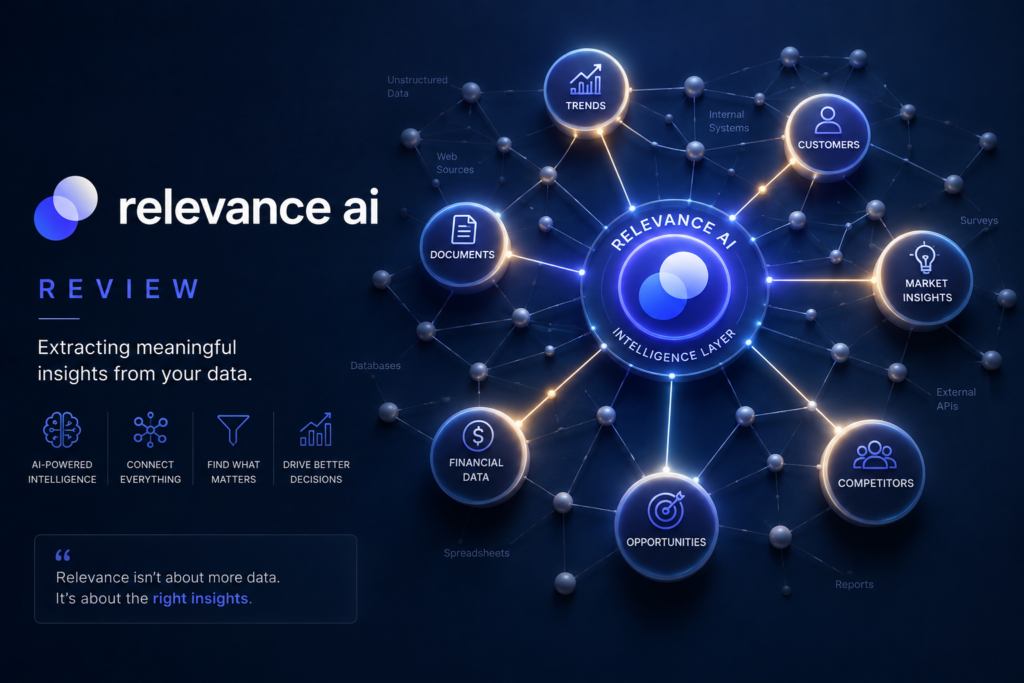
Review type: Research-Based Assessment
Research date: 19 October 2026
Target audience: Small businesses, growing companies, operations teams, automation specialists, and enterprises evaluating AI-agent automation
Primary business problem: Reducing repetitive knowledge work and coordinating multi-step business workflows using AI agents and connected applications.
Disclosure notice: This review is based on publicly available product documentation, official pricing information, and the research sources listed below. Intelligent AI Lab has not independently tested Relevance AI. Features, pricing, integrations, usage limits, and policies may change; verify current details with the provider before making a purchase decision.
Quick Verdict: Relevance AI
| Review detail | Assessment |
|---|---|
| Provider | OnSearch Pty Ltd T/A Relevance AI |
| Official website | Relevance AI |
| Primary business problem | Manual research, lead qualification, knowledge retrieval, and multi-step operational workflows |
| Best-fit audience | Sales, marketing, support, and operations teams building AI agents and AI Workforces |
| Not ideal for | Businesses needing only simple app-to-app automation or a general-purpose AI chatbot |
| Main purpose | Build, deploy, and manage AI agents, tools, workflows, and multi-agent Workforces |
| Strongest documented advantage | AI agents, tools, Workforces, 2,000+ integrations, and BYOK model flexibility |
| Main trade-off | Actions and Vendor Credits can be difficult to forecast, and agent outputs require human review |
| Starting price | Pro: $19/month billed annually or $29/month billed monthly, according to the supplied research |
| Free plan or trial | The supplied research reports that the Free plan has been retired; current trial availability was not independently verified |
| Business-fit verdict | Good Fit for AI-agent-driven sales and operations automation; Conditional Fit for simple automation needs |
| Research-based rating | 4.1/5 |
| Assessment type | Research-Based Assessment |
| Research date | 19 October 2026 |
Our Verdict
Relevance AI is an AI-agent platform designed to help businesses build agents, create reusable tools, connect business information, and coordinate multiple agents through Workforces. Its documented capabilities may suit teams that want to automate multi-step knowledge tasks rather than simply connect applications using fixed rules. The supplied research identifies integrations, API access, knowledge connections, and different subscription tiers as relevant capabilities. However, the actual reliability of agents, ease of implementation, and achievable business savings have not been independently established in this review. Its separate Action and Vendor Credit allowances also mean buyers need to estimate running costs carefully. Relevance AI deserves consideration for a well-defined, measurable workflow, provided the business validates cost, accuracy, integrations, and governance before scaling.
Key Takeaways
- Best reason to consider it: Configurable agents, reusable tools, and multi-agent Workforces.
- Main limitation: Real-world reliability and business outcomes remain unverified in this review.
- Best business application: A repetitive, multi-step knowledge workflow that requires connected tools and human review.
- Pricing consideration: Subscription charges are only part of the potential cost; Actions and Vendor Credits must also be considered.
- Alternative to consider: n8n, Zapier, or Make for workflows that may be solved more simply through conventional automation.
- Our recommendation: Shortlist Relevance AI for a specific use case, then run a limited pilot before committing to wider adoption.
1. Introduction
AI is rapidly transforming how businesses operate, but many organizations still struggle to build AI solutions that can perform real business tasks autonomously. While chatbots answer questions, businesses increasingly need AI agents that can research information, analyze data, automate workflows, and complete tasks with minimal human involvement.
Businesses often spend considerable time gathering information, updating applications, preparing reports, researching customers, and coordinating tasks across multiple systems. Some workflows are predictable enough for traditional automation, while others involve interpreting information and deciding which steps to take next.
Relevance AI is an AI-agent platform designed to help businesses build agents that use tools, work with connected information, and coordinate tasks through multi-agent Workforces. Its documented capabilities include visual or no-code tool building, API access, business application integrations, and knowledge-source connections.
These capabilities may be useful when a business needs more than a chatbot but does not want to build every agent workflow entirely from scratch. However, an agent-based approach can also introduce execution costs, implementation effort, and new governance requirements.
This review evaluates Relevance AI’s documented features, pricing, business applications, integrations, limitations, alternatives, and suitability for business adoption. The central question is whether its capabilities justify using AI agents for a particular business problem.
2. What Is Relevance AI?
Relevance AI is an AI agent development and automation platform developed by Relevance AI. Agents can be configured to use tools, work with relevant information, and interact with supported applications, depending on their setup and permissions.
Founded in 2020, the company initially focused on AI-powered search and data analysis before evolving into a comprehensive platform for building autonomous AI agents. Today, businesses use Relevance AI to create AI-powered assistants capable of performing research, managing workflows, interacting with business applications, and supporting employees and customers.
Unlike traditional chatbots, Relevance AI enables organizations to build AI agents that can reason, make decisions, execute workflows, and collaborate with other tools.
- Provider: OnSearch Pty Ltd, trading as Relevance AI, according to the supplied research.
- Product category: AI-agent development and workflow automation.
- Launch or release information: Not independently verified for this review.
- Core functionality: Building agents and tools, connecting information sources, and coordinating agents through Workforces.
- Target audience: Business operations teams, automation specialists, growing businesses, and enterprises.
- Availability: The reviewed documentation describes a web-based platform and API-related capabilities. Exact client and deployment availability should be confirmed with the provider.
- Deployment model: Not independently verified in sufficient detail for this review.
- Official website: https://relevanceai.com
How It Works
A typical agent workflow can be understood in five steps. The exact implementation depends on the selected tools, integrations, and configuration.
- Input: A user, trigger, or connected workflow supplies an instruction, request, or relevant information.
- Processing: An agent interprets the task and uses its configured instructions and capabilities.
- Tool execution: Where configured and supported, the agent runs tools to retrieve information or perform an operation.
- Review: A person checks the result or approves consequential actions when the workflow requires human oversight.
- Integration or action: The workflow may interact with connected applications or pass its output to another step.
Multi-agent Workforces can coordinate agents across a larger workflow. However, exact triggers, tool actions, approval mechanisms, and integration requirements must be verified for the intended use case.
Business-first principle: Use agents where interpretation and tool use add value. Do not add AI to a task that an existing, reliable rule-based process already handles effectively.
3. Research Methodology and Evidence Standards
How This Review Was Prepared
This review uses product research supplied for Relevance AI, with emphasis on official documentation, published pricing, integration information, and security documentation. It is a research-based assessment rather than a hands-on product test.
The assessment considers:
- Documented product features and capabilities.
- Published plans, prices, usage allowances, and restrictions.
- Business application integrations and API capabilities.
- Knowledge integration and multi-agent workflows.
- Provider-published security and compliance statements.
- Potential business applications, implementation considerations, and alternatives.
Evidence Source Hierarchy
The review prioritizes official product documentation for feature claims, official pricing information for subscription terms, and official security documentation for provider-published security statements. Independent evidence would be needed to corroborate material performance claims.
| Evidence category | Meaning |
|---|---|
| Verified from identified sources | Information described in an identified source, primarily official documentation |
| Research-Based Analysis | Interpretation or recommendation based on documented capabilities and available evidence |
| Not Independently Verified | Information that could not be sufficiently confirmed through independent testing or available research |
| Illustrative Scenario | A proposed workflow, not an implemented or tested solution |
The phrase “verified from identified sources” means the claim is supported by an identified source; it does not mean Intelligent AI Lab independently audited the claim or tested the feature.
What We Could Not Verify
| Evidence area | Finding |
|---|---|
| Real-world reliability | Agent accuracy, failure rates, and production reliability were not independently tested |
| Ease of use | The actual learning curve and implementation experience for nontechnical users remain unverified |
| Support quality | Support responsiveness and resolution quality were not independently established |
| Security and compliance | Provider-published security statements were identified, but an independent security audit was not performed |
| Integration behavior | Documented integration examples were identified; every required action, permission, and edge case was not tested |
| Business performance | No independently validated productivity gains, savings, or ROI were established |
| Usage consumption | Actual Action and Vendor Credit consumption for a specific workflow was not measured |
| Model availability | Exact support for every model provider and specific Claude or Gemini capabilities was not independently confirmed |
| Enterprise terms | Custom pricing, deployment options, and the precise scope of enterprise controls require direct confirmation |
Missing evidence does not establish that a feature is unavailable. It means a buyer should confirm the requirement before relying on it.
Sources Consulted
The following nine sources were identified in the research supplied for this review.
| Source | Information Used |
|---|---|
| Relevance AI pricing documentation | Pro, Team, and Enterprise pricing; retired Free plan; Actions, Vendor Credits, limits, and rollover |
| Relevance AI official pricing page | Enterprise capabilities and provider information |
| Relevance AI security overview | SOC 2 Type II, GDPR, encryption, retention, and deletion information |
| Relevance AI Agents documentation | Agent integrations and API access |
| Relevance AI core agents documentation | Gmail, Outlook, Salesforce, HubSpot, Slack, WhatsApp, Telegram, Google Calendar, and Google Sheets integration examples |
| Relevance AI Tools documentation | No-code tools, APIs, LLM prompts, email, database searches, and code |
| Relevance AI Workforces documentation | Multi-agent Workforces |
| Relevance AI introduction documentation | Knowledge integration for agent workflows |
| Relevance AI Confluence integration | Confluence as a knowledge-source integration |
Source transparency: This review draws on the documentation and research sources listed above. The research date supplied for the product information is 19 October 2026. This does not represent independent live verification of every page on that date. Intelligent AI Lab has not independently tested the platform or audited every provider claim. Recheck pricing, limits, features, and security statements against the linked sources immediately before publication.
4. Key Features of Relevance AI
The following features are relevant to buyers considering agent-based automation. Availability and implementation details depend on the product configuration and plan.
| Feature | What it does | Potential business value | Availability and limitations |
|---|---|---|---|
| AI agents | Lets users configure agents around defined tasks and goals | May reduce repetitive knowledge work | Reliability and output quality require testing |
| Tools | Provides reusable capabilities involving prompts, APIs, email, database searches, and code | May help standardize workflow steps | Actual actions depend on tool configuration and permissions |
| Workforces | Coordinates multiple agents | May support complex, multi-step workflows | More agents may add cost and failure points |
| App integrations | Connects agents to supported applications and triggers | May reduce manual transfer of information | Confirm exact actions, plan restrictions, and authentication requirements |
| Knowledge integration | Connects agents to relevant information sources | May provide business-specific context | Retrieval quality, permissions, and source freshness need validation |
| API access | Supports integration with systems through APIs | May extend workflows to custom systems | Requires appropriate technical configuration |
| Enterprise controls | Published Enterprise capabilities include SSO, RBAC, audit logs, and multi-org management | May help organizations govern broader adoption | Confirm scope and contractual availability |
The Features That Matter Most for Businesses
1. Tools and API access
Reusable tools can turn individual operations into components of a workflow. For example, a business may configure a step to retrieve approved information or interact with a supported application. The potential value comes from connecting the agent’s reasoning to a defined action—not from generating a response alone.
2. Workforces
Workforces may help when a process has distinct stages, such as gathering information, checking it against internal sources, and preparing a draft. The buyer should compare a multi-agent design with a simpler single-agent or rules-based approach to determine whether the added complexity is justified.
3. Integrations and knowledge sources
Connecting agents to relevant applications and documentation may reduce manual work and make outputs more context-specific. However, a published integration count does not guarantee that every required operation is supported or that connected information will always be retrieved accurately.
4. Governance capabilities
For teams using agents across departments, access control and auditability can be important adoption requirements. The provider’s published Enterprise feature list identifies several relevant controls, but their exact scope should be confirmed before procurement.
5. How Businesses Can Use Relevance AI
The following use cases are research-based applications of the documented capabilities, not verified customer outcomes.
| Business function | Example problem | How the tool may help | Human oversight or requirement |
|---|---|---|---|
| Marketing | Gathering source material and preparing content drafts | Agents could collect information and prepare structured drafts | Fact-checking, editorial review, and approval |
| Sales | Researching accounts before customer meetings | Agents could gather approved information and prepare briefings | Validate facts before CRM updates or customer communication |
| Customer support | Finding relevant internal guidance for a query | Knowledge-connected agents could prepare suggested responses | Human review and escalation for sensitive or unusual cases |
| Operations | Repetitive information collection and processing | Agents could run configured tools across workflow steps | Exception handling and permission controls |
| Content creation | Fragmented research and drafting workflows | Tools and agents could organize research and draft content | Editorial review and source validation |
| Data analysis | Collecting information for preliminary reports | Agents could retrieve information and prepare summaries | Validate calculations, data completeness, and conclusions |
Best-Fit Business Use Case
A multi-step internal knowledge workflow that produces a draft for human review appears to be a reasonable initial use case to investigate.
- Business problem: Employees repeatedly gather information from approved business documentation to answer similar internal questions or prepare standard summaries.
- Relevant capability: Knowledge integration, agents, and tools may support information retrieval and structured output generation.
- Inputs and systems: Relevant documentation, an agreed output format, and any required supported knowledge-source integration.
- Expected workflow: Retrieve relevant information, prepare a draft answer or summary, and send it for human review.
- Risks and limitations: Incomplete retrieval, outdated information, incorrect conclusions, access-control errors, and unexpected usage costs.
- Pilot metric: Measure time per completed task, correction effort, factual error rate, and total cost per accepted output.
This is an Illustrative Scenario, not a tested Relevance AI implementation. Its feasibility and value must be demonstrated through a controlled pilot.
6. Intelligent AI Lab Business Decision Analysis
The Business Problem It Is Best Suited to Address
Relevance AI may be relevant to organizations with frequent, multi-step knowledge workflows that require contextual interpretation and interaction with business tools. Examples include gathering information, checking it against internal sources, and preparing an output for a person to review.
Its documented agents, tools, integrations, and Workforces are relevant to that type of problem. However, whether the platform is the best solution depends on the actual workflow, required integrations, operating cost, and acceptable error rate.
Is This the Right Tool for the Job?
| Decision factor | Assessment |
|---|---|
| Primary use case | Multi-step knowledge work involving connected tools and information |
| Capability fit | Moderate to strong at the documented capability level; real-world suitability remains to be validated |
| Main advantage | Combination of agents, reusable tools, knowledge integration, and multi-agent coordination |
| Main trade-off | Usage-cost complexity and unverified production reliability |
| Cost consideration | Subscription, Actions, Vendor Credits, integration effort, maintenance, and human review |
| Implementation consideration | Workflow design, configuration, permissions, testing, and monitoring |
| Key uncertainty | Whether the intended workflow can meet quality and cost targets reliably in production |
When to Choose Relevance AI
Consider shortlisting Relevance AI when:
- The business problem occurs frequently enough to justify automation work.
- The workflow genuinely needs AI interpretation or contextual information.
- Agents must use tools or connected information sources.
- The required application actions are documented and available on an appropriate plan.
- The organization can test the workflow, monitor errors, and retain human oversight.
- The business can estimate usage and measure cost per completed task.
The recommendation is conditional on verifying the specific workflow and its total cost.
When to Choose an Alternative
Consider alternatives when:
- A conventional automation tool can solve the process through fixed rules.
- A required connector or action cannot be confirmed.
- The cost of Actions, Vendor Credits, or implementation is not suitable.
- The business needs a deployment or governance arrangement that has not been confirmed.
- The team lacks the resources to maintain and monitor agent-based workflows.
n8n, Zapier, and Make are worth comparing for more deterministic application workflows. Developer-oriented approaches such as CrewAI may warrant investigation where engineering control is a priority.
When Not to Use AI
AI agents are not automatically the best solution for every repetitive task.
A spreadsheet, form, template, existing application feature, or rules-based workflow may be more appropriate when the process is predictable, structured, and easy to specify. A simpler method can be easier to maintain and may have more predictable costs.
Before introducing AI, improve the existing process and identify the part that actually requires contextual reasoning. Automating a poorly designed process can reproduce its inefficiencies in a more complex system.
Our Recommended Next Step
Conduct a limited pilot.
The documented capabilities justify investigation, but the available evidence does not establish actual reliability or ROI. Choose one low-risk workflow, record a baseline, and compare the pilot with the existing process.
Suggested success criteria include:
- Acceptable factual accuracy and completion rate.
- Reduced time or effort per accepted task.
- Acceptable error and rework rates.
- Predictable cost per completed task.
- Effective human approval and exception handling.
Set targets before the pilot begins. Do not scale unless results meet the agreed quality, security, and economic requirements.
Evidence note: This is a research-based business decision analysis. The proposed benefits have not been demonstrated through an Intelligent AI Lab pilot.
7. Illustrative Business Automation Examples
These are proposed workflows, not workflows Intelligent AI Lab has personally implemented or tested.
Example 1: Internal Knowledge Briefing
Business scenario: A small business repeatedly prepares internal briefings from approved documentation.
Tools involved: Relevance AI, a supported knowledge source, and any required integration or API.
Before: Employees search multiple documents, collect relevant information, and manually prepare a briefing.
Proposed workflow:
- Trigger: An employee submits a request for a briefing.
- Input: The request specifies the subject, scope, and expected output.
- AI processing: An agent uses configured tools and connected information sources to gather relevant material.
- Integration or action: The workflow prepares a structured draft.
- Human oversight: An employee verifies the information against source documents and corrects errors.
- Output: An approved internal briefing.
Potential benefits:
- Less repetitive information gathering.
- More consistent briefing structure.
- A repeatable process for preparing internal summaries.
Requirements and limitations:
- A supported knowledge integration or other documented way to access the source material.
- Appropriate permissions and accurate, current documentation.
- Human review to identify missing or incorrect information.
- Usage monitoring and exception handling.
Suggested success metrics: Time per briefing, factual error rate, correction effort, and cost per accepted briefing.
Example 2: Sales Research Preparation
Business scenario: A sales team needs a consistent briefing before customer meetings.
Tools involved: Relevance AI and the relevant supported information sources or CRM integration.
Before: Salespeople gather account information manually and organize it into notes.
Proposed workflow:
- A salesperson requests a briefing for a specific account.
- The workflow gathers information from approved sources.
- An agent organizes the material into a defined briefing format.
- Where supported and authorized, a configured tool can retrieve or interact with CRM information.
- A salesperson checks the information and approves the briefing.
- The approved briefing is used to prepare for the meeting.
Potential benefits: Less repetitive research and more consistent briefing preparation.
Requirements and limitations: Verify the specific integrations and actions, ensure data access is appropriate, and validate the accuracy and freshness of the information.
Suggested success metrics: Preparation time, error rate, percentage of briefings requiring substantial correction, and cost per accepted briefing.
Both examples should be validated in a controlled pilot before any wider deployment.
8. Pros and Cons of Relevance AI
| Pros | Cons |
|---|---|
| Agents are central to the product’s documented purpose | Production accuracy and reliability were not independently tested |
| Reusable tools can support structured workflow steps | Complex tools may require technical configuration and maintenance |
| Workforces support multi-agent coordination | Multiple agents may add usage costs and failure points |
| The provider describes a broad integration ecosystem | Exact compatibility must be confirmed for each required operation |
| Knowledge integration may support business-specific workflows | Retrieval accuracy, freshness, and permission behavior need validation |
| API access may support custom integrations | Custom integration work may increase implementation effort |
| Enterprise features include documented governance capabilities | The exact scope and contractual availability need confirmation |
| Published plan prices and usage allowances are available in the supplied research | Actions and Vendor Credits make total cost more complex than subscription price alone |
What These Pros and Cons Mean for Buyers
The principal advantage is the combination of agents, tools, integrations, and Workforces. These capabilities may be useful where a business process involves more than a simple trigger-and-action sequence.
The main trade-off is that flexibility introduces implementation and operational responsibilities. Buyers must evaluate agent output quality, usage consumption, exception handling, access permissions, and ongoing maintenance.
The retired Free plan is a material purchasing consideration according to the supplied research. Buyers should not rely on older articles or pricing references that describe a Free plan without checking current terms.
Finally, the absence of independent performance testing is an evidence limitation, not proof that the product performs poorly.
9. Relevance AI Pricing and Plans
Pricing research date: 19 October 2026
Official pricing page: https://relevanceai.com/pricing
Official pricing documentation: https://relevanceai.com/docs/get-started/pricing
The following figures come from the supplied research. They have not been independently confirmed through a live checkout or purchase.
Pricing and Plan Comparison
| Plan | Price | Billing basis | Best for | Important limits or notes |
|---|---|---|---|---|
| Pro | $19/month | Annual billing | Small-scale evaluation and limited workflows | 30,000 Actions/year, $240 Vendor Credits/year, 2 build users, 1 project |
| Pro | $29/month | Monthly billing | Buyers preferring monthly billing | Confirm current terms and any differences at checkout |
| Team | $234/month | Annual billing | Collaborative team use | 84,000 Actions/year, $840 Vendor Credits/year, 5 build users, 45 end users, 5 shared projects |
| Team | $349/month | Monthly billing | Teams preferring monthly billing | Confirm current terms and any differences at checkout |
| Enterprise | Custom pricing | Contract-dependent | Organizations needing enterprise-scale administration and governance | Custom usage arrangements and enterprise features; confirm the scope directly |
The supplied research reports that the Free plan has been retired for new and existing accounts. A current free trial was not independently verified.
Important Plan and Usage Details
Actions: The researched pricing documentation describes an Action as being counted when an agent runs a tool.
Vendor Credits: The supplied research says Vendor Credits cover LLM and tool usage at wholesale cost.
Additional usage charges reported in the research:
- Action top-ups: $80 per 1,000 Actions.
- Vendor Credit top-ups: $20 per 10,000 Vendor Credits.
Rollover terms reported in the research:
- Vendor Credits roll over indefinitely while the subscription remains active.
- Base Actions reset at renewal.
- Purchased Action top-ups roll over.
These are material purchasing details and should be checked against the current pricing documentation before publication or purchase.
What to Know Before Paying
- Annual versus monthly billing: The researched Pro and Team prices differ depending on billing frequency.
- Usage limits: Actions and Vendor Credits are separate allowances. Estimate both for the intended workflow.
- Execution complexity: A workflow involving many tool runs or retries may consume more Actions than a simple workflow.
- Model and tool usage: Actual Vendor Credit consumption depends on the configured workflow and services used.
- User and project requirements: Confirm the number of builders, end users, and projects needed.
- Additional costs: Include implementation, monitoring, maintenance, and human review.
- Enterprise requirements: Confirm pricing, governance, security, support, and contractual terms directly.
- Current availability: Verify the Free plan status and any trial terms on the official pricing page.
Is Relevance AI Worth the Price?
It may be worth the price when the workflow is frequent, the product can complete it to an acceptable standard, and the measured benefit justifies the complete operating cost.
A useful calculation is:
Net monthly benefit = verified time savings + other verified savings − subscription and usage costs − implementation and maintenance costs − human review costs.
This calculation should use measured values from the pilot. Projected savings or expected productivity gains should not be treated as proven outcomes.
Best Plan Recommendation
| Buyer type | Recommended plan | Reason | What to verify |
|---|---|---|---|
| Individual exploring the tool | Cannot determine from documentation alone | The Free plan is reported as retired, and individual requirements vary | Current entry-level terms and minimum usage |
| Freelancer or solo business | Pro may be worth evaluating | Lowest researched paid tier | Whether the Action and Vendor Credit allowances fit the workflow |
| Small team | Pro or Team, depending on requirements | User count, projects, and usage may determine suitability | Builder and end-user limits, shared projects, and usage |
| Enterprise | Enterprise evaluation | The researched plan information lists enterprise governance capabilities | Contract terms, security, governance, support, usage, and deployment requirements |
Do not choose Team or Enterprise simply because they include more features. Select the least expensive plan that meets the actual requirements, after confirming the relevant limits.
10. Integrations and Technical Requirements
The supplied research identifies a broad integration ecosystem and specific examples in communication, CRM, productivity, and knowledge management.
| Integration or requirement | What to check | Findings from the supplied research |
|---|---|---|
| CRM and sales systems | Supported objects, actions, authentication, and synchronization | Salesforce and HubSpot are listed as integration examples |
| Email and collaboration | Supported services and available actions | Gmail, Outlook, Slack, WhatsApp, and Telegram are listed as examples |
| Productivity | Supported operations and permissions | Google Calendar and Google Sheets are listed as examples |
| Knowledge sources | Retrieval behavior, source freshness, and access controls | Confluence integration is documented in the supplied source list |
| API and tools | Authentication, usage limits, plan restrictions, and error handling | API access and reusable tools are described in the supplied research |
| Automation | Supported triggers, actions, and workflow limits | The provider describes 2,000+ app integrations and 1,000+ triggers |
| Security and administration | Roles, permissions, audit logs, and administrative controls | Enterprise capabilities in the supplied research include SSO, RBAC, and audit logs |
| Implementation | Setup, configuration, custom development, and maintenance | Exact effort depends on the intended workflow and has not been tested |
Native vs. Third-Party Integrations
An integration appearing in provider documentation does not guarantee that every required operation is available.
- Documented integration: A service is identified in the supplied product documentation or research.
- Specific action confirmed: The exact operation required by the business has been checked against current documentation.
- Custom integration: Additional API work or bespoke configuration is required.
- Unverified integration behavior: The exact action or its operational behavior has not been independently tested.
The supplied research identifies several services but does not establish every possible action, plan restriction, or edge case. Confirm those details before implementation.
Implementation Considerations
A business should identify the accounts, data sources, credentials, permissions, and workflow steps required before building an agent.
It should also plan for:
- Data preparation and knowledge-source quality.
- Secure credential management.
- Error handling and retry behavior.
- Testing against normal and unusual inputs.
- Human approval for consequential actions.
- Usage monitoring and maintenance.
- Clear ownership of each workflow.
The level of technical skill required for a specific implementation was not independently tested in this review.
11. Relevance AI vs. Alternatives
The following alternatives address overlapping business needs, but they are not identical products. This comparison is a high-level research-based guide, not a live feature or pricing benchmark.
| Tool | Best for | Key difference | Pricing position | Consider it instead when |
|---|---|---|---|---|
| Relevance AI | AI agents, tools, and multi-agent Workforces | Agent-centered workflow design | Supplied research lists paid Pro and Team plans plus custom Enterprise pricing | You need the documented agent and Workforce approach |
| n8n | Flexible workflow automation and integrations | Worth investigating for configurable workflows and technical control | Current comparative pricing not independently verified | The workflow is primarily deterministic or you need different deployment and customization options |
| Zapier | Connecting business applications | Established application automation approach | Current comparative pricing not independently verified | Standard app-to-app automation is sufficient |
| Make | Visual automation scenarios | Visual workflow-building approach | Current comparative pricing not independently verified | You want to model application workflows visually |
| CrewAI | Developer-oriented agent orchestration | Worth investigating for engineering-led multi-agent systems | Current comparative pricing not independently verified | Your team wants greater implementation control and has engineering resources |
| Dify | AI application and workflow development | An alternative approach to building AI applications and workflows | Current comparative pricing not independently verified | Your primary requirement is AI application development |
| Gumloop | Visual AI workflow automation | An alternative visual workflow approach | Current comparative pricing not independently verified | You want to compare visual AI workflow building |
| Lindy | AI assistants and task automation | An assistant-oriented alternative | Current comparative pricing not independently verified | Your workflow is better suited to a guided assistant approach |
Which Tool Should You Choose?
- Choose Relevance AI if its documented agent, tool, knowledge, and Workforce capabilities fit the workflow and the pilot validates the economics.
- Choose n8n, Zapier, or Make if a more conventional workflow can achieve the same result with less complexity.
- Consider CrewAI if the project is engineering-led and needs a developer-oriented agent orchestration approach.
- Consider Dify, Gumloop, or Lindy when their particular approach to AI application building, visual workflows, or assistant-based tasks better matches the requirement.
- Compare further if pricing, deployment, security, or integration behavior is a critical unresolved issue.
Do not assume one platform is universally better. Compare alternatives using the same workflow, success criteria, and total-cost assumptions.
12. Who Should Use Relevance AI?
Recommended For
- Operations teams: Where a repetitive workflow involves multiple steps and information sources.
- Automation specialists: Who need configurable agents, reusable tools, and integrations.
- Growing businesses: That have a clear business problem and resources to evaluate agent workflows.
- Enterprise teams: That need to investigate multi-agent workflows alongside documented governance capabilities.
Not Ideal For
- Businesses needing only basic automation: A rules-based workflow may be simpler and easier to maintain.
- Teams without testing capacity: Agent workflows require validation, monitoring, and exception handling.
- Highly constrained budgets: Usage, implementation, and review costs must be considered alongside the subscription.
- Sensitive or regulated workflows without due diligence: Security, contractual, privacy, and governance requirements need to be verified first.
- Workflows requiring unverified integrations: Do not assume the required operation is supported simply because an application is listed.
Best-Fit Buyer Profile
The most plausible buyer is an operations or automation lead at a small, growing, or larger organization that wants to automate a specific, frequent knowledge workflow. The organization should have access to the relevant business information, a clear success measure, and enough technical or operational capacity to test, monitor, and maintain the workflow.
13. How to Get Started With Relevance AI
This is a research-based implementation guide, not a claim that Intelligent AI Lab has configured or used the product.
Step 1: Identify One Business Problem
Choose a repetitive task with a clear input, expected output, and measurable cost or effort. Avoid beginning with a broad goal such as “automate all operations.”
Step 2: Confirm Product Fit
Check whether the required agent capabilities, tools, integrations, Actions, Vendor Credits, and plan limits support the workflow.
Step 3: Review Data and Permissions
Identify the information the workflow needs, who can access it, and how the provider’s policies apply. Do not use sensitive business or customer information until the relevant terms and controls have been reviewed.
Step 4: Design a Limited Pilot
Define the workflow steps, output requirements, approval points, error handling, and fallback process. Keep human review for consequential actions.
Step 5: Establish a Baseline
Record current performance before introducing the tool. Depending on the process, measure:
- Time per task.
- Cost per completed task.
- Accuracy or error rate.
- Rework and correction effort.
- Response or resolution time.
- Successful completion rate.
Step 6: Evaluate the Pilot
Compare results against the baseline. Include subscription, usage, implementation, human review, and maintenance costs.
Step 7: Decide Whether to Expand
Continue, revise, or stop based on the results. Scale only if the workflow meets agreed quality, reliability, security, and financial requirements.
14. Limitations, Risks, and Governance
AI agents can access information and execute actions through configured tools. The relevant risks depend on the data involved, the permissions granted, and the consequences of an incorrect action.
| Risk area | Questions to investigate | Findings |
|---|---|---|
| Accuracy and reliability | Can outputs be wrong, incomplete, or inconsistent? | Not independently tested in this review |
| Privacy and data retention | What data is stored, retained, or shared? | The supplied research identifies official security documentation; applicable terms must be checked |
| Model training and data use | Are customer inputs used for model training? | Not independently verified for the intended plan and contract |
| Security | What controls and certifications are documented? | The supplied research reports provider statements concerning SOC 2 Type II and GDPR; no independent audit was performed |
| Compliance | Are relevant contractual or regulatory requirements met? | Requires organization-specific due diligence |
| Access and permissions | Can access be restricted appropriately? | SSO, RBAC, and audit logs are listed among researched Enterprise capabilities; exact scope needs confirmation |
| Usage limits | What happens when quotas or credits are exceeded? | The supplied pricing research describes Actions, Vendor Credits, and top-ups; current terms should be confirmed |
| Human oversight | Which outputs and actions require approval? | Must be designed for the specific workflow |
| Vendor dependency | Can configurations, data, and outputs be exported or migrated? | Not independently verified in sufficient detail |
| Support and continuity | What support commitments and continuity arrangements apply? | Specific service commitments were not independently verified |
What Businesses Should Check Before Adoption
The supplied research reports that Relevance AI states it has SOC 2 Type II and GDPR compliance. Those are provider-published statements; this review has not independently inspected audit reports or verified the scope of compliance.
Before adopting the platform for business data, investigate:
- Data storage, processing, retention, and deletion.
- Relevant subprocessors and model providers.
- Contractual restrictions on data use and model training.
- Identity, permissions, credential handling, and auditability.
- Available export and migration options.
- Support arrangements and service commitments.
- The exact security and governance features included in the proposed plan.
For sensitive, regulated, or high-impact workflows, obtain appropriate security, legal, technical, or compliance review.
Human Oversight
A practical approach is to begin with read-only or draft-only workflows. Require a person to review important outputs and approve consequential actions. Expand autonomy only after the workflow has been validated and the organization has established suitable controls.
15. Final Verdict: Is Relevance AI Worth It?
Relevance AI is worth evaluating for businesses that need configurable AI agents, reusable tools, knowledge integration, and multi-agent workflows. Its documented capabilities may be relevant to repetitive knowledge tasks that span several applications or require multiple processing steps.
The most important trade-off is that a flexible agent platform also requires careful implementation and governance. Businesses must understand the Action and Vendor Credit pricing model, confirm the specific integrations they need, and establish how the workflow will handle incorrect outputs, failed actions, and exceptions. The supplied research reports that the Free plan has been retired, so buyers should verify current paid-plan terms and estimate usage before committing.
The evidence available for this review does not establish production accuracy, ease of use, customer ROI, or reliability under real business conditions. For that reason, a numerical rating is not assigned. The qualitative verdict is Conditional Fit for the intended use case of multi-step knowledge-work automation.
Final Buying Recommendation: Pilot
Relevance AI should be shortlisted for a limited pilot when a specific workflow requires its agent-based capabilities. Establish a baseline, define quality and cost targets, and test representative scenarios with human oversight.
Choose a simpler automation approach if the task can be solved reliably through fixed rules. Before purchasing or scaling Relevance AI, confirm current pricing, integration behavior, security requirements, and the actual cost per accepted task.
16. Intelligent AI Lab Rating and Scorecard
A. Business-Fit Verdict
Good Fit for AI-forward sales, marketing, support, and operations teams that need agents for research, qualification, knowledge work, and multi-step automation. It is a Conditional Fit for simple app-to-app automation or non-technical teams.
B. Assessment Type
Research-Based Assessment
This review uses product research and documented sources. It is not a hands-on review or a business pilot assessment.
C. Evidence Confidence
High for core capabilities, pricing, usage model, integration breadth, and security claims, because these are documented by official Relevance AI sources. Material uncertainty remains around real-world agent reliability, AI-output accuracy, credit consumption, and measured business outcomes.
D. Numerical Rating
Research-based rating: 4.1/5
Rating date: 19 October 2026
This rating represents a structured evaluation of documented suitability for the selected use case. It is not a hands-on performance benchmark.
Weighted Scorecard
The following weights are Intelligent AI Lab’s proposed evaluation rubric, not a validated industry standard. Scores reflect Intelligent AI Lab’s research-based assessment of publicly documented capabilities, official pricing, deployment requirements, and fit for the stated small-business use case.
| Criterion | Weight | Score | Evidence and Rationale |
|---|---|---|---|
| Core capability fit | 25% | 5/5 | Relevance AI documents agents, tools, Workforces, knowledge integration, escalations, and API access. |
| Business workflow fit | 20% | 4/5 | Strong documented alignment with sales, support, marketing, and operations workflows; business impact not independently demonstrated. |
| Implementation feasibility | 15% | 3/5 | No-code tools reduce barriers, but agent design, knowledge curation, and usage forecasting require effort. |
| Integrations and interoperability | 15% | 5/5 | Relevance AI documents 2,000+ app integrations, 1,000+ triggers, and broad CRM/email/messaging connectivity. |
| Pricing and cost suitability | 15% | 3/5 | Pro is affordable, but the Free plan is retired and Actions/Vendor Credits can be difficult to forecast. |
| Governance and operational readiness | 10% | 4/5 | Relevance AI states SOC 2 Type II and GDPR compliance; Enterprise adds SSO, RBAC, audit logs, and retention controls. |
Weighted score calculation:
(5 × 0.25) + (4 × 0.20) + (3 × 0.15) + (5 × 0.15) + (3 × 0.15) + (4 × 0.10) = 4.10/5
Research-based rating: 4.1/5
Overall Assessment Summary
- Business-fit verdict: Good Fit
- Research-based rating: 4.1/5
- Evidence confidence: High for documented capabilities, pricing, usage model, and security claims; Moderate for real-world agent reliability, AI-output accuracy, and business outcomes
- Assessment type: Research-Based Assessment
- Overall conclusion: Relevance AI is a strong option for businesses that need AI-agent-driven research, qualification, knowledge retrieval, and operational automation. Its main buyer decision is implementation readiness and usage-cost control: businesses with recurring knowledge work should pilot Relevance AI, while businesses needing simple app automation should compare Zapier or Make first. Its 4/5 rating reflects strong agent capability and integration breadth, offset by implementation complexity and usage-cost uncertainty.
17. Decision Checklist: Should You Choose Relevance AI?
Choose or Shortlist Relevance AI If:
- Its documented capabilities address a specific business problem.
- The workflow genuinely benefits from AI agents or multi-step coordination.
- The required integrations and actions can be confirmed.
- The subscription and expected usage fit the budget.
- Privacy, data handling, and governance requirements can be satisfied.
- The team can evaluate performance through a controlled pilot.
Consider an Alternative If:
- A simple rules-based workflow can solve the problem.
- A required integration or action is unavailable or unsuitable.
- Usage and implementation costs outweigh the likely benefit.
- Security, deployment, or governance requirements cannot be confirmed.
- The team lacks the resources to monitor and maintain agent workflows.
- Another tool better fits the existing technology environment.
Decision guidance: Relevance AI may be worth shortlisting without being ready for immediate deployment. Resolve critical pricing, integration, and security questions before committing. Use measured pilot results—not feature counts—to decide whether to scale.
18. Frequently Asked Questions About Relevance AI
What is Relevance AI used for?
Relevance AI is an AI-agent platform designed to help users create agents and tools, connect business information, and coordinate multi-agent Workforces. Potential applications include knowledge work and multi-step business workflows. Specific results depend on implementation and require validation.
Is Relevance AI free?
The supplied research dated 19 October 2026 reports that the Free plan has been retired for new and existing accounts. A current free trial was not independently verified. Check the official pricing page for current terms.
How much does Relevance AI cost?
The supplied research lists Pro at $19/month billed annually or $29/month billed monthly, and Team at $234/month billed annually or $349/month billed monthly. Enterprise pricing is custom. Actions, Vendor Credits, plan limits, and additional usage charges may affect the total cost. Confirm current terms before purchasing.
Is Relevance AI suitable for small businesses?
It may suit small businesses with a frequent, well-defined workflow that genuinely benefits from AI agents. Smaller organizations should evaluate usage costs, implementation effort, technical requirements, and the human review still needed.
Is Relevance AI better than Zapier or Make?
Not universally. Relevance AI is centered on AI agents and Workforces, while Zapier and Make are established workflow automation alternatives. Compare the same workflow across platforms and choose the simplest solution that meets the requirements.
Can Relevance AI automate business workflows?
The supplied research documents agents, tools, Workforces, integrations, and API access. These capabilities may support workflow automation, but specific actions depend on the configuration, integrations, and permissions. The resulting workflow must be tested before production use.
Does Relevance AI integrate with Salesforce, Slack, or Confluence?
The supplied research identifies Salesforce and Slack among the integration examples and includes official documentation for Confluence integration. Confirm the exact supported actions, required permissions, and plan restrictions for your use case before relying on any integration.
Is Relevance AI safe for business data?
The supplied research reports provider statements concerning SOC 2 Type II and GDPR. This review has not independently audited those claims or assessed the security of a specific deployment. Review current security documentation, data handling, retention, access controls, and contract terms before using sensitive business