
Midjourney Review 2026: Features, Pricing, Use Cases & Is It Worth It for Small Businesses?
Review type: Research-Based Assessment
Last research date: 20 October 2026
Target audience: Designers, marketers, agencies, content creators, e-commerce businesses, and creative teams that need distinctive AI-generated images and video concepts
Primary business problem: Businesses need original, visually distinctive imagery for campaigns, branding, product concepts, and content without relying solely on stock photography.
Disclosure: This review is based on publicly available product information and research supplied for editorial analysis. Intelligent AI Lab has not independently tested Midjourney’s features, benchmarked its outputs, or validated business outcomes. Pricing, features, usage limits, and policies can change. Confirm material details with Midjourney before purchasing.
Quick Verdict: Midjourney
| Review detail | Assessment |
|---|---|
| Provider | Midjourney, Inc. |
| Primary business problem | Creating original visual concepts and AI-generated imagery |
| Best-fit audience | Designers, creative agencies, marketers, content creators, and e-commerce teams |
| Not ideal for | Users seeking a free tool, template-first design, or advanced photo editing |
| Main purpose | AI image and video generation |
| Strongest documented advantage | Image generation with references, web-based editing, variations, and upscaling |
| Main trade-off | No permanent free plan, a prompting learning curve, and important licensing considerations |
| Starting price | $10/month or $96/year, according to the supplied research |
| Free plan | No permanent free plan, according to the supplied research |
| Business-fit verdict | Good Fit for creative-led teams; Conditional Fit for non-designers |
| Research-based rating | 3.3/5 weighted score |
| Assessment type | Research-Based Assessment |
| Evidence confidence | Moderate overall |
| Last research date | 20 October 2026 |
Our Verdict
Midjourney is worth evaluating if your business needs distinctive AI-generated visuals for advertising, branding, product concepts, social media, or content marketing. Its documented feature set includes text-to-image generation, image and style references, a web Editor, inpainting, upscaling, and video generation.
The platform is less suitable when your priority is ready-made marketing templates, advanced photographic editing, or a completely free image-generation tool. Its subscription cost is only part of the investment: prompt development, output review, external design tools, and licensing checks also matter.
Our recommendation: Pilot Midjourney for a defined creative workflow before committing to wider adoption. Compare its results with your current process using measurable criteria such as usable-image rate, revision time, brand consistency, and total cost per approved asset. The research does not establish that Midjourney will automatically reduce costs or improve campaign performance.
Key Takeaways
- Best reason to consider it: Generate and explore visual concepts using text prompts, reference images, variations, and editing features.
- Main limitation: No permanent free plan, and good results may require prompt-writing skills and human refinement.
- Best business application: Campaign concepting, blog imagery, social visuals, product concepts, and creative exploration.
- Pricing to evaluate: The supplied research lists four tiers, from Basic at $10/month to Mega at $120/month.
- Alternatives to compare: Adobe Firefly for Adobe-oriented creative workflows, Canva AI for template-based design, and Figma AI for product-design workflows.
- Recommended next step: Run a small pilot and measure the cost and quality of approved assets.
1. Introduction
Businesses need high-quality visuals for websites, advertisements, product concepts, social media, presentations, and content marketing. Creating these assets traditionally can require professional designers, stock-photo subscriptions, expensive creative software, and multiple rounds of revisions. AI image generation offers an alternative, enabling businesses to create custom visuals from text prompts, although the quality and suitability of the results depend on the tool and the prompt.
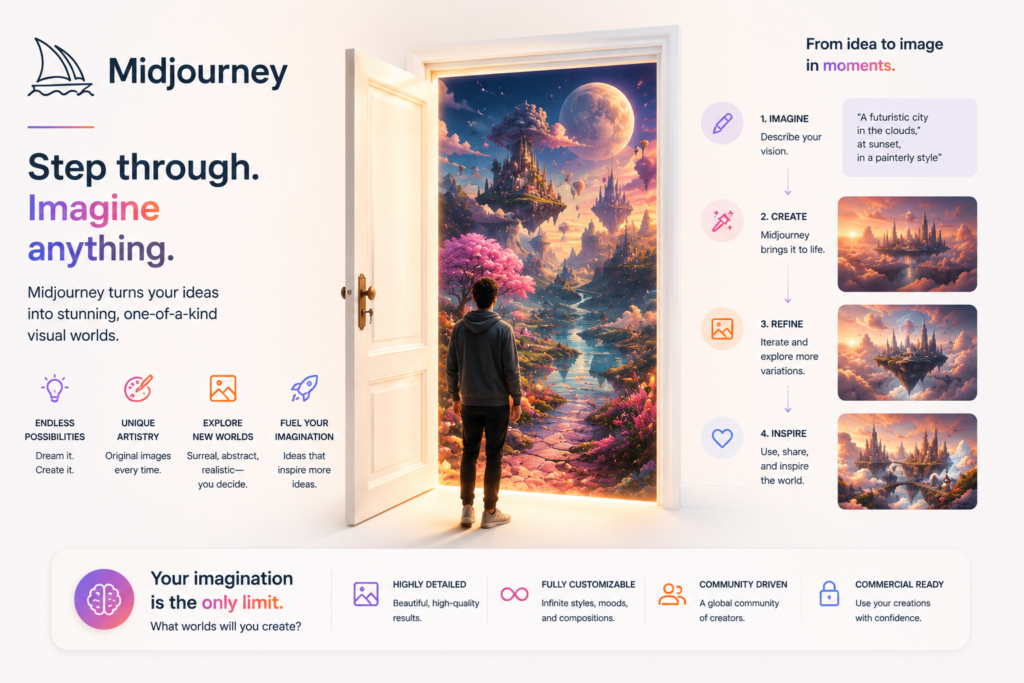
Midjourney is an AI image- and video-generation platform that creates visual content from text prompts and reference inputs. According to the supplied research, users can access it through its website or Discord and use features such as style references, character references, variations, upscaling, and image editing.
For small businesses, the potential value lies in exploring visual directions and producing candidate images without relying exclusively on stock imagery or starting every concept from scratch.
However, AI-generated imagery is not automatically accurate, brand-consistent, commercially suitable, or ready for publication. The relevant question is whether Midjourney helps your business create usable assets at an acceptable cost and risk level.
This review examines its documented capabilities, pricing, business use cases, limitations, alternatives, and suitability for small businesses. It is a research-based assessment, not a hands-on review.
2. What Is Midjourney?
| Attribute | Description |
|---|---|
| Provider | Midjourney, Inc. |
| Product category | AI image- and video-generation platform |
| Core functionality | Image generation, reference-guided creation, editing, inpainting, variations, upscaling, and video generation |
| Target audience | Designers, marketers, agencies, creators, e-commerce businesses, and creative teams |
| Access | Website and Discord, according to the supplied research |
| Business problem addressed | Creating original visual concepts and creative assets |
| Deployment model | Cloud-based service with subscription plans |
Midjourney is primarily a visual-generation tool, not a complete graphic-design, publishing, or business-automation platform. A business may still need a design tool such as Canva or Adobe software for final layouts, typography, brand elements, and production-ready assets.
How Midjourney Works
- Provide an input: Write a text prompt and, where appropriate, supply image, style, or character references.
- Generate visual options: Midjourney produces images based on the supplied instructions and its models.
- Refine the output: Use supported variations, upscaling, and editing features to improve selected results.
- Review the result: Check accuracy, brand alignment, rights, and suitability for the intended audience.
- Prepare the final asset: Export and, where necessary, refine the image in a separate design application.
The quality and usefulness of the final result depend on the prompt, reference material, intended use, and human review. We did not independently benchmark generation speed or output quality.
3. Research Methodology and Evidence Standards
How This Review Was Prepared
The review uses the supplied Perplexity research, which reports consulting Midjourney product and pricing documentation, commercial-use information, terms, privacy documentation, and third-party pricing and product reports.
Intelligent AI Lab has not independently opened and validated every cited source, tested Midjourney, or reproduced the reported findings. Consequently, the source descriptions below should not be interpreted as proof that every current policy or limit has been independently confirmed by Intelligent AI Lab.
The research approach prioritizes:
- Official product documentation for supported features and limitations.
- Official pricing documentation for subscription prices and usage limits.
- Official terms and commercial-use documentation for ownership and licensing.
- Official privacy and security documentation for data handling and controls.
- Reputable independent reporting for corroboration.
- User reviews and community discussions as supplementary, directional evidence.
Evidence Classification
| Label | Meaning |
|---|---|
| Verified from identified sources | A finding reported as confirmed against an identified source. The source and date should be checked before relying on material claims. |
| Research-Based Analysis | Intelligent AI Lab’s interpretation of documented capabilities and available information. |
| Not Independently Verified | The claim could not be sufficiently confirmed through the available research. |
| Illustrative Scenario | A proposed workflow or example, not an implemented or tested solution. |
What We Could Not Verify
| Evidence area | Limitation |
|---|---|
| Image quality | No independent benchmark of photorealism, image quality, or hallucination rate was supplied. |
| Video quality | Video generation is reported as available, but output quality was not independently tested. |
| Brand consistency | Reference features are documented in the supplied research, but consistency across campaigns was not measured. |
| Editor reliability | The web Editor, inpainting, reference features, and upscaling were not independently tested. |
| API access | The supplied research reports conflicting indications about public API availability. |
| Automation integrations | Native n8n, Zapier, and other automation integrations were not independently verified. |
| Support quality | Support experience across subscription tiers was not independently assessed. |
| Business outcomes | Savings, engagement improvements, and faster campaign production were not independently demonstrated. |
| Launch history | The original article’s claim that Midjourney launched in 2022 was not independently verified in the supplied research. |
| Enterprise readiness | Enterprise administration, security certifications, and advanced controls were not independently verified. |
| Copyright outcomes | The legal status of AI-generated imagery in relevant jurisdictions was not assessed. |
Sources Consulted
| Source | Information Used |
|---|---|
| Midjourney plan comparison | Plans, pricing, Relax Mode, Stealth Mode, and commercial-use threshold |
| Midjourney commercial-use documentation | Ownership, commercial use, upscaling, and copyright guidance |
| Midjourney Terms of Service | Content-rights license and user obligations |
| Midjourney web vs Discord | Web Editor, Vary Region, references, and platform access |
| Midjourney Discord Quick Start | Image output size and Discord workflow |
| Midjourney API documentation | Plan pricing and API documentation reference |
| Midjourney privacy policy | Privacy policy reference |
| AI on Mac Midjourney pricing report | Third-party pricing corroboration |
| AI Tool Blog Midjourney pricing report | Fast GPU time and Relax Mode corroboration |
| BestStacked Midjourney review | Web-app availability and workflow corroboration |
| Toolchase Midjourney review | API and web-interface corroboration |
4. Key Features of Midjourney
The following features are reported in the supplied research. Their practical performance has not been independently tested.
| Feature | What it does | Potential business value | Important consideration |
|---|---|---|---|
| Text-to-image generation | Creates images from written prompts | Supports visual ideation and original imagery | Prompt quality affects usefulness. |
| Image prompts | Uses an image as part of the generation input | Helps guide visual direction | Reference assets must be appropriate for the intended use. |
| Style references | Uses reference imagery to guide visual style | May support a more consistent creative direction | Does not guarantee brand consistency. |
| Character references | Helps maintain a character’s appearance across images | May support visual storytelling and campaigns | Consistency needs testing. |
| Web Editor | Includes cropping, panning, and aspect-ratio adjustment | Supports basic refinement within the platform | May not replace advanced image-editing software. |
| Vary Region | Inpaints a selected image area | May help refine parts of an image | Output quality was not independently tested. |
| Variations | Creates alternate versions of an image | Supports creative exploration | Not every variation will be usable. |
| Upscaling | Increases image resolution | May support larger digital assets | Upscaling does not necessarily make an image suitable for every production use. |
| Relax Mode | Allows image generation without using Fast GPU time | May support repeated experimentation | Availability depends on the plan. |
| Stealth Mode | Provides private image and video generation, according to the supplied research | May help protect unreleased creative work | Reported as available on Pro and Mega; verify current terms and privacy implications. |
| Video generation | Supports creation of video content | May support creative exploration for campaigns and social content | Video limits and quality require direct verification. |
Features That Matter Most for Businesses
1. Reference-guided creation
Image, style, and character references may help a creative team guide visual outputs toward a desired direction. Before using the feature for brand assets, test whether it maintains the consistency required by your brand guidelines.
2. Web-based editing
The supplied research reports that Midjourney’s web Editor includes cropping, panning, aspect-ratio adjustment, and Vary Region inpainting. These features may reduce the need for separate tools for basic refinements, although complex compositing and final layouts may still require a dedicated design application.
3. Relax Mode
Relax Mode may be useful for teams that generate many concepts. The reported plan distinctions are important: unlimited Relax image generation is included with Standard and higher tiers, while unlimited Relax video generation is reported for Pro and Mega.
4. Commercial-use and content-rights terms
Midjourney states that users own the images and videos they create, subject to its terms and exceptions. Ownership should not be interpreted as a guarantee of copyright protection in every jurisdiction or as a substitute for reviewing the provider’s license and commercial-use rules.
5. How Businesses Can Use Midjourney
Midjourney is most relevant when visual creation and concept exploration are recurring business needs.
| Business function | Example application | Potential value | Human review required |
|---|---|---|---|
| Marketing campaigns | Generate campaign concepts and alternative visual directions | Explore creative options before final production | Brand fit, claims, audience suitability, and rights |
| Social media | Develop concepts for posts, thumbnails, and promotional visuals | Support a regular content pipeline | Platform requirements, accessibility, and accuracy |
| Blog content | Create article illustrations and featured-image concepts | Produce imagery tailored to a topic | Editorial relevance and cultural appropriateness |
| Product development | Explore packaging, furniture, fashion, or product concepts | Support early-stage visual ideation | Product feasibility and truthful representation |
| Branding | Develop mood boards and visual directions | Explore creative approaches before committing to a design | Brand consistency and approval |
| Content marketing | Create concepts for newsletters, presentations, and digital campaigns | Expand the range of visual ideas | Final design, readability, and brand review |
Best-Fit Business Use Case: Marketing Campaign Concepting
Business problem: A marketing team needs multiple creative directions before committing to a campaign design.
Relevant capabilities: Text prompts, image and style references, variations, upscaling, and the reported web Editor.
Inputs required: Campaign brief, audience information, brand guidelines, suitable reference images, and a review process.
Proposed workflow:
- Define the campaign objective and visual direction.
- Generate candidate concepts in Midjourney.
- Review candidates for brand fit, accuracy, and suitability.
- Refine selected images in Midjourney or an external design tool.
- Obtain approval and prepare final campaign assets.
Risks: Inaccurate product details, inconsistent branding, unsuitable imagery, unexpected editing work, and licensing concerns.
Pilot metrics: Usable concepts per prompt set, time to first usable concept, revision cycles, approval rate, and total cost per approved asset.
These metrics provide a way to test the business case; they are not evidence that Midjourney has already delivered those outcomes.
6. Intelligent AI Lab Business Decision Analysis
What Business Problem Is Midjourney Best Suited to Solve?
Midjourney is best suited to businesses whose recurring bottleneck is creating distinctive visual concepts and imagery. Examples include creative agencies, design teams, content publishers, and e-commerce businesses that need visual exploration beyond standard stock photography.
The decision should focus on the business result rather than the novelty of the technology. Can the team produce usable, on-brand assets with less effort or greater creative flexibility, without introducing unacceptable costs or risks?
| Decision factor | Assessment |
|---|---|
| Primary use case | AI-generated visual concepts and creative assets |
| Capability fit | Strong potential fit for creative-led visual exploration |
| Template-based design | Canva AI may be more suitable for ready-made marketing layouts |
| Advanced editing | Adobe Photoshop or Adobe’s creative ecosystem may be more suitable |
| Implementation | Requires prompting, review, and rights management |
| Cost | Subscription plus experimentation, editing, and human-review time |
| Key uncertainty | Whether the output quality and workflow fit outperform the business’s existing process |
When to Choose Midjourney
Consider Midjourney when:
- You need artistic, distinctive, or concept-driven imagery.
- You want to explore multiple visual directions before final design.
- Reference-guided creation is relevant to your workflow.
- You need basic inpainting and editing alongside image generation.
- Your team can review outputs and manage licensing considerations.
- You can justify the subscription through recurring creative needs.
When to Choose an Alternative
- Canva AI: When branded layouts, templates, presentations, and straightforward marketing design are the priority.
- Adobe Firefly: When the workflow centers on Adobe tools, image editing, and professional creative production.
- Figma AI: When the principal requirement is product design, interface work, and collaborative design workflows.
- Leonardo AI: When its current capabilities better match a specialized concept-art or game-asset workflow.
- ChatGPT: When you need a general-purpose AI assistant for writing, research, planning, and other business tasks in addition to any supported image-generation capabilities.
These are use-case distinctions, not claims that one platform is universally superior.
When AI Image Generation May Not Be Necessary
Midjourney may be unnecessary when:
- Visual needs are infrequent and a stock-photo library already meets them.
- A professional photographer or designer is better suited to the required outcome.
- Exact product fidelity is essential and generated images cannot reliably meet that requirement.
- The business lacks the resources to review outputs and manage rights.
- The workflow involves sensitive information that has not been approved for use with the service.
Recommended Next Step: Run a Limited Pilot
Choose one bounded workflow, such as campaign concepting or blog featured images, and run a two-to-four-week pilot.
Track:
- Usable images per prompt set.
- Time to first usable concept.
- Editing and revision time.
- Brand-consistency review results.
- Fast GPU consumption.
- Total cost per approved asset.
Compare these results with your current process. Expand only if the evidence demonstrates a meaningful business benefit.
7. Illustrative Business Automation Examples
The following workflows are illustrative scenarios. They have not been implemented or tested by Intelligent AI Lab. They also do not assume that Midjourney has a supported public API or a native connector for a particular automation platform.
Example 1: Marketing Campaign Concept Workflow
Business scenario: A small agency needs multiple visual directions for a client campaign before producing the final design.
Potential tools: Midjourney, a writing assistant, Canva or Adobe software, and a human approval process.
Proposed workflow:
- The team approves a campaign brief.
- The brief identifies the objective, audience, brand guidelines, and reference imagery.
- A creative team member generates visual concepts in Midjourney.
- A human reviewer selects and refines appropriate concepts.
- Approved imagery is moved into a design tool for layout and final production.
- The client reviews the final creative assets.
Potential benefits to test:
- More concepts available for review.
- Less time spent on initial visual exploration.
- Fewer revisions before a concept is approved.
Requirements and limitations:
- Reference assets and brand guidelines must be current.
- Generated images require creative and rights review.
- Commercial-use rules must be checked against the company’s circumstances.
- API-based automation must not be assumed without verifying availability.
Suggested success metrics: Time to first usable concept, revision cycles, client approval time, and cost per approved concept.
Example 2: Blog Featured-Image Workflow
Business scenario: A content team wants custom imagery for articles instead of relying exclusively on stock photographs.
Potential tools: Midjourney, a design application, a content management system, and editorial approval.
Proposed workflow:
- An article is approved for publication.
- The editor provides the article topic, intended audience, and visual direction.
- A team member generates candidate images in Midjourney.
- The editor checks relevance, tone, cultural fit, and visual quality.
- The selected image is refined and uploaded to the content management system.
- The article and image are published after approval.
Potential benefits to test:
- Less time spent searching for suitable stock images.
- More flexibility in developing article-specific imagery.
- A more consistent visual direction across content.
Suggested success metrics: Editing time per image, stock-image spending, publication turnaround time, and brand-consistency review results.
Evidence note: Both examples require pilot validation. They are not evidence of proven savings, improved engagement, or increased productivity.
8. Pros and Cons of Midjourney
| Pros | Cons |
|---|---|
| Supports image generation through web and Discord access, according to the supplied research. | No permanent free plan is reported. |
| Supports image, style, and character references. | Effective prompting may require practice. |
| The reported web Editor includes basic editing and Vary Region inpainting. | It is not a complete replacement for advanced photo-editing or graphic-design software. |
| Supports variations and upscaling. | The practical quality of generated outputs was not independently tested. |
| Includes video-generation capabilities, according to the supplied research. | Current video limits and quality require verification. |
| Standard and higher tiers reportedly include unlimited Relax Mode image generation. | Plan restrictions affect how different users can generate images and videos. |
| Midjourney states that users own their generated images and videos, subject to terms and exceptions. | Ownership does not guarantee copyright protection in every jurisdiction. |
| Pro and Mega reportedly include Stealth Mode. | Privacy requirements and the scope of the provider’s license still need review. |
What These Trade-offs Mean for Buyers
For a creative-led business, Midjourney’s value depends on whether the team can turn generated concepts into approved, useful assets. A visually appealing image is not necessarily production-ready: it may need editing, factual review, brand correction, or legal assessment.
For teams that mainly need simple layouts and standardized brand templates, Canva AI may provide a more direct workflow. For teams already working extensively in Adobe software, Adobe Firefly may be worth comparing.
9. Midjourney Pricing and Plans
Research pricing date: 20 October 2026
Verification caveat: The following prices and limits are reported by the supplied research. Recheck the official plan comparison before publication or purchase.
The supplied research reports four subscription tiers. Plans renew automatically unless canceled, and annual billing provides a reported 20% discount when paid upfront.
| Plan | Monthly price | Annual price | Reported Fast GPU time | Reported plan features |
|---|---|---|---|---|
| Basic | $10/month | $96/year | Approximately 3.3 hours/month | No Relax Mode; 3 concurrent Fast jobs |
| Standard | $30/month | $288/year | 15 hours/month | Unlimited Relax Mode image generation; 3 concurrent Fast jobs |
| Pro | $60/month | $576/year | 30 hours/month | Unlimited Relax Mode image and video generation; Stealth Mode; 12 concurrent Fast or 3 Relax jobs |
| Mega | $120/month | $1,152/year | 60 hours/month | Unlimited Relax Mode image and video generation; Stealth Mode; 12 concurrent Fast or 3 Relax jobs |
The supplied research reports that all four plans support image generation through both the Midjourney website and Discord. It also reports that Stealth Mode is limited to Pro and Mega.
Important: The exact current Fast GPU allowances, concurrent-job limits, video-generation limits, and plan restrictions should be confirmed against live documentation. These details can change.
What to Know Before Paying
Annual billing: The supplied prices imply a 20% discount compared with paying the equivalent monthly price for twelve months. Annual plans require upfront payment.
Fast GPU time: Each plan has a reported monthly allocation of Fast GPU time. Actual consumption depends on the generation task and settings.
Relax Mode: Standard and higher tiers reportedly include unlimited Relax Mode image generation. Pro and Mega reportedly include unlimited Relax Mode video generation.
Privacy: Stealth Mode is reported as a Pro and Mega feature. Confirm what it makes private, what exceptions apply, and whether it meets your business’s confidentiality requirements.
Commercial use: The supplied research states that businesses grossing more than US$1 million annually must use Pro or Mega for commercial company use of generated assets. Confirm the current wording and how the threshold applies to your organization.
Additional costs: Include external design tools, prompt experimentation, editing, and review labor when estimating the cost of producing an approved asset.
Is Midjourney Worth the Price?
Midjourney may be worth evaluating when a business produces visual content frequently and has people who can prompt, review, and refine generated outputs.
It may be less attractive for occasional image needs, teams seeking a free service, or businesses that need ready-made templates more than visual experimentation.
The right calculation is not simply subscription cost. It is:
Total cost per approved asset = subscription and usage costs + additional tools + creative and review time, divided by the number of approved assets.
This is a proposed evaluation method, not a claim that Midjourney reduces costs.
Which Plan Should You Consider?
| Buyer type | Plan to evaluate | Reason | What to confirm |
|---|---|---|---|
| Individual exploring the platform | Basic | Lowest-cost reported entry tier | Whether the Fast GPU allowance meets actual needs |
| Content creator or freelancer | Standard | Reported unlimited Relax image generation | Generation volume and time requirements |
| Small business with recurring visual needs | Standard or Pro | Depends on image/video needs and privacy requirements | Current plan features and business-use terms |
| Company above the reported US$1 million revenue threshold | Pro or Mega | The supplied research says one of these tiers is required for commercial company use | Current terms and threshold applicability |
| High-volume creative team | Mega | Highest reported Fast GPU allocation | Actual workload, concurrency, and collaboration needs |
These are starting points for evaluation, not universal purchasing recommendations.
10. Integrations and Technical Requirements
Midjourney should primarily be evaluated as a visual-generation service. Do not assume it can automatically connect to every business system or automation platform.
| Integration area | Current assessment based on supplied research | What to verify |
|---|---|---|
| Web and Discord | Both access routes are reported as supported. | Current features and account requirements |
| CRM and sales systems | No native CRM workflow was established in the supplied research. | Whether a supported connector or export-based workflow meets your needs |
| Email and collaboration | No specific native collaboration integration was independently verified. | Supported sharing and team-access features |
| n8n and Zapier | Native integrations were not independently verified. | Whether a supported integration exists and what permissions it requires |
| API and webhooks | Public API availability remains unresolved. | Official availability, authentication, limits, terms, and pricing |
| Design tools | Outputs may be used in external design applications. | Export formats, image requirements, and the editing workflow |
| Security and administration | Stealth Mode is reported on Pro and Mega. | Administrative controls, permissions, audit capabilities, and enterprise security documentation |
| Implementation | Requires prompts, suitable references, review, and rights management. | Team skills and the full operating process |
Native vs. Third-Party vs. Custom
Native capabilities: The supplied research identifies image generation, reference-guided creation, the web Editor, inpainting, variations, upscaling, and video generation as Midjourney capabilities.
External design workflows: Teams may refine generated assets in Canva, Adobe Express, Photoshop, or other applications. The exact file and workflow requirements should be checked.
Automation and custom development: The research reports that Midjourney has API documentation but also identifies third-party reporting that says no official public API is available. This discrepancy remains unresolved. Do not build a business-critical automation around assumed API access.
Implementation Considerations
Before adopting Midjourney across a team, define:
- Who can create and approve visual assets.
- Which brand and reference images may be used.
- How sensitive information will be handled.
- Which outputs require legal or compliance review.
- Where approved assets will be stored and versioned.
- How image rights and subscription requirements will be monitored.
A manual, human-reviewed pilot is a sensible starting point while integration capabilities are being confirmed.
11. Midjourney vs. Alternatives
The following comparison is based on general product positioning and the supplied research. It is not the result of a controlled product benchmark. Alternative-product prices and feature availability should be verified separately before publication.
| Tool | Best suited for | Main distinction | When to consider it |
|---|---|---|---|
| Midjourney | Artistic and concept-driven AI image generation | Reference-guided image generation and a reported web Editor | You need distinctive visual concepts and can manage review and licensing |
| Adobe Firefly | Adobe-oriented creative production | Adobe ecosystem and image-editing workflows | Your team already relies on Adobe tools or needs integrated editing |
| Canva AI | Marketing graphics and branded layouts | Template-first design and business content workflows | You need ready-made layouts, templates, and brand assets |
| Leonardo AI | Specialized creative and concept-art workflows | Alternative visual-generation workflow | Your requirements align more closely with its current capabilities |
| Figma AI | Product and interface design | UI/UX and collaborative design workflows | You are creating digital products, prototypes, or interface designs |
| ChatGPT | General-purpose AI assistance | Broader writing, research, planning, and other supported tasks | You need a general assistant rather than a dedicated visual-creation workflow |
Which Tool Should You Choose?
Choose Midjourney if your primary requirement is creative image generation and visual exploration.
Choose Adobe Firefly if your existing creative workflow centers on Adobe tools and integrated editing.
Choose Canva AI if your team prioritizes branded marketing layouts and templates over open-ended visual generation.
Choose Figma AI if the main work is interface or product design.
Choose Leonardo AI if its verified capabilities and workflow fit your particular concept-art needs better.
Choose ChatGPT if you need broad business assistance beyond image creation.
No single tool is best for every business. Compare candidates using the same brief, approval criteria, and cost assumptions.
12. Who Should Use Midjourney?
Recommended for
- Graphic designers: Visual exploration, mood boards, and creative concepts.
- Marketing agencies: Campaign concepts and alternative visual directions.
- Content creators: Candidate imagery for articles, thumbnails, and social content.
- E-commerce businesses: Early-stage product concepts and campaign imagery.
- Creative professionals: Visual storytelling and exploratory design.
- Small businesses with creative support: Generating and reviewing custom visual assets.
These are potential applications, not evidence of guaranteed productivity gains.
Not ideal for
- Users who require a permanently free image-generation platform.
- Businesses that mainly need drag-and-drop templates and finished marketing layouts.
- Teams that need advanced photographic editing in one application.
- Organizations that cannot review generated content or manage commercial-use terms.
- Businesses that require verified API access or enterprise controls before adoption, until those requirements are confirmed.
Best-Fit Buyer Profile
The best-fit buyer is a creative-led business or team with recurring visual needs, clear brand guidelines, suitable reference assets, and someone accountable for reviewing and approving generated content.
Its key evaluation criteria should be output quality, brand consistency, editing requirements, commercial-use terms, and total cost per approved asset.
13. How to Get Started With Midjourney
Step 1: Identify One Business Workflow
Choose a narrow use case such as campaign concepting, blog imagery, social visuals, or early-stage product concepts.
Step 2: Confirm Product Fit
Check whether Midjourney’s current generation, reference, editing, and upscaling capabilities fit the selected task. Do not assume a feature will perform well in your specific workflow without testing it.
Step 3: Review Data and Rights
Identify the reference imagery and business information that will be supplied. Review current terms, commercial-use rules, and privacy documentation before uploading sensitive or confidential material.
Step 4: Design a Limited Pilot
Define inputs, output requirements, review criteria, approval steps, and a fallback process. Keep human review for brand fit, accuracy, and rights.
Step 5: Establish a Baseline
Measure the current process before introducing Midjourney. Record time spent producing concepts, revision cycles, external-tool costs, and stock-image expenditure where applicable.
Step 6: Evaluate the Results
Compare the pilot with the baseline using the same criteria. Include subscription cost, GPU usage, editing time, additional tools, and human-review effort.
Step 7: Decide Whether to Expand
Continue, revise, or stop based on evidence. Expand only when the workflow delivers sufficient quality and business value without introducing unacceptable operational or legal risks.
14. Limitations, Risks, and Governance
AI image generation introduces quality, privacy, licensing, and operational questions. These should be considered before using generated assets in commercial workflows.
| Risk area | What businesses should investigate | Current assessment |
|---|---|---|
| Accuracy and reliability | Can outputs misrepresent products, people, or concepts? | Outputs require review; practical reliability was not independently tested. |
| Privacy and data retention | What information is collected, retained, or shared? | Midjourney has privacy documentation, but current retention and training details need direct review. |
| Data and content license | What rights does the provider receive over inputs and generated assets? | The supplied research reports a broad license; review the current Terms of Service carefully. |
| Security | Which security controls and certifications are available? | Certifications and enterprise controls were not independently verified. |
| Compliance | Does the service meet contractual or regulatory obligations? | Suitability for regulated workflows was not established. |
| Access and permissions | What administrative controls are available? | Stealth Mode is reported for Pro and Mega; broader enterprise controls remain unverified. |
| Usage limits | What happens when Fast GPU time is exhausted? | Plan-specific Fast and Relax allowances are reported; current limits require confirmation. |
| Human oversight | Which outputs need approval? | Customer-facing, brand-critical, and sensitive content should be reviewed before use. |
| Vendor dependency | Can assets and workflows be moved to another platform? | External design workflows may be possible; complete export and migration capabilities need verification. |
| Copyright | Are generated assets protected and commercially usable in the relevant jurisdiction? | The provider’s ownership statement does not settle all legal questions. |
Content Rights and Commercial Use
The supplied research reports three important points:
- Midjourney states that users own the images and videos they create, subject to its terms and exceptions.
- Businesses grossing more than US$1 million annually must use Pro or Mega for commercial company use, according to the reported policy.
- Users grant Midjourney a broad, perpetual, worldwide, non-exclusive, sublicensable, royalty-free, irrevocable license relating to user inputs and generated assets.
The exact current wording and applicability of these terms should be checked directly before publication and before commercial adoption.
The supplied research also reports that upscaling another user’s image does not transfer ownership and that permission is required to use the original image. Confirm the applicable current policy before relying on or commercially reusing another user’s work.
Midjourney reportedly states that it cannot provide copyright guidance and recommends consulting a lawyer for specific copyright concerns. The legal status of AI-generated images varies by jurisdiction and circumstances; no general ownership statement can guarantee that every output is protected by copyright.
What Businesses Should Check Before Adoption
- Confirm current prices, plan limits, video allowances, and commercial-use requirements.
- Confirm whether an official public API is available before building automation.
- Review the current Terms of Service and privacy policy.
- Confirm whether the service meets confidentiality, contractual, and regulatory requirements.
- Establish brand guidelines, human approval, and rights-management procedures.
- Seek qualified legal, security, or compliance advice for high-risk use cases.
15. Final Verdict: Is Midjourney Worth It?
Midjourney is worth evaluating for businesses that need distinctive AI-generated imagery for campaigns, branding, product concepts, and content marketing. The supplied research identifies a useful range of features, including reference-guided generation, a web Editor, inpainting, variations, upscaling, and video generation.
Its strongest potential fit is a creative-led team that can develop prompts, evaluate visual options, and refine approved assets. Businesses that need ready-made layouts and standardized marketing materials may find Canva AI more suitable, while Adobe-oriented teams should compare Adobe Firefly.
The main trade-offs are the absence of a permanent free plan, the effort required to produce and review suitable outputs, the need to understand commercial-use and content-rights terms, and uncertainty about public API access. These factors matter particularly for businesses considering automated or security-sensitive workflows.
Final buying recommendation: Pilot Midjourney for creative-led teams. Start with one bounded use case, establish a baseline, and compare the results with the current process. Measure usable-image rate, editing time, brand consistency, and total cost per approved asset. Do not assume that the platform will reduce costs or improve engagement without evidence.
For template-first marketers, compare Canva AI. For Adobe-centered production, compare Adobe Firefly. For businesses that require confirmed API access, enterprise controls, or specific compliance guarantees, resolve those requirements before committing.
16. Intelligent AI Lab Rating and Scorecard
A. Business-Fit Verdict
Good Fit for creative-led businesses, agencies, designers, and content teams.
Conditional Fit for non-designers and small businesses that need to validate output quality, workflow fit, and total cost.
Poor Fit for the target use case when the requirement is a permanently free tool or primarily template-based design.
B. Assessment Type
Research-Based Assessment.
This is not a hands-on product review or a business pilot assessment.
C. Evidence Confidence
Moderate overall. The supplied research reports specific official documentation for core capabilities, pricing, and content-rights terms. However, exact source URLs were not supplied for all cited materials, and API availability, practical output quality, workflow reliability, and enterprise readiness remain uncertain.
D. Numerical Rating
Research-Based rating: 3.30/5
Rating date: 20 October 2026
The score reflects Intelligent AI Lab’s research-based assessment of the selected business use case. It is not based on hands-on testing, independent benchmarks, customer-survey data, or measured business outcomes.
Research-Based Weighted Scorecard
| Criterion | Weight | Score | Evidence and rationale |
|---|---|---|---|
| Core capability fit | 25% | 5/5 | The supplied research identifies image generation, references, editing, inpainting, upscaling, and video generation. Practical performance was not independently tested. |
| Business value | 20% | 4/5 | The capabilities align with campaign concepting and creative exploration, but business impact has not been demonstrated. |
| Ease of use and implementation | 15% | 2/5 | Prompt development, output review, and external design tools may be needed for production-ready assets. |
| Integrations and automation | 15% | 2/5 | Web and Discord access are reported, but public API status and automation integrations remain unresolved. |
| Pricing and cost suitability | 15% | 3/5 | Reported entry pricing is accessible for some users, but there is no permanent free plan and usage limits affect value. |
| Governance and operational readiness | 10% | 2/5 | Content-rights terms are reported, but enterprise controls, certifications, and compliance suitability were not independently verified. |
Weighted score calculation:
(5 × 0.25) + (4 × 0.20) + (2 × 0.15) + (2 × 0.15) + (3 × 0.15) + (2 × 0.10) = 3.30/5
The score is reported as 3.3/5, not rounded up to 4/5. The component scores are analyst judgments, not measured product-performance results.
Overall Assessment Summary
- Business-fit verdict: Good Fit for creative-led teams; Conditional Fit for non-designers
- Research-based rating: 3.3/5
- Evidence confidence: High for documented capabilities, pricing, and content rights; Moderate for real-world quality, workflow reliability, and API availability
- Assessment type: Research-Based Assessment
- Overall conclusion: Midjourney is a credible candidate for teams that need distinctive AI-generated visual concepts. Its reported feature set supports creative exploration, but its suitability depends on output quality, review effort, rights management, pricing, and workflow fit. Creative teams should pilot it before wider adoption; template-first marketers should compare Canva AI. API access and enterprise requirements should be confirmed before building critical workflows.
17. Decision Checklist: Should You Choose Midjourney?
Shortlist Midjourney if:
- You need distinctive, artistic, or concept-driven imagery.
- You want to explore multiple campaign directions.
- Reference-guided generation is useful for your workflow.
- You can review outputs for quality, accuracy, brand fit, and rights.
- Your business has recurring visual needs that may justify a subscription.
Compare alternatives if:
- You need ready-made templates and branded marketing layouts.
- Advanced photo editing is central to your workflow.
- You need a free image-generation platform.
- Your workflow depends on a public API or specific automation integration that has not been confirmed.
Before purchasing, confirm:
- Current subscription prices and usage limits.
- Whether the relevant plan meets your commercial-use requirements.
- Current content-rights and privacy terms.
- Whether required security or administrative controls are available.
- Whether a pilot produces usable assets at an acceptable total cost.
Decision guidance: If quality, brand consistency, API access, or commercial-use risk is critical, resolve the uncertainty through direct verification and a controlled pilot before committing.
18. Frequently Asked Questions About Midjourney
What is Midjourney used for?
Midjourney is an AI image- and video-generation platform. Businesses may use it to explore concepts for marketing, advertising, branding, websites, social media, product ideas, and creative projects.
Is Midjourney free?
The supplied research reports that Midjourney does not offer a permanent free plan. Its reported Basic plan starts at $10/month or $96/year. Check the current official plan information before purchasing.
How much does Midjourney cost in 2026?
The supplied research lists Basic at $10/month, Standard at $30/month, Pro at $60/month, and Mega at $120/month. Reported annual prices are $96, $288, $576, and $1,152, respectively. Verify current prices and usage limits directly with Midjourney.
Is Midjourney better than Canva AI?
They serve different needs. Midjourney is oriented toward AI-generated visual concepts and creative exploration. Canva AI is more appropriate to evaluate when branded layouts, templates, and straightforward marketing design are the priority. The best choice depends on the workflow, not a universal ranking.
Can businesses automate workflows using Midjourney?
Potentially, but the supplied research does not establish that an official public API or specific n8n and Zapier integrations are currently available. Verify API availability, supported actions, permissions, and terms before designing an automated workflow.
Can Midjourney images be used commercially?
The supplied research reports that Midjourney permits commercial use subject to its terms and plan requirements. It also reports that businesses grossing more than US$1 million annually must use Pro or Mega for commercial company use. Confirm the current rules and obtain legal advice where appropriate.
Do users own images generated with Midjourney?
Midjourney states that users own the images and videos they create, subject to its terms and exceptions. The supplied research also reports a broad license granted to Midjourney over inputs and generated assets. Ownership statements do not guarantee copyright protection in every jurisdiction.
Is Midjourney suitable for small businesses?
It may suit small businesses that regularly need distinctive visual concepts and have someone responsible for prompting, reviewing, and refining outputs. Businesses that primarily need standardized templates, occasional images, or a free tool should compare alternatives.