
Introduction
Customer support has become one of the biggest competitive advantages for small businesses. Customers no longer compare your service only with local competitors—they compare it with the instant responses they receive from companies like Amazon, Uber, and Netflix.
The challenge is that most small businesses don’t have large customer support teams. Owners and employees often juggle sales, operations, marketing, and customer inquiries simultaneously. As the business grows, customer support becomes harder to manage.
Common problems include:
- Customers waiting hours—or even days—for a response
- Staff answering the same questions repeatedly
- Missed leads because no one replied quickly
- Rising labor costs as support volumes increase
This is where Artificial Intelligence (AI) is making a real difference.
Today’s AI tools can answer common questions, draft emails, manage WhatsApp conversations, route support tickets, summarize customer history, and even assist human agents in solving complex issues.
The result isn’t replacing people—it is enabling small teams to deliver enterprise-level customer service.
At Intelligent AI Lab, our philosophy is simple:
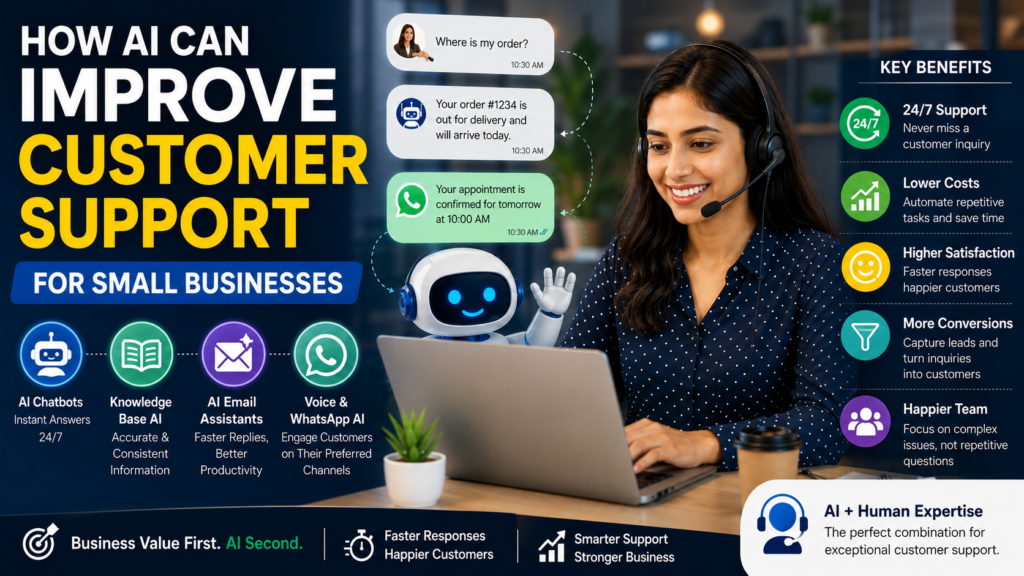
Business Value First. AI Second.
Don’t implement AI because it’s trendy. Implement it because it improves customer experience, saves time, reduces costs, and helps your business grow.
In this guide, you’ll learn how AI can transform customer support, which tools are worth considering, and how to implement AI step by step.
Why Customer Support Is One of the Best Places to Start with AI
Not every business process is ready for AI. Customer support is.
Why?
Because much of customer service consists of repetitive and predictable tasks.
Examples include:
- What are your business hours?
- Where is my order?
- Can I book an appointment?
- What are your prices?
- Do you offer refunds?
- Can you send me a quotation?
Research consistently shows that AI customer support delivers one of the highest returns on investment (ROI) among AI use cases. Many businesses report:
- Faster response times
- Reduced support costs
- Higher customer satisfaction
- Increased employee productivity
- Better lead conversion
Instead of hiring additional staff to answer repetitive questions, AI handles routine inquiries while employees focus on solving complex customer problems.
Biggest Customer Support Challenges for Small Businesses
Before implementing AI, it’s important to understand the business problems you’re trying to solve.
1. Long Response Times
Customers expect answers within minutes—not hours.
Slow responses often result in:
- Lost sales
- Negative reviews
- Customer frustration
- Lower trust
For many service businesses, the first company to respond wins the customer.
2. Repeated Questions
Most businesses receive the same questions every day.
Examples include:
- Business hours
- Pricing
- Appointment availability
- Delivery information
- Refund policy
Employees spend countless hours repeating identical answers.
AI can answer these instantly.
3. High Staffing Costs
As customer inquiries increase, many businesses respond by hiring more staff.
However, salaries, training, and management costs grow quickly.
AI allows existing teams to support significantly more customers without proportional increases in staffing.
4. Missed Leads
Imagine a potential customer sending a WhatsApp message at 9 PM.
If nobody replies until the next morning, that customer may have already chosen a competitor.
AI provides 24/7 first responses, ensuring that no opportunity is missed.
Understanding the AI Customer Support Stack
Not all AI solutions are the same. They serve different purposes within the customer support process.
1. AI Chatbots
AI chatbots are often the first point of contact.
They can:
- Answer FAQs
- Collect customer information
- Book appointments
- Track orders
- Qualify leads
- Escalate complex issues
Best for:
- Websites
- Facebook Messenger
- Live chat
Popular tools include Botpress, Intercom, and ChatGPT-powered bots.
2. AI Knowledge Bases
AI is only as good as the information it can access.
A well-organized knowledge base allows AI to provide accurate and consistent answers based on your business information.
Examples include:
- Product documentation
- Policies
- SOPs
- FAQs
- Internal procedures
Instead of guessing, AI retrieves approved information before responding.
3. AI Email Assistants
Many businesses still rely heavily on email support.
AI email assistants can:
- Summarize long email threads
- Draft professional replies
- Prioritize urgent messages
- Suggest next actions
- Translate customer emails
- Classify support requests
This reduces response times while maintaining consistent communication.
4. Voice AI
Voice AI is becoming increasingly valuable for businesses that receive high call volumes.
It can:
- Answer incoming calls
- Schedule appointments
- Route callers to the right department
- Handle simple inquiries
- Collect customer information
Industries benefiting include:
- Clinics
- Restaurants
- Local services
- Hotels
- Real estate
5. WhatsApp AI
For many small businesses, WhatsApp is the primary customer communication channel.
AI can:
- Respond instantly
- Share product information
- Confirm appointments
- Send reminders
- Capture leads
- Escalate conversations to staff when necessary
Because customers already use WhatsApp daily, it often delivers higher engagement than email.
Business Benefits of AI Customer Support
24/7 Customer Support
Your employees sleep.
AI doesn’t.
Customers receive immediate responses any time of day, improving customer experience while capturing opportunities outside business hours.
Lower Operating Costs
AI handles repetitive work at scale.
Instead of increasing support headcount, businesses can grow while keeping support costs under control.
Employees focus on higher-value conversations rather than repetitive tasks.
Higher Customer Satisfaction
Customers value speed.
Quick responses reduce frustration and improve trust.
AI also provides consistent answers based on approved business information, reducing errors caused by inconsistent manual responses.
More Sales and Conversions
Customer support directly influences revenue.
When potential buyers receive immediate answers, they are more likely to complete a purchase or book a service.
AI bridges the gap between marketing and sales by ensuring every inquiry receives prompt attention.
Real Business Examples
Dental Clinic
Challenge
Receptionists spend most of their day answering appointment requests, insurance questions, and reminder calls.
AI Solution
- Website chatbot
- WhatsApp appointment booking
- Automated reminders
- Voice AI for missed calls
Business Result
- Fewer no-shows
- Reduced administrative workload
- Faster appointment scheduling
- Improved patient experience
Law Office
Challenge
Law firms spend significant time collecting client information before consultations.
AI Solution
- AI intake assistant
- Document collection
- Appointment scheduling
- Case status updates
Sensitive legal advice remains with qualified lawyers.
Business Result
- Faster client onboarding
- Reduced administrative effort
- Better client communication
Restaurant
Challenge
Customers constantly ask about reservations, menu items, opening hours, and delivery.
AI Solution
- WhatsApp AI
- Website chatbot
- Automated reservation confirmations
Business Result
- Faster responses
- More bookings
- Higher customer satisfaction
- Reduced phone interruptions
Retail Store
Challenge
Customers repeatedly ask about product availability, delivery, returns, and promotions.
AI Solution
- AI chatbot
- Order tracking
- Return status updates
- Product recommendations
Business Result
- Lower support workload
- Faster order assistance
- Increased online sales
Travel Agency
Challenge
Travel agencies handle repetitive inquiries about destinations, pricing, visa requirements, and booking status.
AI Solution
- AI assistant for FAQs
- Lead qualification
- Itinerary assistance
- Booking updates
Business Result
- More qualified leads
- Faster customer service
- Improved booking conversion rates
Recommended AI Customer Support Tools
Different businesses have different needs. The best tool depends on your workflow, team size, and customer channels.
| Tool | Best For | Key Strength |
|---|---|---|
| Botpress | AI chatbots | Highly customizable conversational AI |
| ChatGPT | AI assistants | Drafting replies, summarization, knowledge assistance |
| HubSpot AI | CRM and customer support | Integrated customer communication and automation |
| Intercom | Customer messaging | AI-powered chat, ticketing, and customer engagement |
| Freshdesk AI | Help desk automation | Ticket routing, AI assistance, and support analytics |
Tip: Start with one tool that solves your biggest support bottleneck before expanding your AI stack.
Metrics Every Small Business Should Measure
AI should improve measurable business outcomes—not just add new technology.
Track these KPIs before and after implementation.
First Response Time (FRT)
How quickly customers receive the first reply.
Lower response times usually improve customer satisfaction and lead conversion.
Average Resolution Time
Measures how long it takes to fully resolve a customer issue.
AI helps reduce delays by routing tickets, summarizing conversations, and suggesting responses.
Customer Satisfaction (CSAT)
Ask customers to rate their support experience after each interaction.
Improving CSAT indicates that AI is enhancing—not harming—the customer experience.
Conversion Rate
Support isn’t just about solving problems—it also drives sales.
Measure how many customer inquiries turn into:
- Purchases
- Bookings
- Consultations
- Qualified leads
If AI shortens response times and provides better engagement, conversion rates should improve.
Best Practices for Implementing AI Customer Support
Successful AI adoption starts with business processes, not technology.
Follow this practical roadmap:
Week 1: Analyze your current support process and identify repetitive inquiries.
Week 2: Build a structured knowledge base with FAQs, policies, and standard operating procedures.
Week 3: Launch one AI tool—such as a chatbot or email assistant—and train your team on prompts, tone, and escalation rules.
Week 4: Monitor key metrics, gather customer feedback, and refine workflows.
Once the pilot proves successful, expand into more advanced capabilities such as AI ticket routing, WhatsApp automation, or AI agents for multi-step customer service tasks.
Common Mistakes to Avoid
Many AI projects fail because businesses rush into technology without addressing underlying process issues.
Avoid these common pitfalls:
- Buying AI tools before fixing broken support workflows.
- Trying to automate every customer interaction at once.
- Ignoring human oversight for sensitive issues like complaints, refunds, or legal matters.
- Using outdated or incomplete knowledge bases, leading to inaccurate AI responses.
- Failing to measure KPIs such as response time, resolution time, and customer satisfaction.
Remember, AI should enhance your support team—not replace thoughtful human service.
The Future of AI Customer Support
Customer support is evolving rapidly.
Over the next few years, expect to see:
- AI agents capable of resolving complex, multi-step customer issues.
- Voice AI handling natural conversations over phone calls.
- Omnichannel support that seamlessly connects email, chat, WhatsApp, and social media.
- Industry-specific AI assistants tailored for healthcare, legal services, retail, and hospitality.
- Predictive support that identifies customer issues before they become complaints.
Businesses that build strong workflows, organized knowledge bases, and responsible AI governance today will be well-positioned to take advantage of these advances.
Final Recommendation
AI customer support is one of the fastest and safest ways for small businesses to begin their AI journey.
The key is not to automate everything at once.
Start by identifying repetitive support tasks, create a reliable knowledge base, and introduce AI where it delivers immediate business value. Measure the results, refine your processes, and expand gradually.
We believe the most successful AI implementations start with a simple question:
“What business problem are we trying to solve?”
When customer support is slow, inconsistent, or overwhelming your team, AI can help you respond faster, reduce costs, improve customer satisfaction, and convert more inquiries into loyal customers.
Technology alone doesn’t create great customer experiences. Well-designed processes, empowered people, and practical AI working together do.
Frequently Asked Questions
Can AI replace human customer support agents?
No. AI is best used to handle repetitive inquiries, while human agents manage complex, emotional, or high-value conversations.
What is the best AI tool for customer support?
It depends on your needs. Botpress is ideal for AI chatbots, ChatGPT excels at drafting and summarization, HubSpot integrates CRM with support, Intercom is strong for customer messaging, and Freshdesk AI enhances help desk operations.
Can AI answer customer emails?
Yes. AI can draft replies, summarize long email threads, classify tickets, and prioritize urgent requests, helping teams respond more efficiently.
Is AI customer support suitable for small businesses?
Absolutely. Small businesses often benefit the most because AI helps them deliver faster service without significantly increasing staffing costs.
Can AI work with WhatsApp for customer support?
Yes. AI-powered WhatsApp solutions can answer FAQs, confirm appointments, capture leads, send reminders, and seamlessly hand conversations to human staff when needed.