
ElevenLabs Review (2026): Best AI Voice Tool for Businesses?
If you’re considering ElevenLabs, you’re probably not asking “Can it generate speech?” You’re asking whether it can produce on-brand, natural voice fast enough (and predictably enough) to justify paying for it—especially when audio is tied to marketing performance, support quality, training speed, or product experience.
This ElevenLabs Review focuses on business fit: where ElevenLabs is genuinely one of the strongest AI voice platforms, where it’s overkill, and how to decide based on workflow economics—not just impressive demos.
Quick Answer (2026): ElevenLabs is usually a top choice for businesses that need premium, human-like text to speech AI, high-quality voice cloning AI, and a scalable API for voice experiences. It’s not automatically the best option for every SMB because usage-based costs can be hard to forecast and voice-agent deployments often require telephony-first platforms.
What Is ElevenLabs (and what problem does it solve)?
ElevenLabs is an AI voice generator platform used for realistic text-to-speech (TTS), voice cloning, multilingual voice output, and increasingly for developer and real-time voice use cases. In plain English: it helps you turn scripts into natural audio quickly, and it can help you keep that audio consistent with a recognizable “brand voice.”
For many small businesses, the real problem isn’t “we don’t have a voice.” It’s one (or more) of these operational constraints:
- Voiceover production is a bottleneck: recording takes scheduling, retakes, editing, and approvals.
- Revisions are expensive: every script update can mean another recording session.
- Brand consistency is hard: different freelancers, different delivery styles, different audio quality.
- Localization doesn’t scale: translating and re-recording multiplies cost and time.
- Automation needs to sound “human enough”: robotic voices can reduce trust in customer-facing workflows.
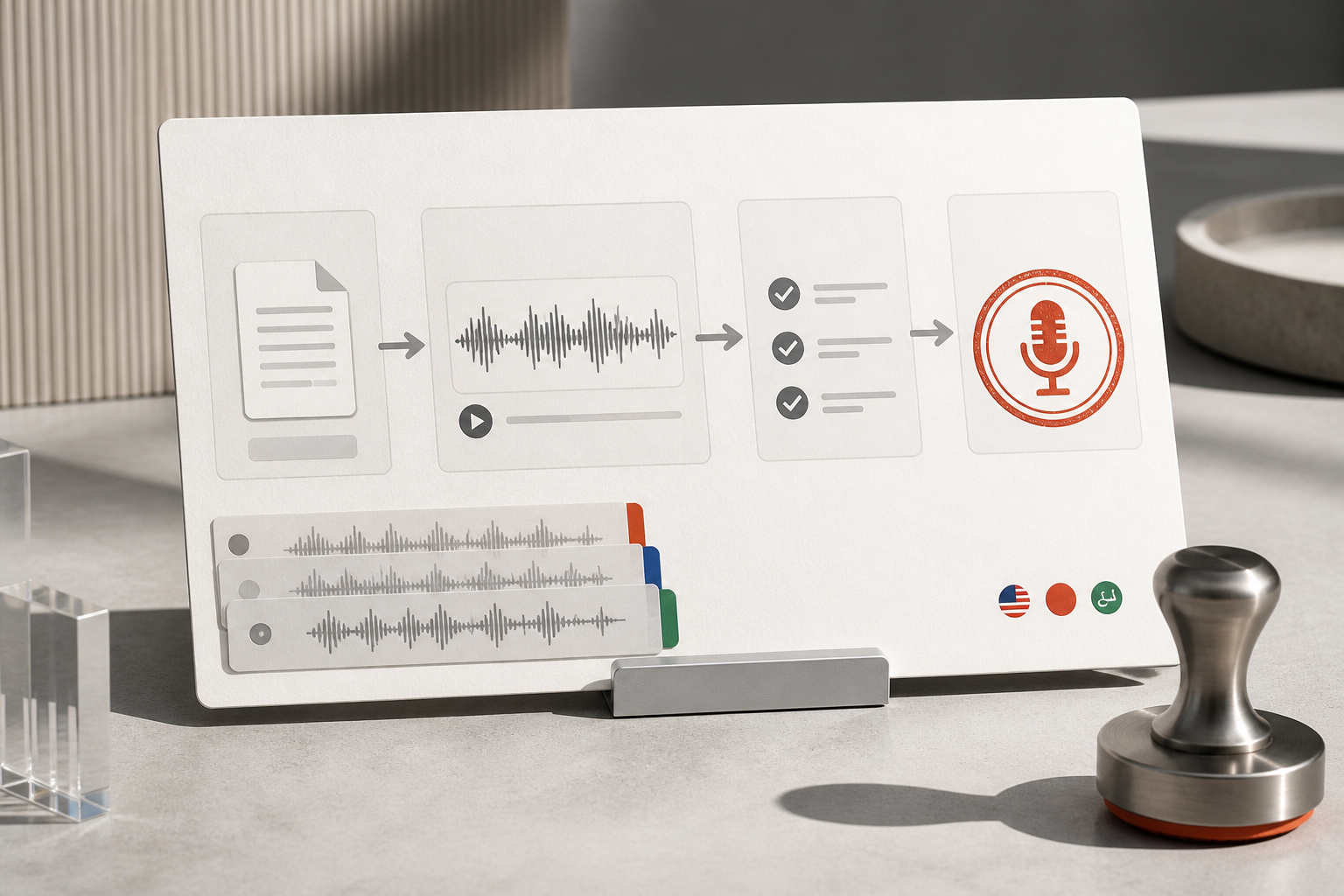
ElevenLabs aims to compress that entire cycle: script → audio → review → publish (and repeat) with fewer delays.
Who Is ElevenLabs Best For?
ElevenLabs tends to be the best business fit when audio quality directly affects revenue, customer experience, or production speed. It’s often the wrong starting point when your voice needs are occasional or when the real problem is call routing, compliance, or agent operations (not narration quality).
Best fit: when premium voice quality is part of the product or the sale
- Marketing teams and agencies producing frequent video ads, social content, product explainers, and ad variants.
- SaaS and product teams building voice into onboarding, in-app guidance, or voice-enabled features (API-centric needs).
- Training and enablement teams shipping lots of SOP narration, internal training modules, or customer education audio.
- Multilingual content teams where turnaround time and consistency matter more than hiring voice talent for each language and revision.
Usually not the best fit: when the workflow doesn’t justify “premium”
- Occasional voiceovers (a few minutes a month) where a simpler, lower-cost TTS tool meets the need.
- Phone automation-first teams whose real requirements are telephony integration, call handoff, monitoring, latency control, and compliance workflows.
- Highly regulated use cases where internal policy or legal review makes “upload content to a vendor” difficult—especially if the content includes sensitive data.
Consultant Insight: The most common buying mistake is choosing a voice tool after a great demo, then discovering the team can’t operationalize it—because approvals, QA, script changes, and cost forecasting weren’t designed into the workflow. A voice tool is only “worth it” when it reliably reduces total time to publish or improves a KPI you actually measure.
ElevenLabs Pricing in 2026 (what we know, and what you must verify)
Pricing is one of the biggest reasons businesses hesitate. Across public reviews and summaries, plan names and numbers are reported differently, and real-world cost depends on usage/credits. That means you should treat any snapshot as directional and confirm details on ElevenLabs’ official pricing page before committing.
Here’s the pricing picture commonly reported in 2026 review coverage:
- Free plan: Available, but at least one source indicates it does not include a commercial license. If you intend to use audio in marketing or client deliverables, assume you’ll need a paid plan (and confirm licensing terms).
- Starter: Often reported around $5/month.
- Creator: Reported as $11/month or $22/month depending on the source (plan structure appears to vary by time and region).
- Pro: Commonly reported around $99/month.
- Higher tiers: Some 2026 reviews reference tiers like Scale (~$330/month) and Business (~$1,320/month) for heavier usage/teams.
Pricing reality: plan price is not the same as production cost
Several reviewers call out a predictable pattern: businesses underestimate credits and regeneration. In practice, you rarely generate audio once. You generate, review, fix pacing or emphasis, regenerate, and sometimes run multiple voice options for stakeholders. That “creative iteration” can materially change cost.
Business-focused pricing table (use this to plan, not to “quote”)
| Plan tier (reported) | Reported monthly price (varies by source) | Best for | Main cost risk |
|---|---|---|---|
| Free | $0 | Testing voice quality and workflow fit | Commercial-use restrictions may apply; limited capacity |
| Starter | ~$5/month | Light TTS needs; early experiments; simple narration | Hitting limits quickly once you iterate or localize |
| Creator | ~$11 or ~$22/month | Creators/SMBs producing regular audio content | Credit forecasting gets harder with revisions and multiple assets |
| Pro | ~$99/month | Teams producing frequent marketing/training audio | Usage scaling beyond expectations; governance/QA workload |
| Scale / Business | ~$330 / ~$1,320/month | High-volume teams; advanced workflows; bigger production needs | Total cost of ownership (process + people + monitoring), not just subscription |
A simple “pricing reality” calculator (estimate your monthly voice workload)
You don’t need perfect math—you need a defensible estimate. Use this framework:
- Finished minutes per month: How many minutes of published audio do you ship?
- Regeneration factor: On average, how many times do you regenerate each segment? (Many teams discover it’s 1.3× to 2.5× depending on approvals.)
- Localization multiplier: How many languages/variants do you produce per asset?
- Buffer for experimentation: Add a small allowance for testing voices/styles.
Planning formula: Total generated minutes = Finished minutes × Regeneration factor × Localization multiplier + Buffer
Then compare that estimate against plan allowances and overage rules on the official pricing page.
Key Features (and what they mean for a business workflow)
Most vendor sites list features. The more useful question is: Which features reduce cycle time or improve outcomes for your workflow?
1) Highly realistic text-to-speech (TTS)
ElevenLabs is frequently praised for voice realism—especially compared to basic TTS tools that sound robotic or overly “announcer-like.” For a business, realism matters when voice affects trust and comprehension:
- Marketing videos where unnatural audio reduces perceived quality
- Training audio where poor prosody (rhythm/emphasis) makes content harder to follow
- Customer-facing audio where a robotic tone damages confidence
Trade-off: Premium realism is valuable, but only if it changes a measurable outcome (conversion rate, completion rate, support containment, production throughput).
2) Voice cloning (reusable voices for brand consistency)
Voice cloning is where many businesses see the “brand voice” advantage: a consistent voice across videos, product demos, internal training, and updates—without scheduling a voice actor for every revision.
When it should be used:
- Consistent narration for recurring content series
- Standardized training modules across teams and locations
- Product update videos that need quick re-records
When it should not be used:
- If you can’t obtain clear permission for the voice source
- If your brand risk tolerance is low and you don’t have a review process
- If internal policy prohibits creating or storing voice prints with third parties
Implementation consideration: Treat cloned voices like brand assets. You need ownership rules, access controls, naming conventions, and a QA checklist (pronunciations, pacing, compliance language, disclaimers).
3) Multilingual voice output (localization speed)
Localization is one of the highest-ROI use cases when you publish the same content across regions. AI voice can reduce the “translation-to-audio” lag dramatically—especially when scripts change often.
Trade-off: Localization still needs QA. Mispronunciations, cultural phrasing, and legal wording can create real business risk. AI reduces production time, not review responsibility.
4) API and “voice infrastructure” direction
ElevenLabs is often described as moving beyond a voiceover tool toward a broader voice infrastructure layer—useful if you’re building voice into products, apps, or automated experiences.
Why it matters: If you need voice as a component inside a broader system (a product onboarding flow, interactive support experience, or in-app narration), an API-first platform can be a better long-term fit than a purely creator-focused tool.
5) Real-time / low-latency ambitions (relevant for voice agents)
Some sources mention sub-100ms latency targets for a specific model/version under standard conditions. Latency matters in live conversations (agents, assistants, interactive IVR) because delays reduce “naturalness” and cause interruptions.
Important nuance: In production voice agents, your total latency includes more than the voice model: speech-to-text, LLM response time, tool calls, and telephony routing. Voice quality alone doesn’t make an agent successful.
Business Use Cases (where ElevenLabs can pay for itself)
Below are common SMB use cases where high-quality AI voice software often creates measurable value. The goal is to connect the tool to outcomes: hours saved, revisions reduced, and assets shipped faster.
Use case 1: Marketing narration for ads, explainers, and social content
Workflow: Draft script → generate voice → stakeholder review → revise script → regenerate → publish → run variants
Why ElevenLabs can be a fit: Marketing is perception-sensitive. A more natural voice can elevate “production quality” without increasing editing overhead. It also makes A/B testing faster because you can generate multiple variants without booking talent.
Watch-outs: Marketing teams often generate many iterations. Your cost risk is not “minutes published,” it’s “minutes generated.”
Use case 2: Product demo and release note voiceovers
If you ship product updates frequently, voiceover updates become a constant tax. AI voice can reduce delays when scripts change at the last minute.
Implementation tip: Standardize your script format (intro, feature, benefit, call-to-action) so regeneration doesn’t cause downstream editing chaos.
Use case 3: Training and SOP narration (internal enablement)
For manufacturing, retail operations, healthcare admin workflows, or multi-location services, narrated SOPs can improve consistency and onboarding speed—especially when literacy levels and language diversity vary.
Compliance note: For regulated industries, keep sensitive details out of prompts and audio generation when possible. Use de-identified scripts and internal review before publication.
Use case 4: Multilingual courses and education content
Workflow: Translate script → generate localized audio → QA → publish in LMS/CMS
This is a classic “scale content without scaling headcount” scenario. AI voice can help you maintain consistent voice delivery across languages (with appropriate QA).
Use case 5: Voice in apps and onboarding experiences
If you’re building a product experience where voice is part of usability (onboarding, accessibility, guided flows), an API-driven voice platform can be a strategic component—not just a content tool.
Trade-off: This pushes you into software delivery: monitoring, fallbacks, testing, and ongoing maintenance.
Use case 6: Customer support voice agents (where ElevenLabs may be only one piece)
Businesses often assume “voice agent” equals “text-to-speech tool.” In reality, voice agents require:
- Telephony integration (SIP/phone numbers/call routing)
- Latency management end-to-end
- Agent monitoring and QA
- Handoff rules to humans
- Compliance and logging (depending on industry)
ElevenLabs can be part of a voice stack, but purpose-built voice-agent platforms may be a better fit when phone operations are the main requirement.
Pros and Cons (business trade-offs, not just feature lists)
Pros
- High realism: Often regarded as best-in-class for natural-sounding speech, which can improve customer perception and content quality.
- Strong for voice cloning: Useful for consistent “brand voice” and repeatable production.
- Beginner-friendly: Many reviews describe simple controls and fast onboarding for basic TTS workflows.
- Scales into developer use cases: API and platform direction makes it viable beyond one-off voiceovers.
- Business value is clear for high-volume teams: Faster production cycles, fewer scheduling dependencies, and quicker iterations.
Cons
- Pricing predictability issues: Multiple sources warn that real usage can be higher than expected due to credits, iteration, and scaling.
- Glitches and scaling complexity: Some reviews mention occasional issues and that complexity increases with heavier usage.
- Not always the best “voice agent” solution: Telephony-first needs often point to specialized voice-agent platforms.
- Operational risk if governance is weak: Voice cloning and customer-facing audio require review processes and permission management.
- Support sentiment is mixed: Reviews across platforms vary, which means internal capability and implementation planning matter.
ElevenLabs vs Alternatives (choose based on your workflow, not hype)
Most comparisons fail because they mix two different categories:
- Voice generation platforms: optimized for narration quality, content production, and reusable voices
- Voice agent platforms: optimized for phone automation, latency, routing, monitoring, compliance, and outcomes like call containment
ElevenLabs is strongest in the first category and can contribute to the second, but it’s not always the best “end-to-end agent” solution.
Business impact comparison table
| Tool | Best for | Ease of use | Time to value | Business size | Notes |
|---|---|---|---|---|---|
| ElevenLabs | Premium TTS, voice cloning, content production, voice infrastructure | High (for TTS) | Fast for narration; longer for product/agent stacks | SMBs to larger teams | Great realism; cost forecasting and governance matter |
| Retell AI | Phone-oriented voice agents for sales/support workflows | Moderate | Moderate (agent setup + QA) | SMBs with call volume | Positioned around agent deployment; not primarily a voiceover tool |
| Bland AI | Enterprise voice automation | Low to moderate (varies by implementation) | Longer | Enterprise | Typically not the first choice for SMB narration needs |
| SMB telephony AI tools (e.g., call automation suites) | Receptionist/support call handling and CX workflows | Moderate | Moderate | SMBs | Often better for phone operations; less focused on premium narration realism |
Expert Verdict (comparison)
Expert Verdict: If your main goal is premium narration and voice consistency, ElevenLabs is usually the stronger starting point. If your main goal is handling phone calls (routing, containment, compliance, call QA), start by evaluating a voice-agent platform and then decide whether you even need ElevenLabs-grade realism in that stack.
Is ElevenLabs Worth It for Your Business? (a practical decision framework)
The “worth it” decision comes down to workflow economics: does ElevenLabs reduce cost per finished minute, shorten production cycles, or increase the performance of voice-enabled assets?
Step 1: Define your business problem (before you pick a plan)
- Content throughput problem: “We can’t ship enough audio/video assets.”
- Quality problem: “Our current TTS sounds cheap and hurts perception.”
- Consistency problem: “We can’t keep a stable brand voice across content.”
- Localization problem: “We can’t update multilingual audio fast enough.”
- Operations problem: “We need to automate phone support/sales calls.”
Step 2: Use a fit matrix (who should choose what?)
| Your situation | Recommended direction | Why |
|---|---|---|
| Solo creator or tiny team making occasional voiceovers | Test ElevenLabs Free/Starter; compare to cheaper TTS tools | You may not need premium realism if volume is low |
| Agency producing many ad variants and client videos | ElevenLabs Creator/Pro (verify allowances); build a QA workflow | Time-to-publish and perceived quality often drive revenue |
| SMB with training needs across locations/languages | ElevenLabs for narration + a standardized script and review process | Consistency and speed matter; QA prevents costly mistakes |
| SaaS team building voice features into an app | ElevenLabs + developer instrumentation + monitoring | API and infrastructure direction supports productization |
| Support team trying to reduce inbound call workload | Start with a voice-agent platform; add ElevenLabs only if needed | Telephony-first needs outweigh “best narration” needs |
Step 3: A decision tree you can use in 5 minutes
- Is your primary output narrated content (ads, explainers, training, demos)?
- If yes → go to #2
- If no (it’s phone calls/IVR/agent operations) → jump to #5
- Does voice quality measurably affect conversion, trust, or completion?
- If yes → ElevenLabs is likely worth testing seriously
- If no → consider cheaper TTS tools first
- Do you need a consistent brand voice across many assets?
- If yes → prioritize voice cloning + governance + QA
- If no → a broad set of stock voices may be sufficient
- Do you localize or revise scripts frequently?
- If yes → treat cost forecasting as a core requirement (credits, regeneration, variants)
- If no → you can optimize for simplicity and lower tiers
- Is the real goal call automation with routing, handoff, and monitoring?
- If yes → evaluate voice-agent platforms first; then decide whether ElevenLabs-level voice quality is necessary
- If no → use ElevenLabs for content and keep telephony out of scope
Implementation Considerations (how to avoid the common SMB mistakes)
ElevenLabs can be easy to start and still hard to operationalize at scale. Here’s what usually determines success.
1) Design the “script-to-audio” workflow
Most teams need a repeatable pipeline. A simple version looks like this:
- Script template (approved tone, length, legal lines)
- Voice selection (one primary, one backup)
- Generation settings (pacing, emphasis guidelines)
- QA checklist (pronunciation, timing, compliance)
- Stakeholder approval (who can request changes?)
- Publishing handoff (video editor, LMS, CMS, product)
Why it matters: Without a defined workflow, iteration explodes and so does cost.
2) Put commercial licensing and permissions in writing
Businesses should treat commercial usage as a policy decision, not a checkbox. At least one source notes the free plan may not include commercial licensing. Even on paid plans, you should confirm the current terms.
Practical approach:
- Confirm which plan covers commercial use
- Document who owns the voice assets
- Store proof of permission for any cloned voice
- Restrict who can generate customer-facing audio
3) Forecast usage based on iterations, not just final minutes
Teams often plan for “10 minutes of audio” and forget the reality: multiple takes, stakeholder preferences, and localization variants. Build your forecast with a regeneration factor and review buffer (see calculator above).
4) Decide how much human oversight you need
Even with great quality, AI voice can mispronounce, mis-emphasize, or deliver unintended tone. For internal training, small mistakes may be acceptable. For regulated or customer-facing content, you need stricter review.
5) Plan for support variability
Reviews suggest sentiment about support can be mixed across platforms. That means your implementation plan should assume you’ll handle some troubleshooting internally: clear owners, documented settings, and a rollback voice option if needed.
Business-First AI Insight: Don’t evaluate ElevenLabs by “best voice.” Evaluate it by cost per approved minute and time to ship. If the tool makes it easy to generate audio but hard to approve and publish it, you’ve automated the wrong part of the workflow.
Start Today / Improve Next / Scale Later (a practical rollout plan)
Start Today (1–2 hours)
- Pick one real script you already use (not a demo paragraph).
- Generate 2–3 voices and run a quick internal review.
- Write a one-page QA checklist: pronunciations, pacing, compliance lines, brand tone.
Improve Next (next 30 days)
- Standardize script templates for your top 2–3 content types (ads, training, demos).
- Create a cost forecast using regeneration and localization multipliers.
- Define approval roles (who can request changes, who signs off).
Scale Later (after you prove value)
- Centralize voice asset governance (naming, ownership, access control).
- Add monitoring if voice becomes product-critical (API usage, error handling, fallbacks).
- If pursuing voice agents, separate the project: choose a telephony/agent platform first, then plug in voice quality where it improves outcomes.
FAQs
Is ElevenLabs worth it for businesses?
It’s usually worth it when premium voice quality and faster production cycles impact revenue or customer experience—such as marketing narration, training content at scale, localization, or voice-enabled product experiences. If you only need occasional audio, a cheaper TTS tool may be sufficient.
Does ElevenLabs have a free plan?
Yes. However, at least one source notes the free plan may not include a commercial license. If you plan to use generated audio in marketing, client work, or monetized content, verify the current licensing terms and consider a paid plan.
How much does ElevenLabs cost in 2026?
Public review sources report a Starter plan around $5/month, Creator around $11 or $22/month (depending on plan structure shown), Pro around $99/month, and higher tiers (such as Scale and Business) for heavier usage. Pricing and allowances can change, so confirm on the official pricing page.
Is ElevenLabs good for voice cloning?
Yes—voice cloning is widely described as a core strength and a major reason businesses choose the platform for brand consistency. The business requirement is governance: permission, access control, and a QA process to reduce brand and compliance risk.
Can I use ElevenLabs commercially?
Commercial use is typically associated with paid plans, while the free plan may have limitations (per at least one source). Always confirm the current commercial licensing terms for your plan and your intended use (ads, client deliverables, product audio, etc.).
What are the main drawbacks businesses should watch for?
The most common concerns are pricing predictability (credits/usage), iteration costs due to regeneration, occasional glitches, and increased complexity as usage scales. Another practical drawback is confusing “voice generation” with “voice agents” and choosing the wrong tool category for telephony-heavy workflows.
Is ElevenLabs good for customer support voice agents?
It can be part of a voice agent stack, especially if you care about realism, but customer support agents typically require telephony integration, monitoring, latency management, and handoff controls. Many businesses should evaluate purpose-built voice-agent platforms first, then decide whether ElevenLabs is needed for voice quality.
Which KPIs should I track to prove ROI?
Track minutes of audio produced, turnaround time per asset, number of revisions, cost per finished minute, content output per week, and performance metrics tied to the asset (for example, conversion rate on video ads or completion rate on training modules).
Final Verdict: Is ElevenLabs the best AI voice tool for businesses in 2026?
ElevenLabs is one of the strongest platforms in 2026 for businesses that need highly realistic text-to-speech, dependable voice cloning, and a path toward voice infrastructure for products and automated experiences. If your business makes money (or saves meaningful time) through frequent, high-value audio, it’s a serious contender and often the right choice.
But it’s not the default answer for every SMB. If your voice needs are light, you may be better served by a lower-cost TTS tool. And if your real goal is phone automation, start with a voice-agent platform built for telephony operations—then add premium voice only where it improves outcomes.
Next step: Pick one real workflow (one marketing video, one training module, or one product demo), estimate your monthly generated minutes using regeneration and localization factors, and run a two-week pilot. The best voice tool isn’t the one that sounds amazing in a demo—it’s the one that reliably reduces your time-to-publish and lowers your cost per approved minute.